
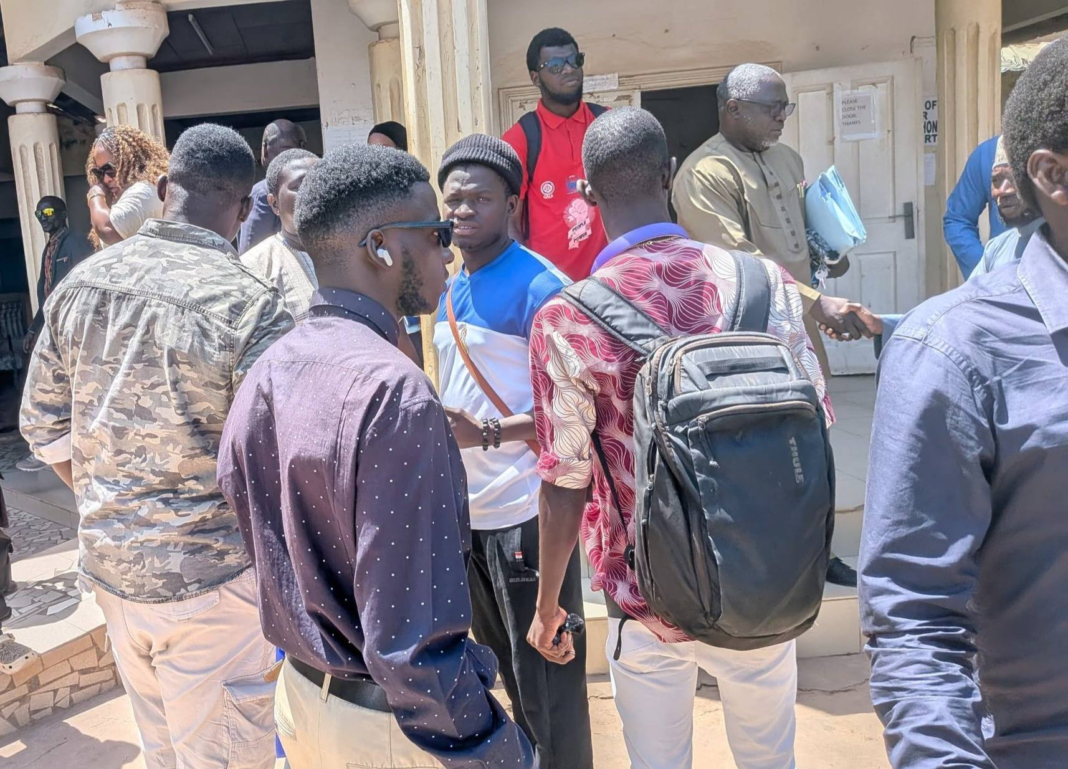
The trial of Kemo Fatty, Alieu Bah, and Omar Camara continues at the Kanifing Magistrates’ Court before Principal Magistrate Sallah Mbye.
Defence Counsel L.S. Camara, representing the accused, and Commissioner Sanneh, representing the Inspector General of Police (IGP), locked horns as the defence argued that the prosecution failed to establish criminal intent or an unlawful assembly, whilst, the prosecution insisted that a prima facie case had been made.
The three accused persons Kemo Fatty, Alieu Bah, and Omar Camara are facing charges of unlawful assembly and common nuisance in connection with the 15th September 2025 incident at the National Audit Office.
The defence counsel, L.S. Camara, has filed a formal “No-Case to Answer” submission, arguing the prosecution’s case is so hollow it does not warrant a defence.
Counsel L.S. Camara opened his submission by reminding the court that the burden of proof rests solely on the prosecution and “never shifts.” He questioned the very foundation of the prosecution’s evidence, asking, “Where is the evidence to support the mens rea (criminal intent) and actus reus (the criminal act)?”
Counsel Camara stated that, having analysed all the witnesses who testified before the court, the question begged to be answered: where is the evidence in support of the mens rea?
Counsel Camara reminded the court that the accused were charged with unlawful assembly against the removal of the Auditor General and common nuisance contrary to Section 137. He said the prosecution, therefore, has an obligation to prove that the accused committed a protest without a permit or caused inconvenience to the public.
“Your Worship, there’s absolutely no evidence to demonstrate that the accused had an unlawful assembly or protest,” he argued.
Citing the Nigerian locus classic of Ibeziako v. Commissioner of Police (1963) 1 All NLR 61, Counsel Camara outlined the three established grounds on which a no-case submission must succeed: where the prosecution has failed to establish the essential elements of an offence; where the prosecution’s evidence has been so discredited under cross-examination that no reasonable tribunal could safely rely on it; or where the evidence is so manifestly unreliable that a conviction would be unsafe.
“There is absolutely no evidence from the entire prosecution’s witnesses to support count one.” Defence Counsel L.S. Camara
Camara also drew on the English authority of R v. Galbraith (1981) 1 All ER 448, where Lord Lane CJ held that a no-case submission should succeed where there is no evidence that the accused committed the offence, or where the evidence is so weak or inconsistent that no reasonable tribunal could convict it.
He further cited the Gambian Supreme Court’s decision in Batch Samba Faye v. The State and the Ghanaian case of The State v. Ali Kassena (1962) as courts of persuasive jurisdiction that have adopted the same principles.
On the substance of the charges, Camara argued that the prosecution’s own witnesses described the accused as standing outside the National Audit Office in a public space to hold a press conference, not a protest.
Counsel Camara submitted that prosecution witnesses stated the accused wanted to hold a press conference without a permit and that, while many people were at the National Audit Office on that day, the accused persons were standing outside in a public space and the police had access to the National Audit Office both inside and outside.
Finally, Counsel Camara urged the court to uphold the no-case submission and discharge the accused persons.
Commissioner Sanneh, representing the Inspector General of Police, urged the court to dismiss the no-case submission, arguing that a prima facie case had been established meaning the evidence is sufficient to require the accused to open their defence.
Commissioner Sanneh informed the court that to prove the charges of unlawful assembly and common nuisance, the prosecution called four witnesses, all of whom are police officers.
Sanneh relied heavily on the testimonies of three witnesses. Police Officer Dawda Jallow (PW1) testified that upon receiving a call to visit the National Audit Office, he found the place “chaotic” with journalists waiting for a press conference.
He dispatched them, but when the accused arrived with the intent to hold a press conference and refused to leave the premises, he summoned Police Intervention Unit (PIU) officers.
Regarding Landing Bojang (PW2), Commissioner Sanneh said the officer testified he was the head of the section deployed to the National Audit Office because the accused insisted on holding a protest.
Officer Bojang testified that upon arrival, he found the accused persons on the ground and the place was so chaotic that he attempted to tell them they could not hold a press conference or protest without a permit. He stated that they refused, and tear gas was used to disperse them before arrests were made.
The third witness, Officer Colley (PW4), did not attend the scene but participated in the subsequent investigation, interviewing individuals in connection with the case.
Commissioner Sanneh’s submission was punctuated by objections from the defence. When Sanneh submitted that PW1 testified the accused came in the name of the Gambians Against Looted Assets (GALA), Counsel Camara objected. Magistrate Sallah Mbye reviewed the court record and confirmed the claim had not been captured in the proceedings.
A similar objection arose when Sanneh stated that the accused had confirmed during interviews that they were members of GALA. Again, a review of the record did not support the submission, and the Commissioner was obliged to reframe, stating instead that Officer Colley had interviewed three GALA members.
Commissioner Sanneh relied on Section 62, which defines unlawful assembly as a gathering of three or more persons with a common purpose, conducted in a manner that causes surrounding persons to reasonably fear a breach of peace. He argued that the accused numbered three, had a common purpose, and by their refusal to leave, had created a chaotic situation.
He also invoked Section 5 of the Public Order Act, which requires a permit for public processions and assemblies, and cited the Supreme Court’s ruling in State v. Ousainou Darboe in support of the permit requirement. He added that Section 25 of the 1997 Constitution does not grant absolute freedom of speech, referring the court to Section 25(4), which points to other laws of the country such as the Public Order Act.
Regarding the common nuisance, Commissioner Sanneh submitted that the actions of the accused caused obstruction and inconvenience, satisfying the definition of the offence under Section 137 of the Criminal Code. He concluded that the prosecution believes a prima facie case is established and urged the court to order the accused to open their defence.
In a reply on the law, Counsel Camara maintained that the charge before the court was an “unlawful protest without a permit,” yet the prosecution’s own evidence suggested the accused were there to hold a press conference, not a protest. He reiterated that none of the prosecution witnesses had testified to facts that met the conditions for unlawful assembly under Section 62.
“What is before the court is a charge of holding an unlawful protest without a permit, yet the evidence only suggests they were trying to hold a press conference,” Camara concluded.
He added that Section 5 of the Public Order Act, which the prosecution sought to rely on, was irrelevant because the accused had not been charged under that Act. Furthermore, he accused the prosecution of misquoting Section 137 regarding common nuisance.
Magistrate Sallah Mbye has adjourned the matter to rule on whether the accused must open their defence or if they will be discharged. The ruling is scheduled for 18th June 2026.