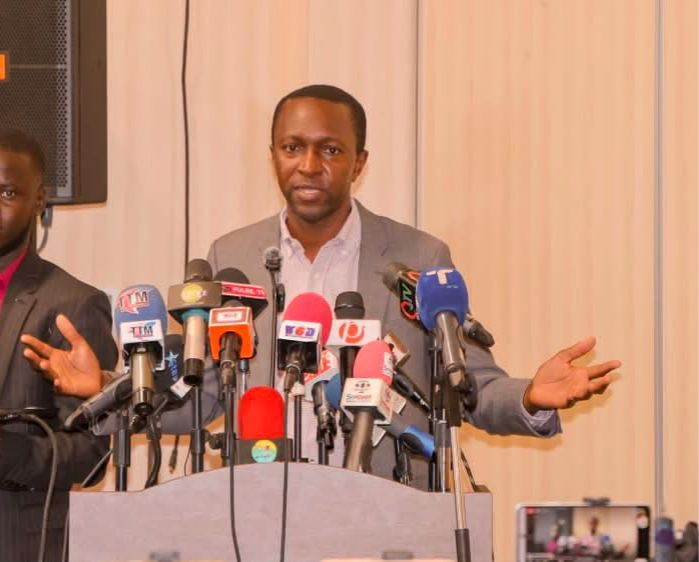
The Deputy Managing Director of the National Water and Electricity Company (NAWEC), Sompou Ceesay, has described the widespread power outage affecting The Gambia as a temporary “glitch” rather than a failure of the country’s electricity system.
Speaking at a press conference organized by the Ministry of Information, Media and Broadcasting Services, Mr. Ceesay said the disruption was an unforeseen technical challenge that the utility is actively working to address.
He noted that the outage comes at a time when electricity demand in The Gambia has grown significantly over the past decade. According to Mr. Ceesay, the country consumed approximately 300,000 megawatt-hours of electricity in 2016, when it relied entirely on domestic power generation and was not connected to any regional electricity network.
“In 2016, we were consuming around 300,000 megawatt-hours of energy, and at that time we were not interconnected with anyone. All of that electricity was being produced by NAWEC,” he said.
By 2026, annual electricity consumption is expected to reach approximately 970,000 megawatt-hours, representing more than a threefold increase over ten years and an average growth rate of about 12 percent per year.
Mr. Ceesay said the rapid rise in demand reflects the significant expansion of the country’s energy sector, as well as changing consumption patterns. Households now account for more than 61 percent of electricity usage, making domestic consumers the largest users of power, ahead of the industrial sector.
“The energy sector has grown significantly over the last 10 years, and it is important to understand that we are operating within a policy framework,” he said. “We have a roadmap that outlines the vision for the sector over the next 40 years, and it is a long-term plan.”
He explained that the government’s energy roadmap includes provisions for maintaining and strengthening local electricity generation capacity. Of the country’s 10 power plants, seven are currently operational, although some facilities are ageing and several engines remain out of service.
Mr. Ceesay added that NAWEC has intensified maintenance efforts over the past year to improve reliability. The utility has already spent more than $1 million on repairs and maintenance works, while total procurement for spare parts and related maintenance activities is estimated at between $2 million and $3 million.
He noted, however, that some payments have not yet been completed because a number of spare parts ordered by the company are still awaiting delivery.