
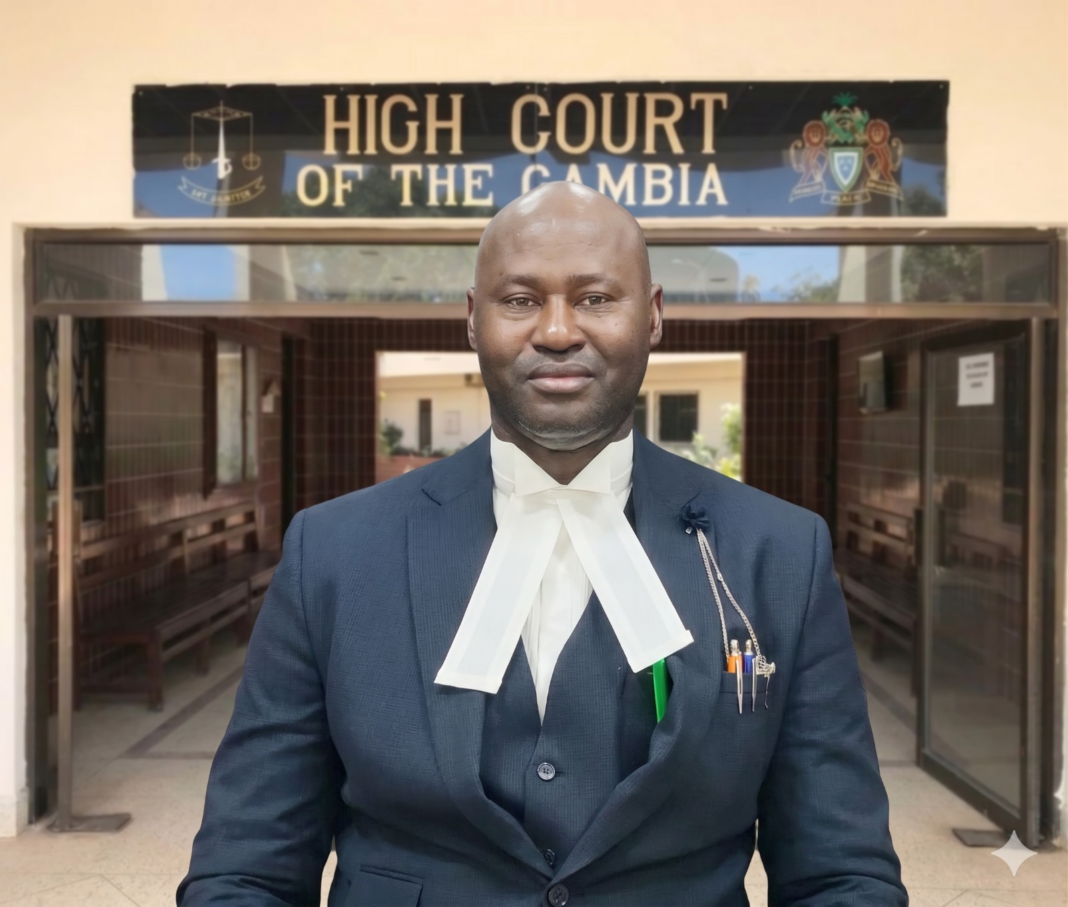
Justice Ebrima Jaiteh holds that Sally Badjie validly gifted a 16 × 40-metre portion of her Kombo North property to Ndey and Haddy Badjie before her death, removing it from the estate available for inheritance.
A civil land dispute originating from a succession disagreement over a property in Wellingara was decided by Justice Jaiteh. The case pitted Mr Mamina Diedhiou, appearing through his appointed power of attorney, Ali Mendy, against two defendants, Ndey Badjie and Haddy Badjie. Counsel S.K. Jobe appeared for the plaintiff while Counsel M.K. Bah represented the defendants.
The property at the centre of the dispute was formerly owned and occupied by the late Sally Badjie, who died on 18 February 2013. The plaintiff, claiming to be her sole biological child and surviving heir, sought to recover the entire property and have the defendants evicted.
The defendants, for their part, maintained that a defined portion of the property measuring 16 metres by 40 metres had been validly gifted to them by Sally Badjie during her lifetime, and therefore formed no part of the estate available for distribution upon her death.
The plaintiff commenced proceedings by Writ of Summons and Statement of Claim, seeking possession of the entire property measuring approximately 35 metres by 40 metres by 37 metres by 40 metres, an order for the eviction of the defendants, a perpetual injunction restraining them from entering upon or interfering with the property, costs, and such further orders as the court deemed fit.
His case rested principally on his status as the soe biological child and lawful heir of the deceased. He deposed that following Sally Badjie’s death, the estate was brought before the Bundung Cadi Court, which issued a Transfer of Ownership dated 17 November 2017, vesting the property in him as the son and heir.
He further contended that he had assumed responsibility for the property by paying rates and taxes to the Brikama Area Council and taking steps to preserve and administer the estate.
In support of his claim, the plaintiff tendered several documentary exhibits: a duly registered Power of Attorney authorising Ali Mendy to act on his behalf, the November 2017 Transfer of Ownership from the Bundung Cadi Court, rates and taxes receipts from the Brikama Area Council, the death certificate of Sally Badjie, and a valuation report relating to the property.
He argued that these documents collectively established both his status as heir and his entitlement to exclusive ownership and possession of the entirety of the property.
The plaintiff further maintained that the defendants were neither biological nor lawful children of the deceased and consequently possessed no legal or equitable interest capable of defeating his claim as sole heir. He characterised their continued occupation of the property as trespass and unlawful interference with his inherited property rights.
The defendants, Ndey Badjie and Haddy Badjie, whilst acknowledging that the property originally belonged to Sally Badjie, strongly disputed the plaintiff’s entitlement to recover the entirety. Their defence was founded on the contention that long before Sally Badjie’s death, she had made a valid lifetime gift known in law as an “inter vivos gift” of a specific portion of the property measuring 16 metres by 40 metres to them.
They averred that they were raised from childhood by Sally Badjie and her late husband and were treated as members of the household and family. They resided with the deceased on the property for many years and were cared for by her as though they were her own children.
The defendants pleaded that in recognition of this relationship, and out of a desire to provide for them after her death, Sally Badjie voluntarily transferred the portion of land on which the residential structures stood.
The defendants further contended that this gift was neither informal nor secretive. It was documented during Sally Badjie’s lifetime before the Alkalo of Wellingara and witnessed by members of the family and community.
In support of their case, they relied on an Attestation dated 15 November 2012, a Certificate of Land Transfer executed during the lifetime of the deceased, a sketch plan identifying the gifted portion, various Brikama Area Council rates and taxes receipts issued in their names, and a subsequent Transfer of Ownership issued by the Bundung Cadi Court on 23 April 2018.
Their position was that the plaintiff, after obtaining the initial Transfer of Ownership from the Bundung Cadi Court in November 2017, had failed to disclose the existence of the earlier gift. They contended that when the facts were brought to the attention of the Cadi Court, including the existence of the transfer documents and witnesses, the Court revisited the matter and issued the subsequent Transfer of Ownership on 23 April 2018, recognising them as beneficiaries of the gifted portion.
The defendants, therefore, maintained that the portion gifted to them ceased to form part of Sally Badjie’s estate upon the completion of the gift during her lifetime.
Issues before the Court, Justice Jaiteh identified five issues for determination:
1. Whether the Bundung Cadi Court had power, competence, or jurisdiction to entertain the defendants’ claim and to revise, set aside, or overturn its own earlier decision in favour of the plaintiff.
2. Whether the plaintiff had proved entitlement to the entire suit property.
3. Whether Sally Badjie made a valid lifetime gift of the 16 metres by 40 metres portion to the defendants.
4. Whether the defendants were trespassers liable to eviction.
5. What reliefs, if any, the parties were entitled to.
On issue one: Jurisdiction of the Bundung Cadi Court. The plaintiff had argued that the Bundung Cadi Court lacked jurisdiction or competence to issue the subsequent Transfer of Ownership in April 2018, thereby effectively revisiting and reversing its earlier decision of November 2017.
Justice Jaiteh dismissed the submission as fundamentally misconceived. Justice Jaiteh held that the question of ,whether the Bundung Cadi Court possessed the power to revisit or vary its earlier decision was not an issue properly arising for determination in these proceedings.
He added that if the plaintiff believed the subsequent decision was made without jurisdiction or in excess of powers, the appropriate course was to challenge that decision directly through the procedures provided by law, whether by appeal or judicial review before a court of competent jurisdiction and not through a collateral attack in unrelated civil proceedings.
Justice Jaiteh affirmed the well-established principle that a subsisting judgment or order of a competent court remains valid, binding, and enforceable until it is set aside by a court possessing the requisite appellate or supervisory jurisdiction.
He noted that the defendants’ case was not predicated on the Cadi Court reversing an inheritance judgment; rather, their position was that the deceased had already divested herself of the gifted portion during her lifetime, and the subsequent Cadi Court proceedings merely gave effect to an existing legal reality.
Issues two and three: Proof of Gift
Justice Jaiteh treated the two issues together, noting that the resolution o,f the plaintiff’s claim to the entirety of the property depended entirely on whether the defendants had successfully established that Sally Badjie had, during her lifetime, divested herself of ownership of the 16-by-40-metre portion by way of an inter vivos gift.
Justice Jaiteh recited the settled legal principles governing gifts. A gift is the voluntary transfer of property from one person to another without consideration. For a gift to be legally effective, the donor must have done everything necessary to transfer the property and place it beyond his or her control.
He said the three essential elements of a valid gift are: first, an intention on the part of the donor to make the gift; second, acceptance of the gift by the donee; and third, delivery or transfer of the subject matter.
Justice Jaiteh cited the classical statement of the principle from Turner L.J. in Milroy v Lord (1862) 4 De G.F. & J. 264, to the effect that the settlor must have done everything which, according to the nature of the property, was necessary to transfer it and render the settlement binding.
He also drew on the English Court of Appeal’s decision in Re Rose [1952] Ch. 499, holding that once a donor has done all that is necessary to transfer property, equity will regard the gift as complete.
Particularly instructive of Justice Jaiteh was the decision of the Supreme Court of Nigeria in Adesubokan v Yinusa (1971) 1 All NLR 225, in which the court held that a person is entitled to dispose of his property during his lifetime by way of gift to any person of his choice, whether or not that person is his heir.
Justice Jaiteh in the case applied the principle, holding that the validity of a gift does not depend upon whether the donee is a biological child, heir, or relative of the donor; what matters is whether the donor intended to give the property and whether the gift was completed during the donor’s lifetime.
“The validity of a gift does not depend on whether the donee is an heir. What matters is intention and completion during the donor’s lifetime.”
Applying the principles to the evidence, Justice Jaiteh was satisfied that all the ingredients of a valid inter vivos gift had been established. On intention, the court examined Exhibit D3, the Attestation dated 15 November 2012.
Although not drafted in technical legal language, its intention was described as unmistakable: Sally Badjie expressly acknowledged that Ndey Badjie and Haddy Badjie had been brought up under her parental care and support, and stated that because of her advancing age and deteriorating health, she desired that they should continue to have a place to live after her death.
He said the document bore her thumbprint, was witnessed by several persons, and was executed during her lifetime, predating both her death and the commencement of the present dispute. Justice Jaiteh assigned it considerable evidential weight.
On acceptance, Justice Jaiteh noted that the defendants had accepted the gift, occupied the property, maintained it, and exercised acts of ownership over it for many years. On delivery and transfer, the evidence showed that Sally Badjie had personally caused the transfer documents to be prepared before the Alkalo of Wellingara and placed the defendants in possession of the gifted portion and subsequent payment of rates and taxes reinforced the conclusion that the gift was completed and acted upon.
Justice Jaiteh was equally unimpressed by the plaintiff’s failure to adduce any credible evidence that the documents relied upon by the defendants were forged, fabricated, fraudulently procured, or executed without Sally Badjie’s authority. Nor had the plaintiff established that she lacked the mental capacity to make a valid disposition of her property.
Justice Jaiteh noted that the documentary evidence of the defendants predated the plaintiff’s inheritance proceedings and therefore carried considerable probative value.
Particularly significant in Justice Jaiteh’s assessment was an admission made by Ali Mendy under cross-examination. He conceded that when the plaintiff commenced proceedings before the Bundung Cadi Court, the second defendant was already residing on the suit property, and that the deceased had raised the first defendant from childhood.
Justice Jaiteh found the admissions highly significant, holding that they demonstrated the defendants’ occupation was neither recent nor opportunistic, but long-standing and derived directly from their relationship with the deceased weakening the plaintiff’s characterisation of them as trespassers who had unlawfully entered the property after Sally Badjie’s death.
Having considered the totality of the evidence, Justice Jaiteh found, on the balance of probabilities, that Sally Badjie had validly and effectively gifted the portion measuring 16 metres by 40 metres to the defendants during her lifetime, and that that portion consequently ceased to form part of her estate and was not available for inheritance upon her death. Issues two and three were accordingly resolved against the plaintiff and in favour of the defendants.
Issue four: Trespass and eviction, having found that the disputed 16-by-40-metre portion was validly gifted to the defendants during the lifetime of Sally Badjie, Justice Jaiteh held as a matter of law that the defendants were not trespassers upon that portion. Their occupation derived directly from the authority and disposition of the deceased owner herself.
“A person lawfully in possession pursuant to a valid gift cannot be treated as a trespasser merely because another person subsequently claims inheritance rights over the property,”
The plaintiff’s claims for possession, eviction, and perpetual injunction in respect of the gifted portion were accordingly dismissed.
In his vardit and final orders, Justice Jaiteh entered judgment heavily in favour of the defendants and made the following final orders and declarations:
1. It is declared that the late Sally Badjie was the original owner of the landed property situated at Wellingara, Kombo North District.
2. It is declared that during her lifetime, Sally Badjie validly gifted the portion measuring 16 metres by 40 metres to the 1st and 2nd defendants, Ndey Badjie and Haddy Badjie.
3. It is declared that the said gift was complete, valid, and legally effective before the death of Sally Badjie.
4. It is declared that the gifted portion ceased to form part of the estate of Sally Badjie upon completion of the gift.
5. It is declared that the defendants are the lawful owners and possessors of the said 16-by-40-metre portion and are not trespassers thereon.
6. The plaintiff’s claim for possession of the entire property is dismissed.
7. The plaintiff’s claim for eviction of the defendants is dismissed.
8. The plaintiff’s claim for a perpetual injunction against the defendants is dismissed.
9. It is declared that the plaintiff, as the biological child and heir of Sally Badjie, is entitled only to the remainder of the estate property not compromised in the valid lifetime gift made to the defendants.
10. The parties shall, within ninety (90) days of the judgment, cause the property to be professionally surveyed and demarcated in accordance with the existing transfer documents and sketch plans.
11. Both parties are restrained from interfering with, encroaching upon, alienating, or otherwise disturbing the lawful possession and enjoyment of their respective portions pending demarcation.
12. In view of the family nature of the dispute and in the interest of promoting harmony and reconciliation, each party shall bear their own costs.