


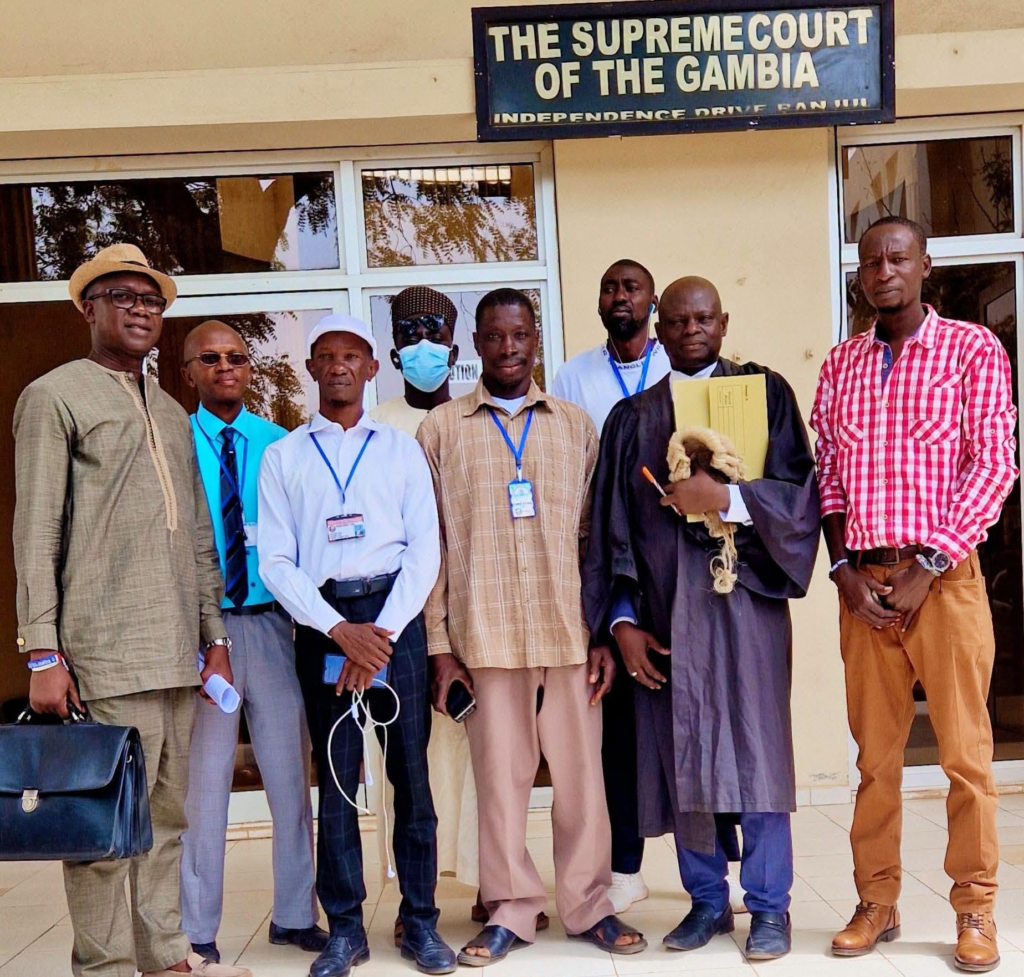
The Supreme Court has delivered a unanimous decision upholding the constitutional validity of the Commission of Inquiry (Amendment) Act 2023, rejecting a lawsuit that challenged three sections allowing the President to grant amnesty to persons banned from holding public office by commission of inquiry findings.
A judgment delivered on July 8, 2026, by Justice A. Bah, on behalf of a five-member panel of the Supreme Court, found that sections 19, 20, and 21 of the Amendment Act do not conflict with the constitutional framework governing commissions of inquiry (sections 200 to 206 of the 1997 Constitution) and were not made in excess of legislative authority.
The case was brought by the Coalition of Progressive Gambians and journalist Kemeseng Sanneh (Kexx Sanneh) against the Attorney General and the Clerk of the National Assembly, with counsel L.J. Darboe representing the plaintiffs and M.D. Mballow, PSC with A. Gibba, SC for the state (defendants).
Background to the lawsuit. The Commission of Inquiry (Amendment) Act 2023 (Act No. 12 of 2023) was passed by the National Assembly on November 2, 2023, and assented to by the President on December 1, 2023. The amendment modified the Commission of Inquiry Act 1903, a statute that predates the 1997 Constitution and provides the procedural framework for commissions of inquiry issued under presidential authority.
The three challenged sections introduced a procedure that allows a person serving a ban from holding public office pursuant to an adverse commission finding to apply for a commutation (amnesty) of that ban.
The procedure requires the person (applicant) to submit a written application to the Minister of Justice, who must forward it to the President within fourteen days for consideration. The President, in consultation with the Cabinet, may commute the whole or part of the ban. To qualify, a person must have served at least three years of the ban and not been convicted of any offence during that period.
The Amendment Act defines “Commission of Inquiry” in section 2A as meaning “the commission issued under section 200 of the Constitution of the Republic of The Gambia,” thereby bringing the statutory act into conformity with the constitutional provisions.
The plaintiffs’ constitutional arguments. The Coalition of Progressive Gambians and Kemeseng Sanneh contended that the National Assembly acted without constitutional authority in amending the Commission of Inquiry Act to provide for presidential amnesty powers. The argument centred on the supremacy of sections 200 to 206 of the Constitution, which establish the constitutional regime for commissions of inquiry.
The plaintiffs emphasised section 204(2) of the Constitution, which provides that a person against whom an adverse finding has been made may appeal to the Court of Appeal “as if the finding were a judgment of the High Court.”
Counsel J. Darboe argued that it constitutes the exclusive judicial route for challenging commission findings, and that the Constitution envisages no presidential role whatsoever in setting aside or mitigating such findings.
The plaintiffs further argued that the presidential power to grant mercy or clemency is confined by section 82 of the Constitution to criminal cases, and only after conviction. They contended that if the President is to be granted amnesty powers in cases of adverse commission findings which are civil or administrative in nature, the Constitution itself must be amended, not the statutory Commission of Inquiry Act.
Additionally, the plaintiffs pointed to sections 90(1)(e) and 62(3)(c) of the Constitution, which disqualify from election to the National Assembly and presidency, respectively, persons found by a commission of inquiry to be incompetent to hold office, “and the findings have not been set aside on appeal.” The plaintiffs argued that once a commission finding is accepted by the government, it stands until overturned by the courts, not by presidential action.
The defendants’ Constitutional defense. The state counsel and Clerk of the National Assembly counsel countered that the National Assembly possessed authority to enact the Amendment Act under section 100(1) of the Constitution, which vests legislative authority in the National Assembly. They argued that the amendment does not conflict with sections 200 to 206 and does not usurp judicial power contrary to section 120.
The defendants characterised the presidential amnesty power as an executive mitigation of the administrative consequences of a ban, not an overturning of the underlying commission finding or judicial usurpation.
In oral arguments, counsel for the state (defendants) emphasised that the amendment does not take away the right to appeal; rather, it establishes the procedure to be followed when a person is banned. He added that the finding itself is not touched; only the consequences of the ban may be commuted.
State counsel argued that the amnesty procedure and the right of appeal are not mutually exclusive. A person could appeal an adverse finding to the Court of Appeal or, without appealing, apply for amnesty while serving the ban. The two processes, they contended, can run in parallel.
In its analysis, the Supreme Court analysis Jurisdiction and the power to strike down legislation. The first issue before the court was whether the Supreme Court possessed jurisdiction to grant the plaintiffs’ fourth relief—to strike out sections 19, 20, and 21 as unconstitutional. The defendants had challenged that, arguing that section 100(1) of the Constitution vests legislative authority solely in the National Assembly, leaving no room for the courts to strike down legislation.
Justice Bah addressed that by reference to section 127(1)(b) of the Constitution, which grants the Supreme Court exclusive original jurisdiction “on any question whether any law was made in excess of the powers conferred by this Constitution or any other law upon the National Assembly or any other person or authority.”
The Supreme Court held that jurisdiction necessarily extends to making declarations and orders as to the constitutionality of legislation.
The Supreme Court further noted that while the power to legislate resides exclusively with the National Assembly, the power to declare legislation invalid or ultra vires resides with the courts.
“The doctrine of separation of powers does not preclude this; rather, it underlies it. The judicial function is to interpret laws and enforce the Constitution,”.
On the practical question of whether a “declaration” of unconstitutionality differs from an “order striking down” a law, the Supreme Court held that the distinction is terminological, not substantive. Once a provision is declared inconsistent with the Constitution, section 4 of the Constitution, the supremacy clause renders it void automatically. Whether the Court declares it invalid or orders it struck down, the provision carries no force of law.
The Supreme Court noted its reliance on the principle of severability, articulated in Attorney-General for Alberta v. Attorney-General for Canada (1947, A.C. 503) and applied in Attorney-General v. Momodou Jobe (1984, 1 A.C. 689), whereby a provision ultra vires the Constitution may be severed if the remainder of the Act can independently survive.
The Supreme Court accordingly held that it possessed jurisdiction to grant Relief 4, though it noted that such relief is usually subsumed within the declaration of unconstitutionality itself.
Before reaching the substantive question, the Supreme Court addressed the legal framework governing challenges to Acts of Parliament. Justice Bah stated that once passed, an Act is presumed valid and constitutional until proven otherwise. The Legislature is presumed not to legislate in a vacuum, but to make laws for “peace, order and good governance.”
Citing Gambia Press Union and Others v. The Attorney General (May 2018) and the Privy Council authority of Steven Grant v. The State (2006, UKPC 2), the Supreme Court held that the burden on a party asserting unconstitutionality is “a heavy one.”
“The Plaintiffs, having asserted a violation of the Constitution, bore the burden of proving so. In the Court’s assessment, they failed to discharge the burden,”.
The Supreme Court held that the Commission of Inquiry Act 1903 is a valid existing law and has not been repealed in any form. It forms part of the Laws of The Gambia pursuant to section 7(c) of the 1997 Constitution and is contained in Volume 5 of The Laws of The Gambia 2009.
The Supreme Court noted that the Second Schedule of the Constitution, dealing with Transitional and Consequential Provisions, contains section 6 on “Existing Law,” which authorises the President, with the approval of the National Assembly, to make such provision as may be necessary for repealing, modifying, adding to, or adapting any existing law to bring it into accord with the Constitution. Rather than repealing the 1903 Act, the President and National Assembly exercised this power to modify and add to it.
The Supreme Court observed that the principal effect of the Amendment Act was to tie the definition of “Commission of Inquiry” in section 2A to section 200 of the Constitution, thereby ensuring that any commission of inquiry issued would be done pursuant to the Constitution. This brought the statutory act into conformity with the Constitution, rather than placing it in conflict.
Justice Bah noted that sections 200 and the Commission of Inquiry Act, section 2(1), are “virtually identical and in fact, they are almost word-for-word” in their description of the President’s power to issue commissions. Therefore, the Act cannot be said to be irreconcilable with the Constitution.
The central contention of the plaintiffs was that sections 19, 20, and 21 rob the courts of their judicial power by allowing the President to overturn commission findings through amnesty. The Court rejects that characterisation.
Justice Bah held that the findings of commissions of inquiry are administrative and investigatory in nature, “notwithstanding the judicial powers accorded them under section 202(2) of the Constitution.” A commission issues a report; the government may accept or reject its conclusions. The President has no power to overturn any such finding, and the Amendment Act, “by any stretch of the imagination or interpretation,” does not grant him such powers.
The Supreme Court distinguished between two concepts: the findings themselves, which remain final and incontestable by executive action, and the consequences of a ban (the deprivation of the right to hold office). The Amendment Act provides for amnesty only regarding the latter.
It stated that Section 204(2) of the Constitution vests in the Court of Appeal the power to hear appeals against adverse commission findings.
The Supreme Court held that the right remains entirely unaffected by the Amendment Act. A person against whom an adverse finding has been made may elect to appeal to the Court of Appeal or to forego an appeal.
The Supreme further stated that the amendment Act creates an alternative avenue for those who do not wish to appeal: they may apply for a commutation of the ban while serving it. The Supreme Court noted that nothing in the Amendment Act bars a person from first appealing to the Court of Appeal and, if unsuccessful, later applying for amnesty while serving the ban, adding that the two processes are not mutually exclusive; they can run in parallel or sequentially.
The Supreme Court found that the plaintiffs had not demonstrated how the procedure for amnesty could “deprive the Court of Appeal of its vested power to hear appeals against adverse findings of commissions of inquiry and vest in the President the power to overturn such findings.” The Supreme Court noted that learned counsel J. Darboe for the plaintiffs had been “unable to tell this Court” how such deprivation occurs.
The Supreme Court addressed the argument that section 82 of the Constitution limits the presidential prerogative of mercy to criminal offences only. Justice Bah observed that section 82 does indeed limit the prerogative to criminal cases and post-conviction scenarios.
However, the Supreme Court asked: “What learned counsel J. Darboe for the Plaintiffs has not told this Court is whether there is any provision in the Constitution that prevents the President from exercising mercy in any other case, particularly in cases of a civil or administrative nature.”
The Supreme Court held that no such prohibition exists. The Constitution does not restrict presidential mercy to criminal contexts. The Amendment Act has extended the Executive’s capacity to exercise clemency to persons found by a commission of inquiry, whose circumstances are administrative rather than criminal.
The Supreme Court also emphasised that the prerogative of mercy whether in criminal or administrative contexts does not remove or expunge the underlying fact of conviction or finding and it merely pardons the consequences. It added that the principle was articulated by the Supreme Court in Amadou Sanneh v. The State (SC Criminal Appeal No. 007/2015, July 17, 2019), where the Court stated: “The Constitution grants the President only a prerogative of mercy which cannot remove a conviction; it merely pardons its effect.”
The Supreme Court further stated that Section 21(2) of the Amendment Act itself reinforces that principle: “A commutation under this section shall not expunge the findings pursuant to which the ban was made.” The record of the adverse finding endures; only the duration and consequences of the ban may be mitigated.
The Supreme Court rejected the plaintiffs’ argument that any amnesty provisions must be inscribed in the Constitution, not in the Commission of Inquiry Act. Justice Bah held that the Commission of Inquiry Act 1903, as the principal legislation governing the mechanics of commissions of inquiry, is precisely the appropriate place for such amnesty provisions. It is the existing law specifically enacted to govern commissions of inquiry, now tied to section 200 of the Constitution. To require an amendment to the Constitution itself would be both unnecessary and burdensome.
The Supreme Court noted, in the alternative, that even if section 20 were deemed inconsistent with section 200, the offending words could be severed under the blue pencil test, simply by deleting “issued under this Act” to leave the amnesty provision applicable to all commissions of inquiry.
Finally, Justice Bah addressed an argument advanced by the defendants: that the plaintiffs had failed to establish a legally enforceable right or interest that was affected by the Amendment Act. The plaintiffs argued that no persons in the country are currently serving a ban from holding public office pursuant to the Commission of Inquiry Act 1903, because the President has never issued a commission under that Act (only under the constitutional provisions in section 200).
The Supreme Court stated that argument that the case is merely an abstract constitutional question may well be correct. However, the plaintiffs were not in a position to adduce evidence to thas effect. The Supreme Court observed, “if that were the case, one is tempted to ask the rationale for bringing this action in the first place.”
The Supreme Court noted that a suit that does not disclose a cause of action and seeks only to protect the Constitution in the abstract, without showing a legally enforceable right or interest of the plaintiff in danger of being affected, is incompetent and should be struck for want of jurisdiction.
The Supreme Court unanimously held:
The Supreme Court possesses jurisdiction to grant relief striking down unconstitutional provisions of legislation;
Section 19 of the Commission of Inquiry (Amendment) Act 2023 (Implementation of Ban from Holding Public Office) is not in conflict with sections 200-206 of the Constitution, was not made in excess of legislative authority, is intra vires the Constitution, and is declared valid;
Section 20 of the Commission of Inquiry (Amendment) Act 2023 (Amnesty for Persons Banned from Holding Public Office) is not in conflict with sections 200-206 of the Constitution, was not made in excess of legislative authority, is intra vires the Constitution, and is declared valid
Section 21 of the Commission of Inquiry (Amendment) Act 2023 (Persons Qualified to Apply for Amnesty) is not in conflict with sections 200-206 of the Constitution, was not made in excess of legislative authority, is intra vires the Constitution, and is declared valid.
There was no order as to costs. The judgment was delivered unanimously by a five-member bench comprising Justice A.D. Yahaya, JSC; Justice C.S. Jallow, KC, JSC; Justice A. Bah, JSC; Justice E.F. M’Bai, JSC; and Justice O.M.M. Njie, JSC, with all members agreeing to the judgment delivered by Justice Bah