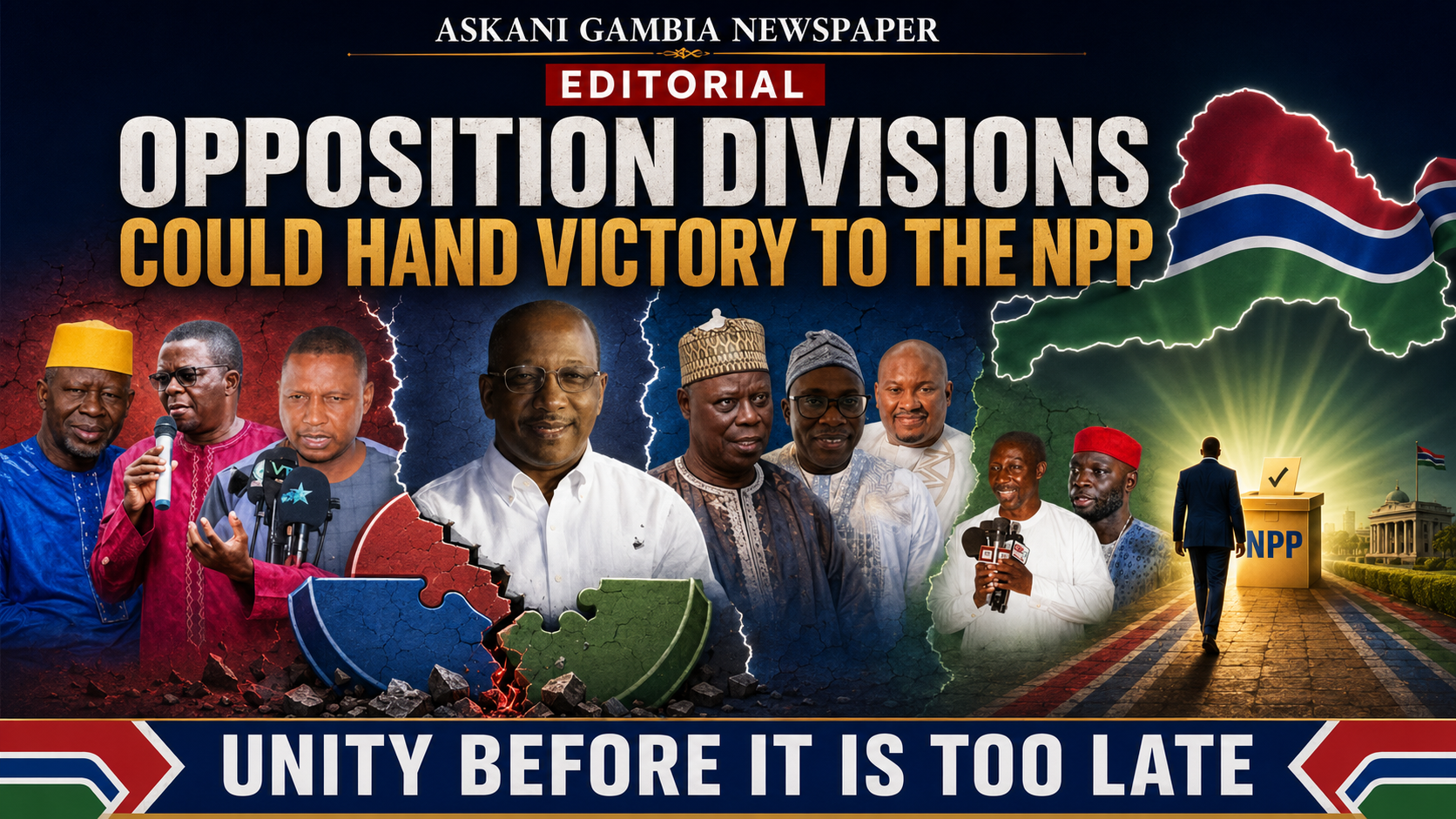
Bugeh du matt, ngorr matt. With The Gambia approaching another decisive presidential election, opposition parties must recognise a difficult political reality: internal rivalry could become their greatest obstacle to forming a credible coalition.
Ku bugga laip nyaka laip. Disagreements over leadership, party interests and candidate selection, if repeated, could endanger the opposition’s credibility in the eyes of the public. If these divisions continue, the ruling National People’s Party (NPP) could benefit from a fragmented field, regardless of growing public concern over governance, unemployment, corruption and the cost of living.
Rairo amut, nyaka wahtan moyy li’am. Opposition leaders must therefore place the national interest above personal ambition. There is still a chance for reconciliation but it will require compromise, mutual respect and transparent decision-making.
Acha nyu defko jougis, acha nyu wahtaneko, mo wara jittu.The best way forward would be to set up a respected and politically neutral mediation committee with religious leaders, civil society representatives, women, young people and experienced statespersons. Before parties choose a leader, there must be an agreement on a common policy agenda, coalition rules and a mechanism for dispute resolution.
Mbollo moyy doleh. The coalition’s flag bearer should be chosen through a transparent process that is acceptable to all the participants. This could be through a primary election, an electoral college or a delegate vote supervised by an independent body. There should be clear criteria – including electability, integrity, national appeal, leadership experience and commitment to coalition principles – that should guide the process. Every aspirant must also sign an agreement to support the winner.
Ndimbal nassa feka loho borom. A party-led coalition offers important advantages. An established party may bring nationwide structures, trained supporters, campaign experience and stronger financial and organisational resources. Its identity can make mobilisation easier.
Ndeyji shih jahanayy lai teddeh. However, this model also carries serious disadvantages. Smaller parties may fear domination by the leading party, while unsuccessful aspirants may feel that they have simply been asked to surrender their political identities. Old rivalries and mistrust can consequently undermine unity.
Jittal Gambia moyy njerinyi rewmi. A candidate-led coalition might be a more neutral vehicle and parties could support a candidate without formally joining another party. Such a candidate might appeal to independents and voters looking for change but not strongly aligned to any opposition organisation.
Njitt moyy kinyu jittal. But a candidate-centred system has its disadvantages too. It can be too dependent on one person, and lack deep institutional roots. Disagreements can be over campaign control, appointments, policies and the future of the coalition in the aftermath of victory.
Saama kolareh, banya jamfaa amna soloh. The most practical compromise may be a candidate-led coalition supported by a binding agreement among participating parties and guided by a jointly adopted national reform agenda. The candidate should lead, but coalition institutions must remain stronger than any individual.
Kubaiy sabanex gop sanaharr. The opposition must decide whether it wants collective progress or individual prominence. History will not judge its leaders only by what they demanded, but also by what they were prepared to sacrifice for national unity.