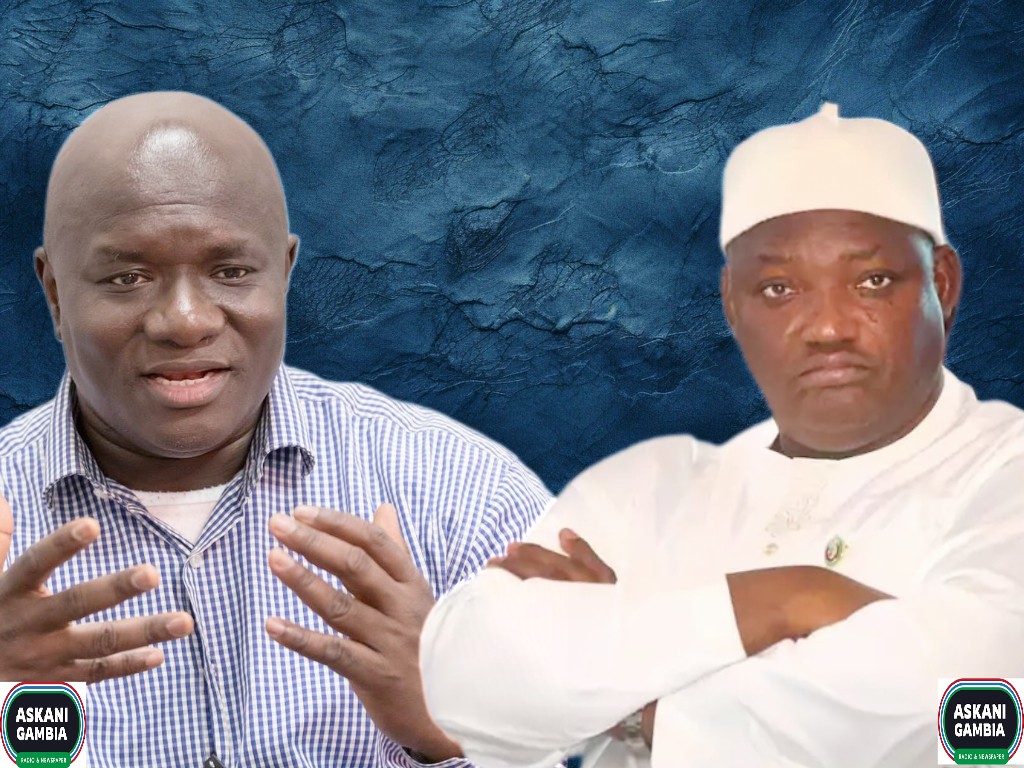
Either Ebrima G. Sankareh does not understand corruption, or, like many African technocrats before him, he has chosen to defend and normalize the very culture of poor leadership and impunity that continues to undermine Africa’s development.
Appearing on Coffee Time with Peter Gomez this morning, Sankareh declared emphatically that President Adama Barrow is not corrupt and that he could vouch for him on the Holy Qur’an. Such a categorical assertion is remarkable, not because it is convincing, but because it flies in the face of well-documented facts and public records.
From the very beginning of this government, questions of transparency emerged. In 2017, President Barrow distributed 57 vehicles to National Assembly Members without ever publicly disclosing the source. Nearly a decade later, Gambians still do not know who provided those vehicles, under what arrangement, or for what purpose. That is not transparency, it is a violation of public trust.
In 2018, a sum of US$750,000 intended for the Government was deposited into the account of the First Lady by Chinese sources. For the president’s spouse to receive money meant for the state is, in any democracy, a scandal. Yet to date, the matter remains inadequately explained and unaccounted for. But that Chinese company would later win government contracts. Only Sankareh would call that clean.
Pres. Barrow himself has publicly admitted giving National Assembly Members brown envelopes to secure political objectives. He said it himself. In any serious democracy, such conduct would raise immediate concerns about bribery and abuse of office. Yet Sankareh appears untroubled.
The President has also stated that his residence in Mankamang Kunda was built through “donations from friends”, a direct violation of the Constitution under Section 222. Again, there has been no transparent accounting, and Sankareh is not bothered.
Beyond individual incidents lies a larger question: wealth. President Barrow personally hands out millions of dalasi in donations to communities and individuals. His official salary is 6 million dalasi per annum. Basic arithmetic shows he cannot sustain that level of giving without other, unreported sources of income. Yet Gambians have never been given a verifiable account of his assets.
In 2024, Minster of Lands Hamat Bah took the official plot of land earmarked for the building of the residence of the Chief Justice to hand it over to Pres. Barrow in total contravention of the state Lands Act. Currently, the Barrow is building a fortified palace there in full glare of Sankareh who said that is not corruption!
While the Constitution requires asset declarations by public officials under Section 223, the declarations submitted to the Independent Electoral Commission serve only as nomination requirements. They are not subjected to any meaningful verification process capable of determining the legality or legitimacy of accumulated wealth.
Then there is the pattern of impunity. Investigative journalists have repeatedly exposed corruption involving the president’s associates, friends, and family. Most recently, The Republic published a damning report detailing how the President’s nephew allegedly gained access to millions of dalasi through the Ministry of Finance, the Ministry of Trade, and the Central Bank, enabling a meteoric rise in his wealth and business influence.
Numerous official reports, by the National Audit Office, parliamentary committees, commissions of inquiry, and other state-led investigations, have documented serious cases of financial mismanagement and corruption. Yet many of those adversely mentioned, including ministers, have neither been prosecuted nor disciplined. Instead, some have been retained, promoted, or redeployed. Corruption is not the exception. It is the central, prevailing theme of this administration.
If it were not the damning report of The Republic and the subsequent protest led by GALA in 2025, the plunder of the assets of the Tinpot Dictator would have gone with the wind. Left to Barrow alone, the looting of those assets was a forgone conclusion. Under his watch, the assets were looted by public officials and associates without fear or shame. But Sankareh is not bothered.
President Barrow deserves credit for assenting to the Access to Information Act. However, legislation alone does not create transparency. In practice, public institutions continue to withhold critical information from citizens, civil society, and the media. Major agreements, contracts, and concessions, including the port concession agreement, remain hidden from public scrutiny. Worse still, government officials frequently resort to threats of legal action against journalists who expose corruption.
And what about Barrow’s own attitude toward corruption? He has never demonstrated outrage. Instead, he once remarked that corruption is “as old as mankind”, the casual dismissal of a man who sees graft as normal. He speaks the language of anti-corruption while rewarding corrupt officials at every turn.
For any citizen to claim Barrow is not corrupt would be outrageous. But for a senior government official like Ebrima Sankareh, someone who sits closest to the seat of power, who cannot credibly claim ignorance of these reports, to go on national media and swear on the Holy Qur’an that this president is clean is an insult to every Gambian who demands accountability.
The issue is not whether corruption exists in the Gambia. The evidence overwhelmingly shows that it does. The real question is whether the President has shown the leadership to confront it. Based on the public record, he has not. That is why Sankareh’s attempt to certify President Barrow as corruption-free is not merely unconvincing, it is an affront to the intelligence of Gambians who have watched these events unfold for nearly ten years.
For The Gambia, Our Homeland