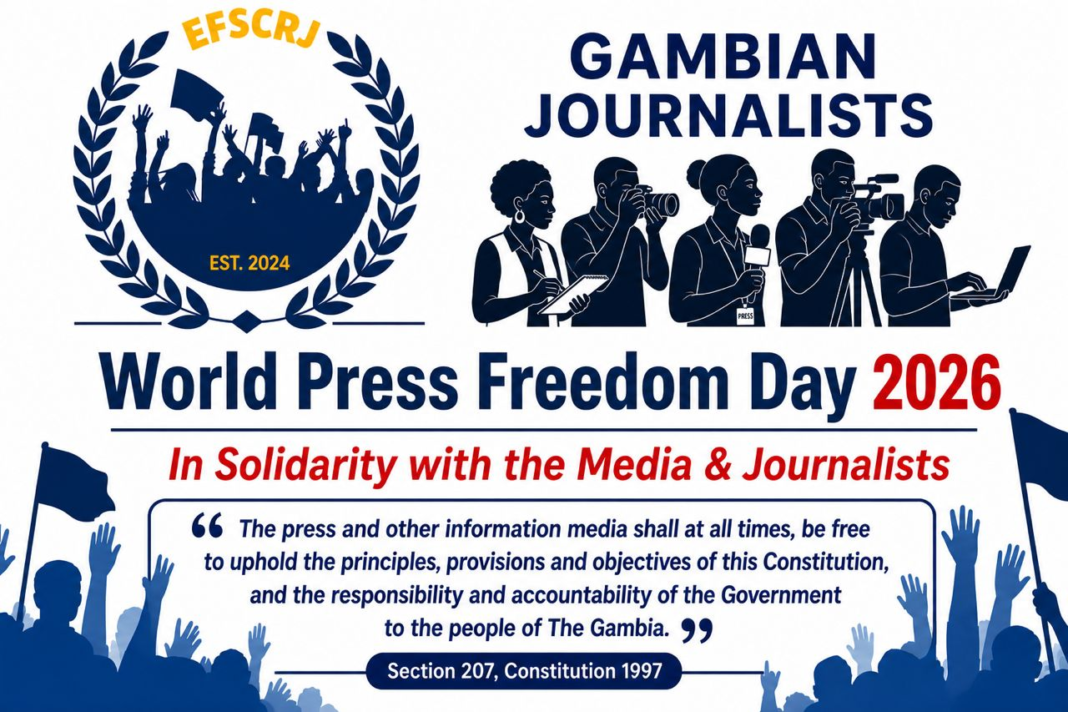
The Edward Francis Small Centre for Rights and Justice joins journalists and media workers across the Gambia in commemorating World Press Freedom Day 2026.
On this day, we pay tribute to the men and women of the Gambian media who have played a defining role in the struggle for independence, democracy, human rights, and justice. From Edward Francis Small, who led the independence movement through journalism, to generations of media practitioners who carried forward that legacy, the press has remained a cornerstone of national progress.
We honour the fallen heroes and heroines of the media -William Dixon Kolley, Sanna Tiks Manneh, Baa Trawally, Junkunda Daffeh, Deyda Hydara, Baboucarr Gaye, Suwaibou Conateh, George Christendom, Sabel Jagne, Pa Modou Faal, Sise Sawaneh, and many others whose contributions and sacrifices will never be forgotten. We also celebrate the veterans – Marcel Thomasi, Sam Sarr, Pap Saine, Demba Ali Jawo, Peter Gomez, Amie Joof Cole, Jainaba Nyang, and the hundreds of dedicated young journalists working across platforms and institutions today. We salute you all.
Gambian journalists have consistently stood at the forefront of the struggle for a free, just, and prosperous society. They have remained steadfast in fulfilling their constitutional duty to hold the government and all centres of power accountable on behalf of the people.
As we mark this day, we acknowledge the significant improvement in the media environment since 2017. After enduring decades of repression, the expanded civic space represents meaningful progress.
However, nine years after the end of authoritarian rule, journalists in the Gambia continue to operate under persistent constraints. Draconian laws remain in the statute books despite rulings by both the Supreme Court and the ECOWAS Court declaring aspects of them unconstitutional. Offences such as ‘false information and broadcasting’ and criminalizing online criticism of public officials remain and continue to pose serious threats to press freedom.
Since 2017, there have been repeated instances of verbal threats and court cases against journalists by senior government officials, including the President. Media houses have faced economic pressure through the selective denial of state advertising and contracts. We have also witnessed arbitrary closures of media institutions, arrests, and physical assaults on journalists by both state and non-state actors and often without accountability.
Of equal concern are ongoing attempts by the Ministry of Information to introduce unnecessary, arbitrary, and anti-media regulations, which risk reversing the gains made in recent years. In this context, the country’s improved ranking in the 2026 global press freedom index must be received with caution, as it contrasts sharply with the lived realities of journalists on the ground.
EFSCRJ reminds the Government of its constitutional obligations under Sections 17, 25, 207, and 208 to protect freedom of expression and the independence of the media, as well as its regional and international human rights commitments. The media is not merely a stakeholder but more importantly a constitutional pillar mandated to hold power accountable on behalf of citizens.
We call on journalists across the Gambia to remain resolute and unwavering, mindful that they walk a noble path of public service. We further call on all citizens to stand in solidarity with the media. The media belongs to the people – it informs, empowers, and defends them. It is the primary tool through which citizens access information, exercise their rights, participate in governance, and demand accountability.
An attack on the media is an attack on the citizenry and on democracy itself. Protecting the media is protecting the Republic.
EFSCRJ stands firmly with journalists and will remain relentless in advocating for a free, independent, and unfettered media in the Gambia.
2026: The Year of Empowerment – Empowered Citizens. Accountable Leadership.