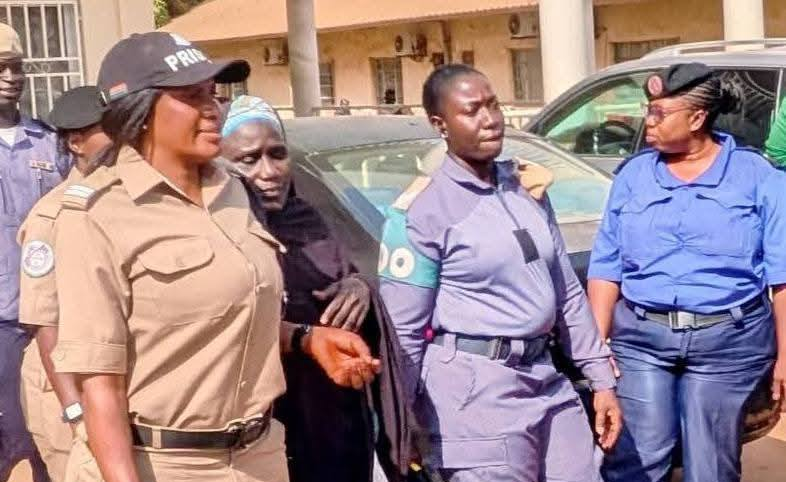
Counsel K. Jallow for Fatou Camara one of three women standing trial over the death of an infant allegedly subjected to female genital mutilation, has filed a no-case submission arguing the prosecution has produced nothing more than hearsay, rejected statements and contradictory medical evidence against her client.
Counsel K. Jallow has urged the acquittal of Fatou Camara of Wellingara on charges linked to the death of an infant girl without requiring her to mount any defence by filing a no-case submission arguing that the prosecution’s entire case against her is built on hearsay testimony, improperly obtained statements that the court has already rejected, and medical findings so contradictory that they cannot safely ground a conviction.
Fatou Camara, the 1st of three accused persons before Justice I. Janneh of the Binding High Court, faces two charges of conspiracy to commit a felony and prohibition of female circumcision, contrary to Section 32A(2)(b) of the Women’s (Amendment) Act, 2015.
The prosecution alleges she carried out female genital mutilation on Baby Sarjo Conteh on or about 8 September 2025 at Wellingara a procedure the state says caused the child’s death.
The other two accused, Hawa Conteh and Oumie Sawaneh, are the 2nd and 3rd accused persons respectively. The no-case submission filed by Counsel K. Jallow of Dandimayo Chambers relates solely to the case of the 1st Accused (Fatou Camara)
In attempting to prove its case, the prosecution called eleven witnesses mainly police officers and medical personnel and tendered exhibits including photographs, hospital records, and an autopsy report. Its central argument is that Baby Sarjo Conteh died as a result of female genital mutilation allegedly carried out by the accused persons.
However, according to the defense Counsel’s submission, exhibits which the prosecution attempted to tender were rejected by the court before even reaching the question of what they proved. Among them are the cautionary and voluntary statements purportedly obtained from all three accused persons, which were objected to and rejected by the court based on non-compliance with Section 31(2) of the Evidence Act and the Judges’ Rules leaving the prosecution’s case without its most direct incriminating evidence.
“The Prosecution’s case, even at its highest, does not disclose any evidence upon which a reasonable tribunal could convict the 1st Accused.” Counsel K. Jallow submitted.
Counsel K. Jallow no case submission proceeds witness-by-witness through the prosecution’s evidence, analysing what it characterises as a near-total absence of admissible material connecting Fatou Camara to any offence.
Counsel K. Jallow argued that the first three prosecution witnesses all police officers from the Child Welfare Unit are dismissed as providing purely procedural testimony as none witnessed any alleged offence. Counsel K. Jallow also contended that PW2’s account of why the child was brought to the hospital was derived entirely from what the child’s mother told her, making it hearsay while PW3 acted on information from a personal friend rather than any independent investigation.
Counsel K. Jallow added that PW5, a police officer who attended the autopsy at the Edward Francis Small Teaching Hospital (EFSTH) and took photographs of the deceased with explanatory notes of the photographs linking it with FGM as the cause of death. Counsel K. Jallow notes PW5 is not a medical expert and was not qualified to determine the cause of death and her explanation carries no evidential value.
Counsel K. Jallow further stated that PW7, a medical doctor, confirmed under cross-examination that she never examined the deceased her knowledge of the case came entirely from information relayed to her during hospital meetings, adding that the Medical Examination Form shown to her was disowned as not originating from the hospital and the court rejected the prosecution’s attempt to tender it through her.
“PW8, the Head of Department at Bundung Hospital, acknowledged that his knowledge was derived from another doctor who is not a pathologist,”. Counsel Jallow stated.
Counsel Jallow challenged the detailed forensic report Exhibit D the autopsy report prepared by PW11, Professor Ogun, a pathologist who examined the body at EFSTH.
Counsel Jallow stated that the report records that the patient “allegedly underwent genital cutting” and identifies external haemorrhage as the cause of death. She added that under cross-examination, however, the pathologist made several concessions; that timely medical intervention could have averted death from continuous bleeding; that he could not tell what instrument was used to cause the laceration; and that he could not independently determine what caused the injuries he observed.
Counsel Jallow pointed out what she calls an internal inconsistency at the heart of the report. She said while the examiner begins cautiously by saying the patient “allegedly” underwent genital cutting thereby acknowledging uncertainty the clinicopathological correlation section asserts with apparent confidence that the deceased lost blood through genital cutting. Counsel Jallow characterises it as an ‘unexplained shift from uncertainty to certainty on a material issue’ with no evidential or analytical bridge provided.
“The report moves from speculation to conclusion without demonstrating the reasoning required to support such a finding.” Counsel K. Jallow submitted.
Counsel Jallow argues that by the fact that the pathologist was provided with a Medical Examination Form before conducting the autopsy which indicated that the baby had been circumcised the day before death. Counsel Jallow contends this was not a clinical finding but hearsay, and raises the real possibility that the examiner’s conclusions were influenced by a pre-existing narrative rather than objective pathological findings.
“The Brought-In-Dead (BID) Form from Bundung Maternal and Child Health Hospital, admitted as Exhibit B and prepared by Dr Irma Font at the time the child was admitted recorded the cause of death not as FGM but as ‘unknown, probably hypovolemic shock (coincidence).’ The form contains no reference to genital cutting as the confirmed cause of death”.
Counsel Jallow argues the contemporaneous medical record made at the critical moment of admission materially undermines the prosecution’s causal theory and raises significant doubt as to whether FGM has been established as the cause of death at all, neither the document nor the Triage Form (Exhibit C) mentions or implicates Fatou Camara in any way.
Defence counsel K. Jallow’s no-case submission is brought under Section 245 of the Criminal Procedure Act 2025, which empowers a court, at the close of the prosecution’s case, to dismiss the case and acquit the accused if the evidence adduced does not disclose a case sufficiently established to warrant the accused entering a defence.
Counsel Jallow cites a authority from Gambian, Nigerian, and English courts. The Gambian Supreme Court case of Batch Samba Faye v The State (2014-2015) GSCLR 37 is relied upon for the proposition that where any ingredient of an offence is not proved, the accused is entitled to be discharged.
The Nigerian locus classicus of Ibeziako v Commissioner of Police (1963) 1 All NLR 61 and the English Practice Note in R v Galbraith (1962) 1 All ER 448 are cited for the test that a no-case submission will succeed where evidence is so weak, discredited, or inconsistent that no reasonable tribunal could convict.
Counsel Jallow particularly pointed to Ceesay v The State (1960-1993) G.L.R. 117, in which the Court of Appeal emphasised that a successful no-case application not only protects the accused from the witness box where they might be compelled to make damaging admissions but prevents the prosecution from plugging holes in its own evidence through cross-examination of defence witnesses.
Counsel K. Jallow identifies three interlocking failures in the prosecution’s case against Fatou Camara.
First, on the conspiracy charge, Counsel Jallow argues that the prosecution has adduced no evidence whatsoever of any agreement, communication, or meeting of minds between the 1st Accused and any alleged co-conspirators and no prosecution witness testified to any interaction between Fatou Camara and any other person in furtherance of a common criminal purpose.
Second, on the substantive FGM charge, Counsel Jallow stated that no witness saw the 1st Accused perform any procedure on the deceased and no medical evidence identifies her as responsible. No admissible statement links her to the act. There is a complete failure of proof on the central element that she actually carried out the alleged procedure.
Third, on causation, Counsel Jallow contended that even setting aside the question of individual responsibility, the prosecution has failed to establish through credible, consistent medical evidence that FGM was the proven and exclusive cause of the fatal haemorrhage, adding that the autopsy is internally contradictory; the pathologist acknowledged uncertainty; the contemporaneous hospital record does not confirm FGM as the cause.
“To call upon the 1st Accused to enter a defence would be to compel her to explain or disprove allegations that the Prosecution itself has failed to establish. That would amount to a reversal of the burden of proof, which the law does not permit.” Counsel Jallow argues.
A successful no-case submission would result in the acquittal of the 1st Accused without being required to open her defence or call a single witness.