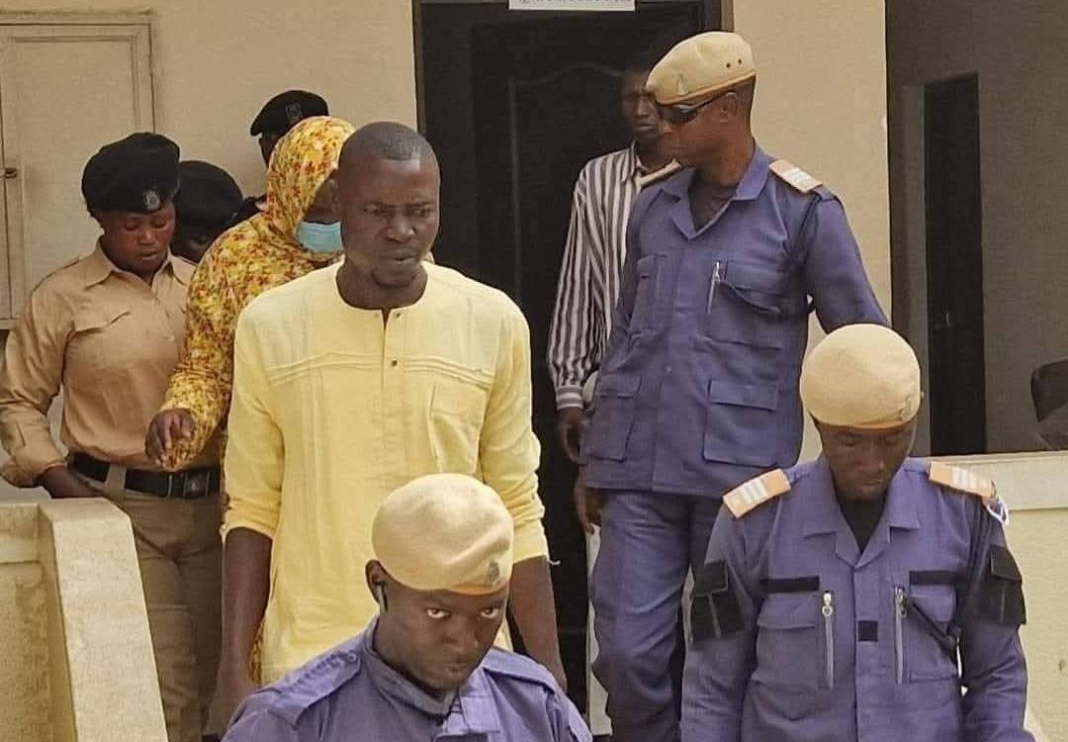
Counsel Lamin J. Darboe has filed a final “Reply on Points of Law” on behalf of Ousainou Bojang in the Sukuta-Jabang Traffic Lights shooting trial.
Counsel Lamin J. Darboe’s critique of the State’s prosecution strategy. The filing, which serves as the final word for the first accused Ousainou Bojang, asserts that the State’s case is built on a “deliberate mischaracterisation” of facts and a fundamental misunderstanding of the laws governing confessions and alibis.
Counsel J. Darboe maintains that the State has failed to provide a concrete “nexus” linking Ousainou Bojang to the murder of two police officers at the Sukuta-Jabang Traffic Lights in September 2023.
Counsel J. Darboe’s points of law begin by addressing the core ingredients of a murder charge. While the defense Counsel Darboe does not dispute that the deaths of the officers occurred, it argues that the prosecution has failed to answer the “central question”: Did Ousainou Bojang commit the act?
Citing the landmark case of Batch Samba Faye v. The State (2014-2015), Counsel Darboe argues that the prosecution must prove beyond a reasonable doubt that the accused was the individual who caused the death.
Counsel Darboe maintains that throughout the entirety of the State’s case, no circumstances were established that prove Ousainou Bojang was the person who pulled the trigger.
The point of law references Bojang v. The State (1997-2001), which underscored the high threshold required for visual identification, which Counsel Darboe claims was not met in this trial.
Counsel Darboe’s point of law highlights the legal definition of a “confession” under Section 31(1) of the Evidence Act. Counsel Darboe argues that the prosecution has fundamentally misconceived the term.
Counsel Darboe provides the definition of Confession. Counsel Darboe cites Section 31(1) of the Evidence Act, which defines a confession as a “voluntary admission.”
Counsel Darboe argues that the State has “misconceived” the section, asserting that any statements attributed to Ousainou Bojang were neither voluntary nor obtained in compliance with the law.
Counsel Darboe alleges that investigative officers “deliberately failed to comply” with legal safeguards during Bojang’s detention. Counsel Darboe argues that under the authority of Mamadou Jallow v. Commissioner of Police, an involuntary or improperly obtained statement cannot be used to sustain a conviction.
Counsel Darboe strongly rejected the State’s claim that Ousainou Bojang’s alibi was a late addition to the trial. Counsel Darboe provided a timeline of events to prove otherwise.
Counsel Darboe stated that the alibi was raised immediately upon Bojang’s arrest asserting that Ousainou Bojang informed Commissioner Momodou Sowe (PW5) of his whereabouts upon his arrest.
Also, Counsel Darboe stated Ousainou Bojang offered his mobile phone to investigators at the time of his arrest to verify his communication with Kathleen McGee (DW11), an alibi the defence claims the State “negligently failed to investigate” in their “desperation to have someone pinned to the crime.”
Citing Sampson Idowu v. The State (2013), Counsel Darboe argued that once an alibi is raised, the burden is on the prosecution to disprove it. Counsel Darboe maintained that the testimony of six defence witnesses (DW1, DW2, DW3, DW4, DW5, and DW11) who placed Ousainou Bojang in Brufut using a guest’s Wi-Fi during the time of the shooting remains unshaken.
Counsel Darboe reiterated that the lack of forensic evidence DNA, fingerprints, or ballistics matching Ousainou Bojang is fatal to the State’s case. Referring to Miller v. Minister of Pensions (1947), Counsel Darboe reminded the court that the “burden of proof” lies solely on the State, and that “reasonable doubt” must always be resolved in favour of the accused.
Counsel Darboe further cited The State v. Yankuba Touray (2021) to support the argument that a conviction cannot rest on weak circumstantial evidence without forensic corroboration.
Counsel Darboe concluded by stating that the prosecution’s final address represents a “clear misconception of the applicable law.” Counsel Darboe prayed for the court to look past the “mischaracterisation” and acquit Ousainou Bojang on all counts.
With all briefs and replies now submitted, the “ball is in the court’s court.” Justice is expected to be delivered on March 30, 2026, when Justice Jaiteh will judge whether the Bojang siblings will be convicted or set free.