

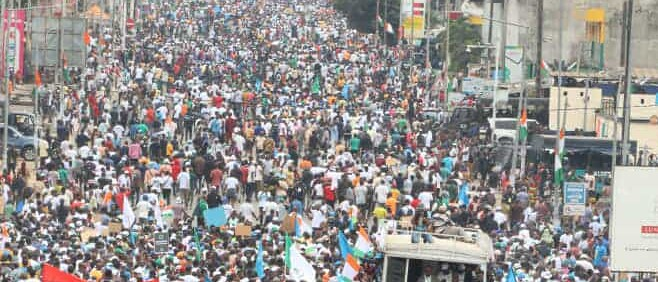

In Abidjan, thousands of Ivorians gathered to protest the exclusion of opposition leaders from the forthcoming presidential election.
Ivory Coast, the largest economy in francophone West Africa, is set to conduct a presidential election in October. Earlier this year, the electoral commission barred four main opposition figures from running, including former President Laurent Gbagbo and former Credit Suisse chief executive Tidjane Thiam.
On Saturday morning, protesters assembled in Yopougon, a bustling suburb of Abidjan, displaying banners with slogans like: “Enough is enough!”, “No true democracy without true justice,” and “We are millions saying YES to Gbagbo and Thiam.” Earlier this year, Gbagbo and Thiam united to contest against the incumbent President Alassane Ouattara.
In the previous month, 83-year-old Ouattara declared his intention to pursue a fourth term. Ouattara’s candidacy faces challenges following his 2016 constitutional amendment that eliminated presidential term limits.
“We do not seek a fourth term, and we request a revision of the electoral roll; that is our demand,” stated Sagesse Divine, an activist who took part in Saturday’s march. “Our desire is for all candidates’ names to be included, and we seek to approach the elections in a peaceful manner; that is our only request.”
A vote amidst rising tensions
No immediate comments were made by Ivorian authorities.
Thiam, the president of the Democratic Party of Ivory Coast, secured victory in the party’s primary through an uncontested vote.
Considered the primary opponent of Ouattara, he has been prohibited from competing due to the assertion that he held French citizenship when he announced his candidacy, despite having subsequently renounced his French nationality. The law in Ivory Coast prohibits individuals with dual nationality from seeking the presidency.
Elections in Ivory Coast have often been marked by tension and violence. When Ouattara declared his intention to run for a third term, numerous individuals lost their lives in the ensuing election violence.
Ouattara is the most recent addition to a rising group of leaders in West Africa who maintain their positions by altering constitutional term limits. Leaders of coups in the region have cited purported corruption within democratic governments and modifications to electoral processes as justifications for their power grabs, resulting in a division within the Economic Community of West African States (ECOWAS).
Ouattara defended his choice to run by stating that the Ivory Coast is encountering unparalleled security, economic, and monetary challenges that necessitate experienced management for effective resolution.