
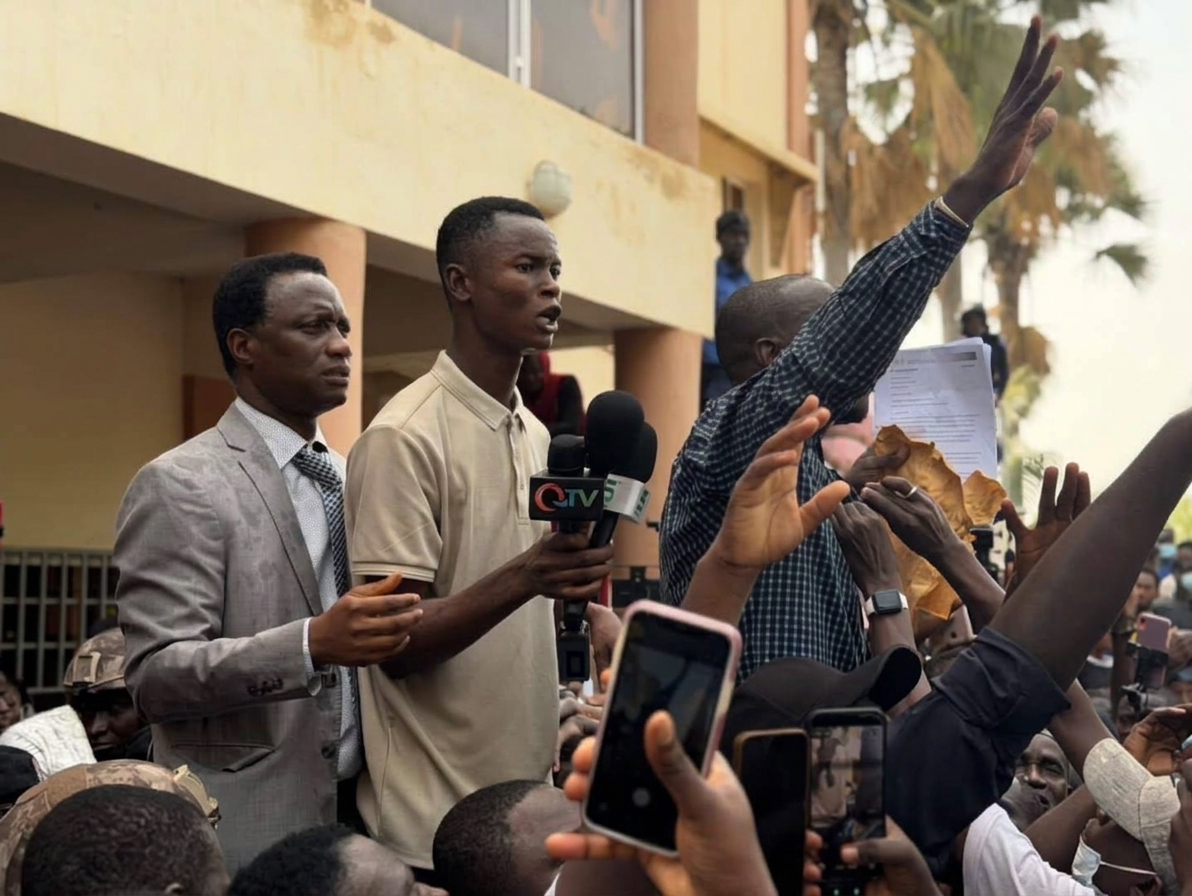
Students at the University of The Gambia (UTG) have taken to the streets in protest over worsening conditions at the Faraba Banta campus, demanding urgent government intervention and warning that lectures could be suspended if their concerns are not addressed.
The demonstration, organised by the University of The Gambia Students’ Union (UTGSU) 24th Executive Council, was held on Monday at the university’s Peace Building campus in Kanifing. It followed growing frustration over unreliable transportation, the closure of the campus cafeteria, inadequate drinking water supplies and persistent internet connectivity problems.
In a petition addressed to the Minister of Higher Education, Research, Science and Technology, the students’ union said the difficulties surrounding the university’s relocation to Faraba Banta had resurfaced, creating serious obstacles to academic activities barely six weeks into the semester.
Representing more than 12,000 students, the union described transportation as one of the most pressing challenges, saying unreliable bus services have repeatedly caused students to miss lectures, examinations and other important academic engagements.
According to the petition, an agreement between the ministry and the Gambia Transport Service Company (GTSC) provides for the deployment of 20 buses to transport students to and from the campus. However, the union accused the company of failing to honour the arrangement fully.
It said only 12 buses are made available for the 6:30 a.m. departure, while four additional buses are introduced at 9:30 a.m., often arriving late at designated pickup points. The union also raised concerns about the conduct of some drivers, alleging that students have been subjected to degrading treatment.
The petition refers to an incident that took place on Friday, October 23, when students waiting at the Coastal Road and Sukuta Traffic Light pickup points were allegedly stranded as the busses did not turn up. Many were forced to go home, missing lectures and scheduled assessments.
The union also recalled an earlier incident in the first week of September, when students were reportedly stranded at the Faraba campus until around 9 p.m., highlighting what it described as the continuing failure to provide dependable transportation.
Another major concern that has emerged is food availability. The extension of the cafeteria closure has denied students reliable meals during the school day, adding to the challenges for students who spend long hours at the university, the union said.
It also complained about inadequate supplies of clean drinking water and poor internet connectivity, arguing that the situation is affecting students’ ability to conduct research, access learning materials and complete their coursework.
The students’ leadership said it had repeatedly attempted to resolve the problems through discussions with the relevant authorities, but those engagements had produced little tangible improvement.
It pointed to a meeting convened by the ministry on September 25, during which assurances were reportedly given, but said the situation deteriorated afterwards. The cafeteria issue was also raised at a University Governing Council meeting on October 6, without any response, according to the petition.
A further complaint submitted to the ministry on October 15 over transportation difficulties reportedly failed to bring improvements. The union said another meeting with the Directorate of Student Affairs on October 22 also ended without a meaningful resolution.
With previous engagements yielding little progress, the union has now issued a series of demands and set firm deadlines for the authorities.
It wants all 20 buses provided for under the transportation agreement to be deployed by Tuesday, October 27. It has also insisted that no buses should return to the depot before the scheduled 2:30 p.m. departure from Faraba.
On campus facilities, the students are demanding an adequate supply of clean drinking water and the reopening of the cafeteria under qualified food vendors by the same deadline.
The union has given the authorities until Friday, October 30, to establish reliable internet connectivity across the campus.
It has further demanded a written response from the ministry by close of business Tuesday, outlining the measures being taken to address the situation, explaining why the transportation agreement has not been fully implemented and providing a clear timetable for restoring internet services.
The student leadership warned that failure to meet these demands would result in further demonstrations and the suspension of lectures across the university.
It maintained that responsibility for any disruption to the academic calendar would rest with the authorities, accusing them of failing to resolve problems that fall within their responsibility.
The union has also raised concerns about students who have missed examinations and assessments because of transportation failures. It is demanding that such students be protected from academic penalties for circumstances beyond their control.
According to the petition, some lecturers continued administering tests despite being aware that affected students could not reach the campus. The union questioned the fairness of penalising students for missing assessments when the transportation arrangements had failed.
Monday’s demonstration marks a further escalation in the dispute between the students’ leadership and the authorities over conditions at Faraba Banta.
The protest has renewed pressure on the Ministry of Higher Education and university management to address concerns over basic campus services, transportation and the general welfare of students.
For students, it’s more than an inconvenience. They say reliable transportation, food, clean water and internet connectivity are critical for their continued education and should not be left unsettled as academic activities continue.