United Democratic Party (UDP) leader and Secretary General ANM Ousainu Darboe has paid tribute to party members who endured imprisonment, violence and, in some cases, death during the party’s 30-year political history.
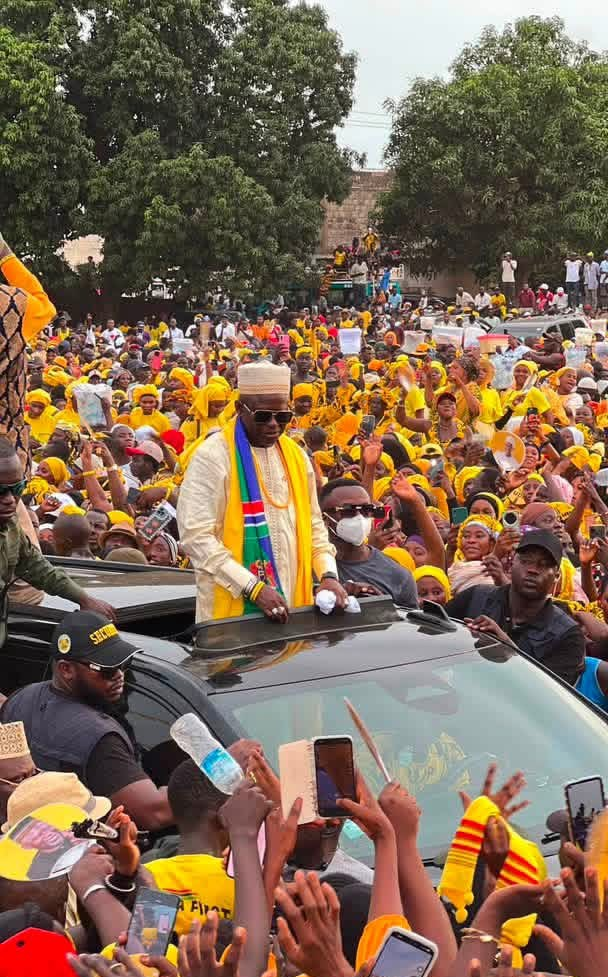
Addressing thousands of supporters at the UDP’s 30th anniversary rally at Brikama SSP on Sunday, Darboe said the occasion was not simply about celebrating the party’s survival but also recognizing the sacrifices made by those who participated in its struggle.
“We are not mourning them; we are celebrating them,” Darboe told the gathering.
The anniversary rally brought together thousands of UDP supporters, representatives of allied political groups, political party leaders and members of the media.
Much of Darboe’s speech focused on some of the most difficult periods in the UDP’s history, particularly during the 22-year rule of former President Yahya Jammeh.
He recalled September 22, 1996, as one of the darkest moments in the party’s early history. According to Darboe, UDP supporters were ambushed at Denton Bridge, where several young party members, including Fa Badjo Darboe and Kebuteh Jafuneh, were allegedly subjected to torture.
Darboe said the following day, more than 70 people who had been injured during the political violence were brought to his home.
He also recalled the arrest and alleged beating of Amadou Sanneh by agents of the National Intelligence Agency in the same month, saying Sanneh had been targeted because of his political opposition to the then-ruling Alliance for Patriotic Reorientation and Construction (APRC).
Darboe said recounting these events was intended not merely to revisit the past but to ensure that younger generations understood the sacrifices made by Gambians who challenged authoritarian rule.
He recalled a confrontation at Fass Njaga Choi, where he said police refused to grant the UDP permission to hold a political meeting. According to Darboe, party officials decided to proceed without a public-address system and were later ordered by police to return to Banjul.
Darboe said he told the officers that the party members would leave only if they were arrested and taken away.
He presented the incident as one of several moments that helped challenge what he described as a climate of fear surrounding political activities under the Jammeh administration.
The UDP leader also referred to events at Chamoi Bridge, accusing authorities at the time of attempting to implicate party supporters in incidents that could have been used to weaken the opposition party. He acknowledged the contributions of Binta Sabally, Sarjo Kunjang Sanneh and Fatou Darboe during that period.
Darboe devoted particular attention to Solo Sandeng, the UDP activist whose death in state custody in April 2016 became a major turning point in the opposition campaign against Jammeh.
Sandeng and other activists had demonstrated for electoral reforms before his arrest and subsequent death. Darboe said the incident prompted senior UDP figures to take to the streets demanding answers, resulting in their own arrests and imprisonment.
He described Sandeng as a political activist who sacrificed his life in pursuit of political change and also remembered Lang Marong, Modou Ngum, Kafu Bayo, Nyanging Bojang, Babucarr Camara and Falang Sonko among those he said paid a heavy price during the country’s political struggles.
Nearly a decade after the events of 2016, Darboe argued that some of the reforms sought by the activists had yet to be fully achieved. He specifically criticized the continued existence of the Public Order Act, which he said imposes restrictions that remain a challenge to political freedoms and electoral competition.
He also referred to the killing of student demonstrators in April 2000 and the arrests of UDP supporters at Fass Njaga Choi, placing those incidents within a wider history of political resistance that eventually contributed to the political transition of 2016.
However, the anniversary rally was also an opportunity for Darboe to focus on the UDP’s political ambitions ahead of the December 5 presidential election.
He said the party was continuing to pursue the aspirations of those who had sacrificed their lives alongside its current alliance partners. He emphasized opposition unity as essential if the coalition is to challenge President Adama Barrow at the polls.
Darboe urged Gambians to reject ethnic divisions and other differences, portraying the forthcoming election as a critical opportunity for political change. He called on voters to remove the Barrow administration through the ballot box.
Looking beyond the election, Darboe outlined several priorities he said would guide a UDP-led government, including greater representation for persons with disabilities in government, including senior appointments, as well as increased support for farmers and a stronger focus on agriculture.
Despite the party’s electoral ambitions, the dominant theme of Darboe’s address remained the UDP’s history and the sacrifices of those who helped sustain it through some of The Gambia’s most turbulent political periods.
For Darboe, remembering the party’s fallen members was not an exercise in mourning but a reaffirmation of the political ideals for which they struggled.
Thirty years after the UDP’s formation, he told supporters, the responsibility for completing that unfinished political journey now rests with the generation that remains.