
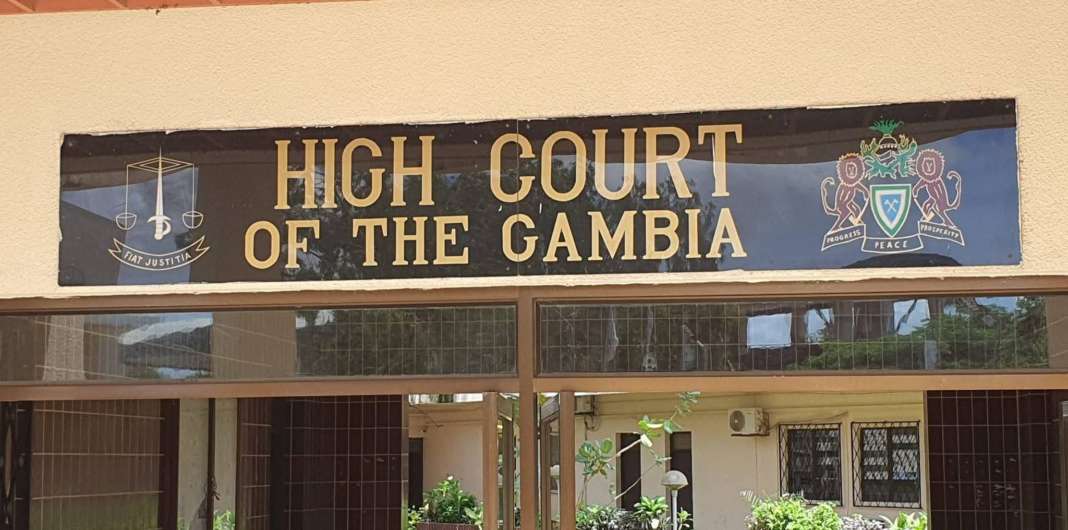
Justice Sidi K. Jobarteh of the High Court has convicted two boys of armed robbery and conspiracy to commit a felony following a trial in which both accused persons denied the charges, alleged police brutality, and claimed they did not know each other, only for their own pre-trial statements to place them together at the scene of the crime.
Lamin Sandeng, the first accused, and Ebrima Jallow, the second accused, were found guilty on both counts by Justice S.K. Jobarteh. Each was sentenced to ten years’ imprisonment for robbery and four years for conspiracy, with both sentences ordered to run concurrently.
The sentences were backdated to 7th October 2022, the date the convicts were first remanded in custody, meaning the nearly four years already spent in pre-trial detention will count toward the serving of their sentences.
During the trial, Counsel A. Badjie appeared for the State. C. Uduma appeared for the accused persons.
The accused persons faced two counts. The first was conspiracy to commit a felony, contrary to Section 368 of the Criminal Code. It was alleged that on the 30th September 2022, at Serekunda, the accused persons conspired with each other to rob one Ebou Njie of his mobile phones and cash, thereby committing an offence.
The second count was robbery, contrary to Section 272 of the Criminal Code and punishable under Section 273(2). It was alleged that on the same date and place, while armed with a knife, the accused persons robbed Ebou Njie of a Tecno Pop 3 phone, a Nokia/Microsoft Windows phone, cash amounting to D5,040, an identity card, and a voter’s card.
Both accused persons pleaded not guilty to both charges.
To prove its case, the prosecution called on six witnesses and seven exhibits tendered before the court. The complainant, Ebou Njie, testified as the first prosecution witness (PW1).
He stated that on the night of the incident, he was returning home after stopping at a shop near City Pop to buy water and eggs. As he continued walking, he was suddenly set upon by the accused persons. One of them held him by the neck and squeezed it, while the other twisted his hand behind his back. One of the attackers was armed with a knife. During this violent encounter, his Tecno Pop 3 phone, his Nokia/Microsoft Windows phone, cash of D5,040, his identity card, and his voter’s card were taken from him.
A police officer arrived at the scene, prompting the accused persons to flee. Although officers chased them, the two escaped. PW1 reported the matter to the police station. Later that night, while on patrol, officers received a tip-off that the suspects were at City Pub. They proceeded to the location, arrested the accused persons, and recorded their cautionary and voluntary statements, in which both men confessed to the commission of the offences.
The Microsoft Windows phone, identifiable by its distinctive white cracked cover, was recovered from Sulayman Jallow, who confirmed that the accused had sold it to him. The accused admitted to selling the phone. They stated that the Tecno Pop 3 phone had a cracked screen, was sold for D500, and the proceeds were shared between them.
The Microsoft Windows phone, they claimed, was faulty and had been discarded; however, it was recovered and tendered as Exhibit A. The knife allegedly used in the robbery was recovered and tendered as Exhibit B. The cautionary and voluntary statements of the first accused were admitted as Exhibits B1 and B2, while those of the second accused were admitted as Exhibits A1, A2, and A3.
PW1 and the arresting officers testified that although it was late at night and raining at the time of the incident, the street lights were on, enabling them to identify the accused persons.
At the close of the prosecution’s case, both accused persons testified in their own defence. Neither called a witness nor tendered an exhibit.
The first accused, Lamin Sandeng, told the court that on 2nd October 2022, he was standing at the gate of his compound talking to someone when three people alighted from a taxi and approached him. One of them slapped him without explanation and told him he would understand the reason upon reaching the police station. He was handcuffed, beaten, and his own phone was seized. He was placed in the cells upon arrival at the station.
He testified that on the third day, he was removed from the cells. He said the complainant was brought to identify him the following day, but failed to recognise him. The police, he alleged, told him that PW1 had complained that the attacker was wearing the same shirt as him.
He was returned to the cells and removed again on the fifth day. He was asked to sign documents but refused, saying he did not know the contents. He testified that he was beaten mercilessly and told that he would only receive bail if he signed. Unable to bear the pain any longer, he eventually signed. He was then taken to court and remanded.
Under cross-examination, the first accused maintained that he was at home on the day of the incident, that he did not know City Pop because he did not go out often, and that he was arrested between 9:00 p.m. and 10:00 p.m. He also maintained that he does not know the second accused.
The second accused, Ebrima Jallow, testified that he is a tailor who had recently arrived in The Gambia from Senegal. He stated that on the day in question, his employer asked him to deliver fabric to a customer in Serekunda after closing from work.
On his way back, a vehicle stopped in front of him, and police officers came out. They asked whether he was “Boy Pullo.” He replied that he was not Boy Pullo but Ebrima. He was arrested and told at the police station that a robbery victim had described the perpetrator as tall and slim, a description they believed matched him. He told the officers he could not be the only tall and slim person in the country.
He testified that he was beaten and placed in the cells. The following day, he was given documents to thumbprint, denied bail, and subsequently taken to court. He stated that he did not know the first accused and only met him in court for the first time.
Under cross-examination, the second accused stated that he does not know City Pop and was sleeping on the night of the incident, and that, being Senegalese, he does not know The Gambia well.
However, in his cautionary statement, the second accused had narrated a different account. He stated that on 30th September 2022, he was walking home with the first accused when they saw a man walking ahead of them. The first accused grabbed the man from behind while he positioned himself in front. He removed two phones and D1,500 from the man’s pockets. They ran away, sold one phone for D500, shared the money, and dispersed.
Justice Jobarteh, in her analysis, began by emphasising the foundational principle of criminal law: the burden of proof rests entirely on the prosecution to establish every element of an offence beyond a reasonable doubt.
Citing the celebrated House of Lords decision in Woolmington v DPP (1935) AC 462 and reinforcing the Gambian Court of Appeal precedent in The State v Malick Njie (2012) GCA, she held that while any real doubt must benefit the accused, the doubt must be genuine and not fanciful. The state must win on the strength of its own case, not the weakness of the defence.
Addressing Count One, Justice Jobarteh noted that the Criminal Code does not provide an exhaustive statutory definition of conspiracy. She turned to the Oxford Dictionary of Law (7th Edition), defining it as an agreement by two or more persons to behave in a manner that constitutes an offence.
Citing the English authority of R v Shivpuri (1986) 2 ALL ER 334, she noted that conspiracy is legally complete the moment the agreement is made, regardless of whether the criminals succeed in executing the act.
Furthermore, referencing Nyaboe v Republic (2000) 1 ER 111 and Archbold Criminal Pleading, Evidence and Practice (2023 Ed.), she affirmed that a criminal agreement can be legally inferred from conduct and surrounding circumstances.
Justice Jobarteh found that the coordinated mechanics of the attack, one man choking the victim while the other emptied his pockets, followed by a joint escape, the shared sale of the loot, and splitting the money, were entirely inconsistent with spontaneous action. It proved prior understanding and a joint enterprise.
Furthermore, Justice Jobarteh pointed out that both cautionary statements independently placed the two men together, matching perfectly in detail. The striking consistency between these independent statements made the defence’s courtroom claim that they had “never met” completely unbelievable, heavily damaging their credibility.
On the claims of police torture, Justice Jobarteh took judicial notice of the words of Lord Denning in Due Process of the Law (page 102), which warns that defendants very frequently claim their confessions were beaten out of them, fabricated, or framed once they get to court.
Justice Jobarteh noted that such serious allegations must be backed by credible evidence, which the defence failed to provide. She reminded that a voir dire (a trial-within-a-trial) had already been conducted to test these claims. The voir dire concluded that the statements were given voluntarily and complied fully with the Judges’ Rules and Section 31(2) of the Evidence Act 1994.
The court attached deep probative weight to the statements because their internal details, such as the exact number of phones taken, how one was disposed of, and the unique cracked cover of the other, were later verified by completely independent physical evidence and witness testimony.
Turning to Count Two, Justice Jobarteh cited Section 272 of the Criminal Code, breaking robbery down into four distinct elements: The act of theft, the use or threat of actual violence, and a direct temporal connection between the violence and the theft.
She said the violence being deployed to obtain/retain the property or overcome resistance. She cited the Supreme Court decision in Lamin Jah v The State (2020), which clarified that creating an apprehension of violence is legally sufficient to ground a robbery conviction, even if no blood is drawn.
Justice Jobarteh found all elements met. Mobile phones and cash are legally capable of being stolen. The choking and hand-twisting constituted actual violence, and the brandishing of a knife heavily intensified the victim’s fear and broke his capacity to resist. Because the violence directly facilitated the theft, it formed one continuous criminal transaction.
While acknowledging the inherent dangers of visual identification during rainy nights, Justice Jobarteh noted that the state’s case did not rely on visual recognition alone. Instead, it was built on a tightly woven fabric of circumstantial and direct evidence: the recovery of Exhibit A (the distinct white-covered phone), the voluntary confessions, and the presence of functional street lighting verified by multiple witnesses.
Following the announcement of the guilty verdicts, Defense Counsel C. Uduma pleaded for leniency. She submitted that Sandeng (29) and Jallow (22) were young men, first-time offenders, and had families relying on them for support. She emphasized that their time spent in remand since 2022 had already exposed them to the harsh realities of prison life. The state confirmed neither man had a prior criminal record.
In her final sentencing, Justice Jobarteh balanced public safety against the personal profile of the convicts. She noted that while armed robbery violently threatens public peace carrying a maximum statutory penalty of life imprisonment the youthfulness of the offenders could not be ignored.
Justice Jobarteh observed that youth inherently involves immaturity, poor judgment, and high susceptibility to negative peer influence. Stating that sentences which completely extinguish all hope of reform do not serve the wider interests of justice, she exercised her judicial discretion to temper punishment with mercy.
Youth carries with it immaturity, poor judgment, and susceptibility to bad influence,” the judge stated, noting that a sentence completely erasing hope would not serve the broader interests of rehabilitation
Accordingly, she sentenced both men to 4 years for conspiracy and 10 years for armed robbery, to be served concurrently, effective from their initial remand date of October 7, 2022. Both convicts were reminded of their constitutional right to appeal the judgment to the Court of Appeal.