
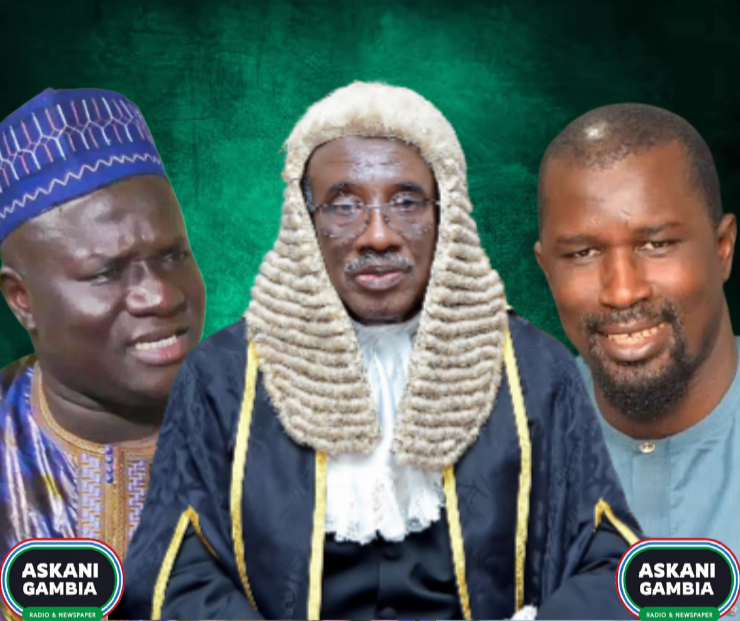
The Supreme Court’s ruling of July 7 should not be viewed merely as a dispute over the President’s removal of the Auditor General. Nor is it simply about administrative relations between institutions or an attempt to reconcile individuals. It is a constitutional moment whose implications extend far beyond the parties before the Court. At stake was the integrity of our constitutional order, the independence of public institutions, and the future of democratic governance in the Gambia.
The judgments of supreme and constitutional courts are among the most consequential acts of governance in any democracy. They do far more than resolve disputes. They define the meaning of the Constitution, shape public institutions, establish standards of lawful conduct, restrain the abuse of power, and provide guidance for future governments. They determine not only what is legal, but what conduct is expected in a constitutional democracy.
History offers countless examples. The United States Supreme Court in Brown v. Board of Education transformed American society by dismantling state-sanctioned racial segregation in education. In United States v. Nixon, it affirmed that not even the President is above the law but must disclose information. India’s Supreme Court, through Kesavananda Bharati, created the ‘Basic Structure Doctrine’ to prevent elected governments from destroying the essential features of constitutional democracy. South Africa’s Constitutional Court repeatedly curtailed executive excesses, most notably in the Economic Freedom Fighters case, where it held Pres. Jacob Zuma accountable for violating the Constitution. Here in the Gambia, the Supreme Court’s decision in the Ya Kumba Jaiteh case reinforced constitutional protections against arbitrary executive action.
These judgments endure because they did not merely declare the law but went further to transform governance by imposing necessary and inevitable remedies. They strengthened institutions, empowered citizens, and reinforced constitutional limits on political power.
The July 7 ruling should have been approached from this broader constitutional perspective. It was not enough for the Supreme Court to declare that the removal of Auditor General Momodou Ceesay was unconstitutional. The logical and constitutionally consistent remedy should have been his reinstatement. Anything less leaves the unconstitutional act substantially intact and weakens the practical force of the Constitution.
This case stands on the same constitutional footing as the Supreme Court’s decision in the Ya Kumba Jaiteh case. In that landmark judgment, the Court reaffirmed the principle of separation of powers by ordering the reinstatement of a nominated National Assembly Member whose unconstitutional removal had undermined the independence of the Legislature.
The present case concerns an institution of no lesser constitutional significance. The National Audit Office is not an agency of the Executive, but an independent constitutional institution established under the Constitution to audit public finances and hold the Executive accountable for its stewardship of public resources. Like the National Assembly, the NAO is deliberately insulated from political interference to preserve its independence, integrity, and credibility.
It therefore follows, both logically and constitutionally, that if the unlawful removal of Ya Kumba Jaiteh required reinstatement to restore the constitutional order, then the unconstitutional removal of Auditor General Momodou Ceesay should equally have attracted the same remedy.
Both cases implicate the same foundational constitutional principles: the rule of law, separation of powers, institutional independence, checks and balances, and executive accountability. To treat them differently creates an inconsistency in constitutional protection that risks weakening the very institutions the Constitution was designed to shield from executive interference.
An unconstitutional decision should not be allowed to produce its intended outcome. Otherwise, the message to future officeholders is deeply troubling: violate the Constitution if you wish, because even if a court later declares your actions unlawful, the objective you sought may still stand. Today, Barrow stands victorious for violating our Constitution!
This is not merely a academic concern. It creates a dangerous precedent for executive overreach and sends a frightening signal to independent constitutional offices. Future Auditors General, Electoral Commissioners, Ombudspersons, Human Rights Commissioners, Anti-Corruption Commissioners, and other constitutional office holders may feel compelled to temper their independence for fear of suffering the same fate. Constitutional independence becomes fragile when unlawful executive action carries no meaningful consequence.
The Court had an opportunity to confront this reality by situating the case within the Gambia’s own constitutional history. Our country has lived through decades in which a president arbitrarily dismissed judges, magistrates, electoral commissioners, National Assembly Members, auditors general, and other public officials. Such abuses were defining features of authoritarian rule and among the principal reasons Gambians voted for democratic change in 2016. That history cannot be ignored.
It is therefore profoundly troubling that within the current supposedly democratic dispensation we again witness the unconstitutional removal first of a nominated National Assembly Member and then, within seven years, an Auditor General. These are not isolated incidents. They raise serious questions about the security of constitutional offices and the resilience of democratic institutions.
By declining to reverse the President’s unconstitutional action, the Supreme Court has, regrettably, rewarded arbitrariness rather than decisively rejecting it. The former Auditor General and his legal team secured an important legal victory. But the larger constitutional question remains unresolved hence the nation has lost.
President Barrow knew, or ought to have known, that the Constitution did not permit the removal of the Auditor General in the manner he proceeded. Yet he accomplished precisely what he intended: the Auditor General was removed from office. Although the highest court declared the action unconstitutional, it did not restore the constitutional order that existed before the violation. In practical terms, the unconstitutional objective was achieved.
The lesson that future presidents may draw is obvious and disturbing. They may conclude that the political benefits of unconstitutional action outweigh the legal risks, particularly if the most serious consequence is a declaration of unlawfulness accompanied by financial compensation while the executive decision itself remains effective. Such an approach weakens constitutional restraint rather than strengthening it.
This is why constitutional remedies matter. A declaration without an effective remedy often fails to deter future violations. Where the Ya Kumba Jaiteh ruling did not deter Pres. Barrow in removing the Auditor General, why should anyone hold that this ruling, which is short of reinstatement as in the previous case, will prevent him from sacking another constitutionally protected officer in the near future? Constitutional democracies are not protected by declarations alone, rather they are protected by remedies that restore legality, vindicate constitutional principles, and ensure that no one benefits from unconstitutional conduct.
The argument that reinstatement is inappropriate because of animosity between individuals or institutions is unpersuasive. It is not the role of the Supreme Court to mediate personal relationships. The Court is the guardian of the Constitution, not a peacebuilding or conflict-management institution. Its foremost duty is to uphold constitutional supremacy and restore constitutional order. Constitutional remedies cannot be diluted or denied because unlawful actions have created strained relationships. To do so is to allow political expediency to prevail over the Constitution itself.
Sixty-one years after independence, and nearly a decade after the end of authoritarian rule, the Gambia should have zero tolerance for constitutional violations, especially by those entrusted with upholding the Constitution. The rule of law is not sustained merely because courts identify violations. It is sustained because constitutional breaches attract effective legal consequences that restore public confidence and deter future abuse.
This case represented a historic opportunity for the Supreme Court to articulate, with clarity and conviction, the central constitutional principles upon which our democratic future depends, i.e., constitutional supremacy, the rule of law, separation of powers, checks and balances, and the independence of constitutional institutions. It was an opportunity to establish clear limits on executive authority and reaffirm that no President stands above the Constitution.
For a small nation emerging from dictatorship, pursuing transitional justice, and confronting persistent poverty, corruption, inequality, and institutional fragility, this judgment could have become a defining constitutional milestone. It could have strengthened the “Never Again” agenda by demonstrating that unconstitutional conduct would never be permitted to achieve its intended purpose.
Instead, the ruling represents a missed opportunity to reinforce democratic consolidation at a time when signs of democratic backsliding are glaring and widespread. By failing to order reinstatement, the Court missed the chance to fully restore constitutional order and to send an unmistakable message that abuse of executive power will neither be tolerated nor rewarded.
With this ruling, the Constitution has prevailed in principle but not in practice. Momodou Ceesay and his lawyer won the day, but the Gambia lost.
For The Gambia, Our Homeland
By: Madi Jobarteh