
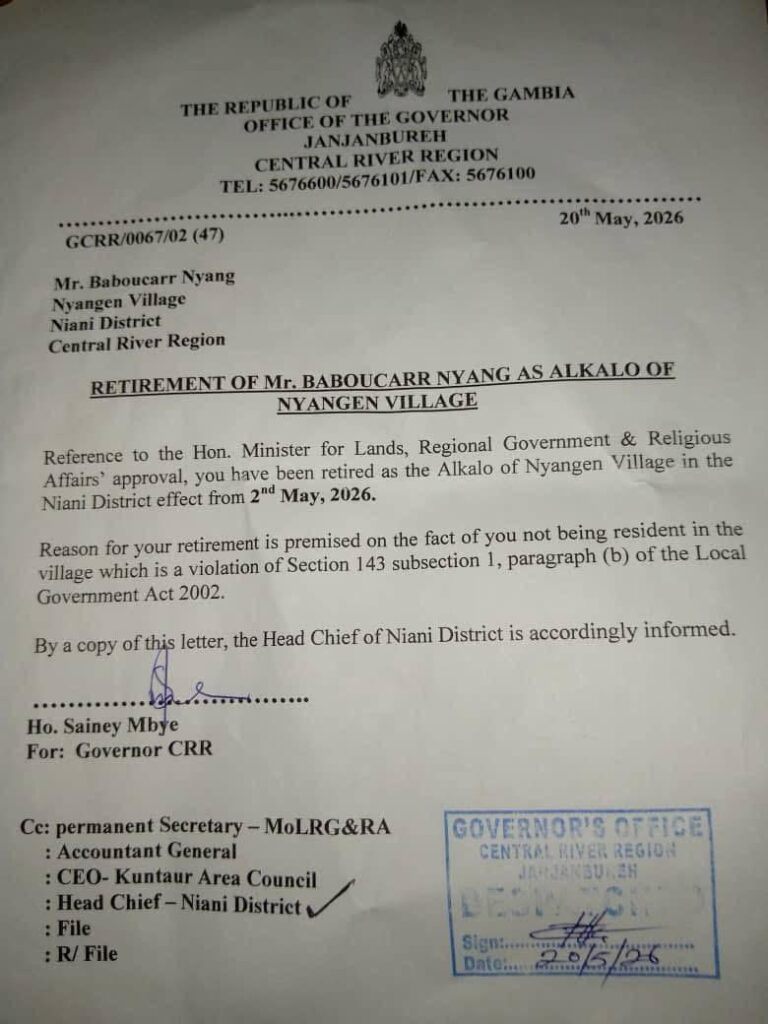
The so-called retirement of Alkalo Baboucarr Nyang of Nyangen Village is illegal, unjustifiable, and a blatant abuse of administrative authority under the Local Government Act 2002. A proper reading of Sections 142 to 145 of the Act clearly demonstrates that neither the Governor nor the Ministry has acted in accordance with the law. The action not only violates the statutory provisions governing the appointment and removal of Alkalolu, but also raises serious concerns about political victimization, abuse of office, and the erosion of the rule of law.
The letter claims that Alkalo Baboucarr Nyang was removed because he was not resident in the village, relying on Section 143(1)(b) of the Act. However, this provision has been grossly misapplied. Section 143 concerns the qualifications and disqualifications for appointment as an Alkalo. While subsection 143(1)(b) states that a person qualifies for appointment if he “was born and is resident in the village,” this provision relates only to eligibility for appointment and not removal from office.
The law is very clear on how an Alkalo ceases to hold office. Section 144 states that an Alkalo ceases to hold office only upon death, resignation, disqualification under Section 143(2), or removal under Section 145. The disqualifications under Section 143(2) are limited to unsoundness of mind, conviction for specified offences such as fraud or violence, election-related offences, or bankruptcy. None of these conditions have been cited against Alkalo Baboucarr Nyang.
Furthermore, Section 145 empowers only the Minister responsible for Local Government and Lands to remove an Alkalo, and only on specific grounds, i.e., misconduct, incompetence, or inability to perform the functions of office arising from infirmity of mind or body or any other cause. The letter issued to the Alkalo cites none of these legally recognized grounds. Instead, it invents a reason that the law itself does not recognize as a basis for removal. Consequently, the imposed retirement is unlawful, hence null and void.
Equally alarming is the fact that the letter itself was issued by the Governor of the Central River Region, Ousman Bah, who possesses no legal authority whatsoever to appoint or dismiss an Alkalo. Sections 142 and 145 are explicit that the authority to appoint and remove an Alkalo rests solely with the Minister responsible for Local Government and Lands. Therefore, by issuing this so-called retirement letter, the Governor acted outside the law and in blatant excess of his authority.
This conduct represents a serious abuse of administrative power and a direct violation of the principle of legality in public administration. Public officials cannot arrogate unto themselves powers that the law does not grant them. Any administrative action taken without lawful authority is invalid and unconstitutional in spirit and practice. If Governors can arbitrarily dismiss traditional leaders without legal basis, then the country risks descending into a dangerous culture of impunity where public power is exercised according to whims, political convenience, and personal interests rather than law.
The broader context surrounding this matter makes the situation even more troubling. The removal of Alkalo Baboucarr Nyang follows the earlier confiscation of his official stamp during the voter registration exercise amid allegations that he sympathized with the UMC political movement. Viewed against this background, the current action raises serious and legitimate concerns of political persecution and victimization against a traditional leader because of perceived political affiliation.
I therefore urge the Ministry of Lands, Regional Government and Religious Affairs to immediately rescind this illegal letter and reinstate Alkalo Baboucarr Nyang to continue performing his lawful functions as Alkalo of Nyangen Village. Equally, the actions of the Governor in this matter must be subjected to scrutiny and accountability to ensure that abuse of office and unlawful administrative conduct do not become normalized within public institutions.
For The Gambia, Our Homeland