
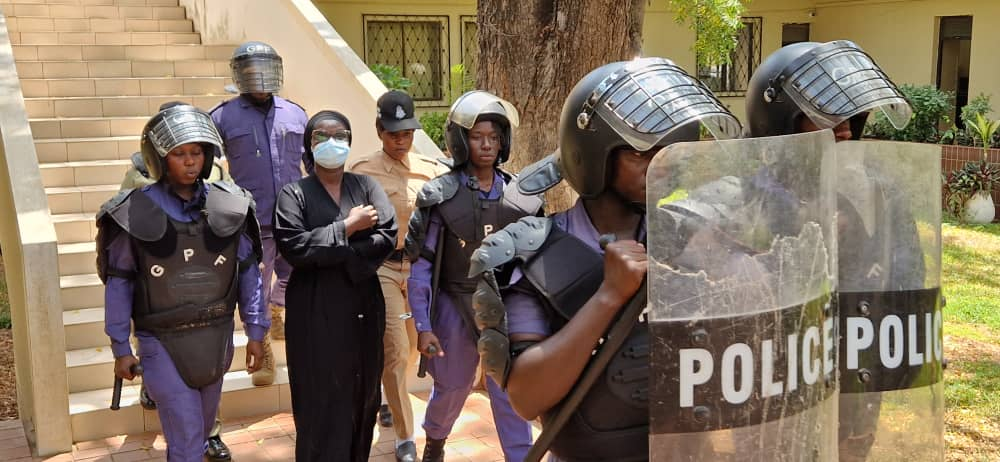


The Supreme Court has affirmed a fresh trial (de novo) in the murder case of Kumba Sinyan, upholding the High Court Practice Directions of 2013 and 2019 and dismissing the Attorney General’s challenge to their applicability in capital offence proceedings.
In its ruling, the Supreme Court rejected the State’s argument that restarting the trial would constitute a miscarriage of justice and confirmed that the High Court Practice Directions, which mandate a fresh hearing when a new judge assumes a criminal case and the accused does not consent to continuing from the previous Judge, are neither unconstitutional nor contrary to fair hearing principles.
State Counsel Wakawa represented the state in the appeal, while defence counsel S. Twum appeared for Kumba Sinyan.
Kumba Sinyan was first arraigned on November 9, 2022, charged with the murder of Lamarana Jallow at the Friendship Hostel. According to court records, Lamarana Jallow was killed by cutting his stomach with a razor blade. Kumba Sinyan pleaded not guilty, and proceedings commenced before Hon. Justice Sidi K. Jobarteh.
The prosecution, led by Principal State Counsel M. Sanyang, presented ten witnesses and eighteen exhibits before closing its case on March 14, 2024. The defence was scheduled to open on April 15, 2024, but delays occurred after defence counsel raised concerns about the accused’s mental health. Following a court-ordered psychological evaluation, Kumba Sinyan was declared fit to stand trial and began testifying on June 26, 2024, continuing across six consecutive court sittings.
The case took a turn in September 2024 when Justice Jobarteh proceeded on maternity leave. Upon her return, the Chief Justice reassigned the matter to Hon. Justice Adenike J. Coker, a newly appointed High Court judge.
Upon the case transfer, defence counsel S. Twum filed a motion requesting that the trial commence afresh, invoking the High Court Practice Directions. The Directions explicitly mandate a de novo hearing in criminal trials when a new judge assumes the case, and the accused does not consent to proceeding from where proceedings stopped.
State Counsel M. Sanyang opposed the motion, arguing that a fresh trial would prejudice the prosecution. She contended that restarting proceedings would cause significant delays, waste resources already expended over more than a year of diligent prosecution, and amount to a miscarriage of justice, particularly since the State had completed presenting its case.
On April 2, 2025, Justice Coker ruled in favour of the defence, emphasising the mandatory nature of the Practice Directions. In her decision, Justice Coker stated: “The position of the law must guide the Court. In a criminal trial such as this, for the capital offence of murder, the accused person must be given every opportunity to properly present her case.”
Justice Coker held that the seriousness of the offence, combined with the judicial transfer, justified a full restart in the interest of justice, and directed that the matter commence de novo.
Dissatisfied with Justice Coker’s ruling, the Attorney General’s Chambers filed an appeal to the Supreme Court, challenging the applicability of the Practice Directions. Principal State Counsel Abdulmuhsin A. Wakawa argued that a de novo trial would not serve the interest of justice and would breach Sections 4 and 5 of the 1997 Constitution, which protect public interest and judicial integrity.
The State also raised concerns about the potential unavailability of prosecution witnesses, some of whom have reportedly left the jurisdiction, and emphasised the waste of public resources over a trial spanning more than two years and three months.
On May 7, 2025, the State filed a motion before the High Court seeking a stay of proceedings pending the Supreme Court’s determination. Defence counsel S. Twum opposed the stay application.
Justice Coker granted the stay on June 4, 2025, finding that the balance of prejudice favoured the State. She reasoned that the State would be prejudiced by assembling witnesses and commencing the de novo trial only to potentially reverse course if the Supreme Court appeal succeeded. While acknowledging the delay imposed on the defence despite the accused being held in custody for a capital offence, Justice Coker deemed it appropriate to await the Supreme Court’s guidance before proceeding further.
The Supreme Court’s ruling today affirms that the High Court Practice Directions are constitutionally sound and applies them to Kumba Sinyan’s case. In upholding the de novo mandate, the Supreme Court reaffirmed core principles of procedural fairness in capital offence proceedings, particularly the right of an accused to present their case before a judge who has heard all evidence from the outset.
The Supreme Court disagreed with the state’s appeal and returned the case to the High Court for a fresh trial before Justice Coker