In 2025, the Edward Francis Small Centre for Rights and Justice dedicated the year to Transparency and Accountability, two of the five pillars of our institutional mandate. Our focus was directed primarily at the State and its organs, agencies, and officials, holding them to account on the basis of the Constitution, existing laws, institutional mandates, and the Gambia’s regional and international obligations.
Throughout the year, EFSCRJ utilized all available and lawful avenues to advance transparency and accountability. These included the submission of information requests under the Access to Information Act, formal letters, position papers, policy briefs, and issuing public statements as well as engagement in public advocacy, strategic litigation, peaceful protest, and coalition-building with civil society organizations and concerned citizens. Our objective has been to ensure that public institutions operate within the rule of law, exercise their mandates with diligence and efficiency, and deliver tangible improvements in the lives of Gambians.
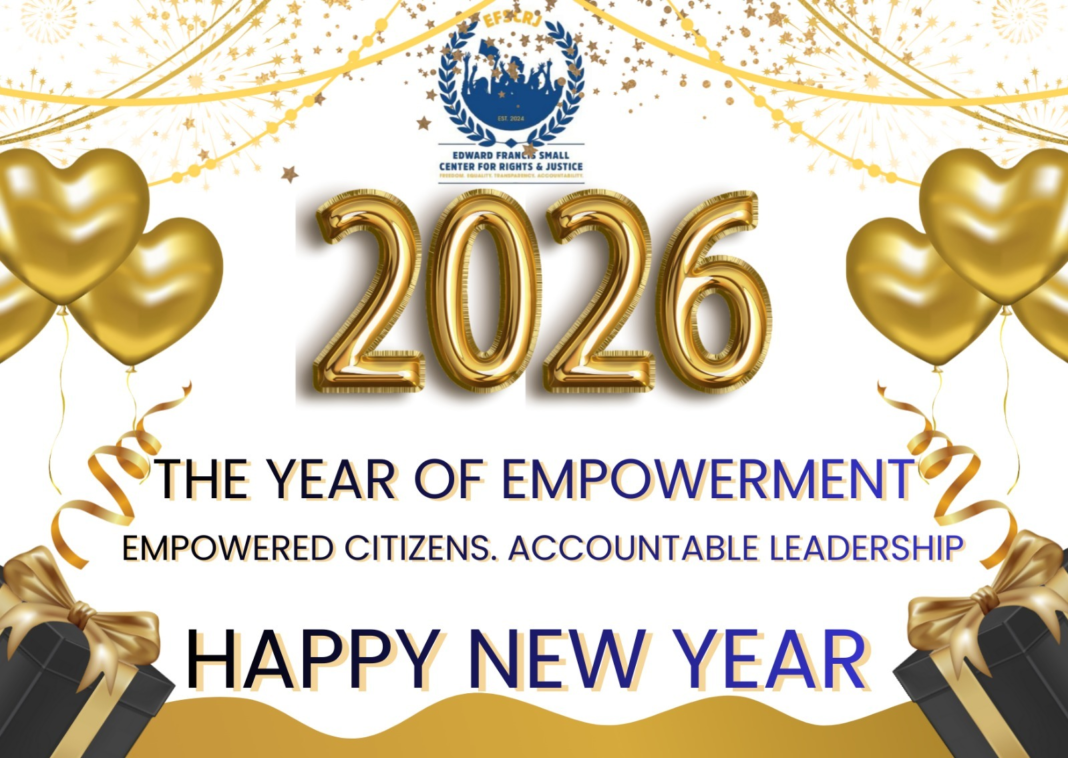
While we remain deeply concerned about the persistent deficits in transparency and accountability across the State, EFSCRJ hereby declares 2026 as “The Year of Empowerment.” This declaration does not diminish our commitment to transparency and accountability, which remain core and continuous objectives of the Centre.
Empowerment is a central pillar of EFSCRJ’s Strategic Plan 2025 – 2029, anchored on Empowering Citizens for Change. As the country enters a critical election year, culminating in the 2026 presidential elections, EF Small Centre will intensify its engagement in civic and voter education, community mobilization, and the strengthening of movements, groups, individuals, and organizations. Our aim is to enhance public understanding of human rights, democratic governance, public policy, and development, thereby building an informed and engaged citizenry capable of shaping its own destiny.
Through peaceful, non-violent, inclusive, and democratic means, EFSCRJ will seek avenues, partnerships and solidarity with all stakeholders to enlighten citizens on their rights and duties, the obligations of the State, and the lawful mechanisms available to defend rights, demand services, and hold public authorities accountable. Our empowerment drive is fundamentally geared toward strengthening democracy, upholding the rule of law, promoting peace and social cohesion, protecting human rights, and improving the delivery of quality public goods and services.
We underscore that empowerment is a product of enlightenment and organization. Accordingly, our work will focus on equipping citizens with knowledge and tools that enable them to organize, stand in solidarity, and actively participate in the defense of democracy and good governance. An empowered citizenry is indispensable to the realization of popular sovereignty and the determination of the Republic’s future.
Mindful that the Gambia only recently emerged from decades of brutal autocratic rule, and cognizant of the longstanding culture of self-perpetuating rule since independence, EFSCRJ will urge citizens to uphold the principle that no president should serve more than two terms. Self-perpetuating rule erodes democracy, weakens institutions, fuels corruption and abets human rights violations, deepens poverty and inequality, undermines peace and security, and entrenches impunity. In 2016, Gambians collectively resolved to end rule by one individual indefinitely. Where the political leadership fails to uphold this commitment, the responsibility now rests with citizens to defend this principle through their votes.
In this regard, we reiterate our call on Pres. Adama Barrow not to seek a third term in 2026 but to withdraw his candidacy and hand over the opportunity to another individual. Such a decision would not only serve to strengthen democracy and good governance in the Gambia, but it will also highlight his commitment to term limits that he promised in 2016.
As we embark on this national empowerment drive, EFSCRJ calls on all stakeholders be it civil society, the media, faith-based organizations, political actors, the private sector, traditional leaders, and development partners to intensify civic and voter education as the foundation of democratic empowerment.
Happy 2026 – The Year of Empowerment.