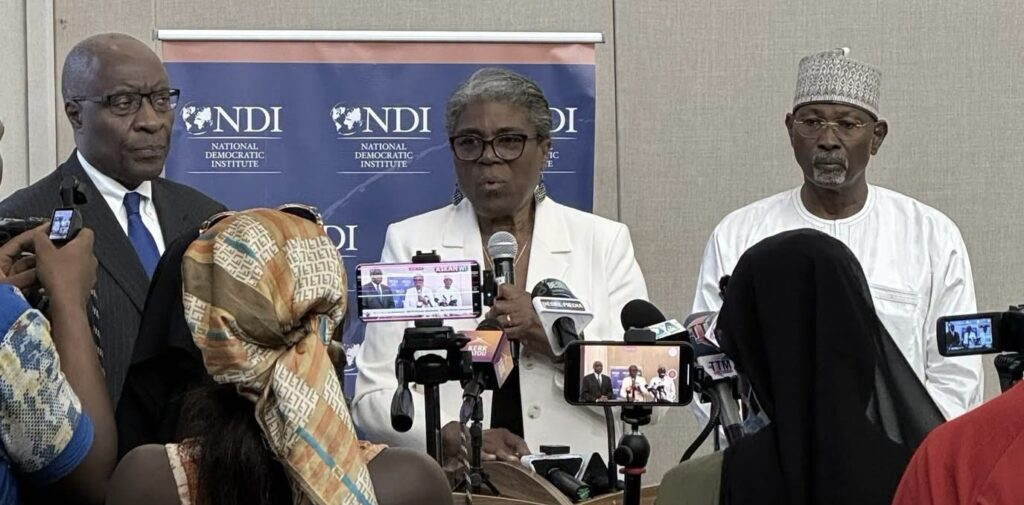
The National Democratic Institute (NDI) has urged The Gambia’s electoral authorities, political parties and government to take urgent steps to strengthen transparency, reduce political tensions and protect the credibility of the December 5 presidential election.
The recommendations follow an international Pre-Election Assessment Mission that visited The Gambia from August 24 to 28 and met with President Adama Barrow, potential presidential candidates, the Independent Electoral Commission (IEC), political parties, civil society organizations, security officials, media practitioners and other stakeholders.
The NDI said preparations for the election were generally progressing as planned, but warned that rising hate speech, ethnic rhetoric and misinformation could undermine an otherwise peaceful electoral process.
The mission said Gambians had experienced significant improvements in political, civic and media freedoms since the 2016 change of government. However, it found that key legal and constitutional reforms remain unfinished, with the 1997 Constitution still in force after two failed attempts to adopt a new constitution.
Voter Register Raises Concerns
One of the immediate issues highlighted by the mission is the voter registration process.
The IEC registered approximately 212,000 new voters during the 2026 supplementary registration exercise. However, the NDI said concerns had been raised about possible registration of underage voters and non-Gambians, particularly because of the continued use of attestations to establish citizenship.
The mission also noted that Revising Courts, which were expected to begin hearing objections to the provisional voter register in July, had not yet started sitting at the time of its visit. There were 1,694 attestation-related and other objections awaiting adjudication.
NDI urged the IEC to ensure that the courts sit without further delay and that a finalized voter register is made publicly accessible before the election.
Results Transparency
The mission also highlighted concerns surrounding the counting and announcement of election results, noting that errors during previous elections had damaged public confidence in the IEC.
The commission has indicated that it intends to improve transparency, including by projecting results on public screens at collation centers. NDI nevertheless called for results to be published quickly and accurately, disaggregated by polling station as they are announced.
The institute also encouraged the IEC to improve its communication through social media, particularly to reach younger voters, and to provide clearer information about the tabulation and collation process.
Rising Ethnic Rhetoric
Perhaps the strongest warning in the assessment concerns the growing use of identity politics.
The NDI said appeals to ethnic loyalties and attacks based on ethnic identity appeared to be increasing. During its five-day visit, the delegation was informed of four instances of online hate speech involving attacks by one ethnic group against another.
Several stakeholders, including civil society representatives and the police, identified hate speech and misinformation as among the greatest risks to a peaceful election.
The institute called on political parties, candidates and their supporters to reject statements and social-media content that could inflame ethnic tensions.
It also urged presidential candidates to sign a public peace pledge and called on parties to resolve electoral disputes through established legal mechanisms rather than through confrontation.
Campaign Financing and Alleged Voter Inducement
NDI also raised concerns about the lack of transparency surrounding political financing.
The assessment found that The Gambia has no comprehensive disclosure requirements for political donations or campaign funding. The mission also heard reports of alleged voter inducement, including the distribution of cooking equipment, jerseys and even ambulances during political activities.
According to NDI, the absence of clear regulations governing campaign spending could give wealthier parties an advantage and undermine a level playing field.
Women and Youth Remain Underrepresented
Despite strong voter participation, the mission highlighted the limited representation of women and young people in political institutions.
Women account for 52 percent of the population and 57 percent of registered voters, yet only five women occupy seats in the 58-member National Assembly.
Young people under 35 make up more than 75 percent of the population but remain significantly underrepresented in elected office. NDI identified campaign costs, traditional norms, party structures and limited opportunities as barriers to greater participation.
Media Freedom and Journalist Safety
The report also acknowledged improvements in media freedom while warning that restrictive laws remain in place.
The mission noted that comprehensive media reforms have stalled and that the Gambia Press Union has documented 18 cases of physical attacks against journalists in recent years that have not been investigated or sanctioned.
NDI urged the government to review laws affecting the media and ensure that journalists can operate freely. It also called on media organizations to strengthen fact-checking and responsible reporting to counter misinformation and hate speech during the election period.
Longer-Term Democratic Reform
Beyond the December election, NDI called for renewed efforts to reform The Gambia’s constitutional and electoral framework.
Its recommendations include strengthening the independence of the IEC, reviewing the appointment process for electoral commissioners, ending the use of attestations, introducing diaspora voting, regulating campaign financing and improving political representation for women, youth and other marginalized groups.
The institute also called for reform of the Public Order Act to protect freedom of assembly and urged the government to fully implement laws designed to strengthen civic and political freedoms.
The assessment comes as The Gambia enters a critical electoral period. With the presidential election scheduled for December 5, followed by National Assembly and local elections in 2027, NDI said protecting the country’s democratic gains will require political leaders, institutions, civil society and citizens to work together.
The central message of the assessment is that The Gambia has made significant democratic progress since 2016, but that progress remains vulnerable unless electoral transparency, political tolerance, institutional independence and constitutional reform are strengthened.
Source: National Democratic Institute – Gambia PEAM Statement