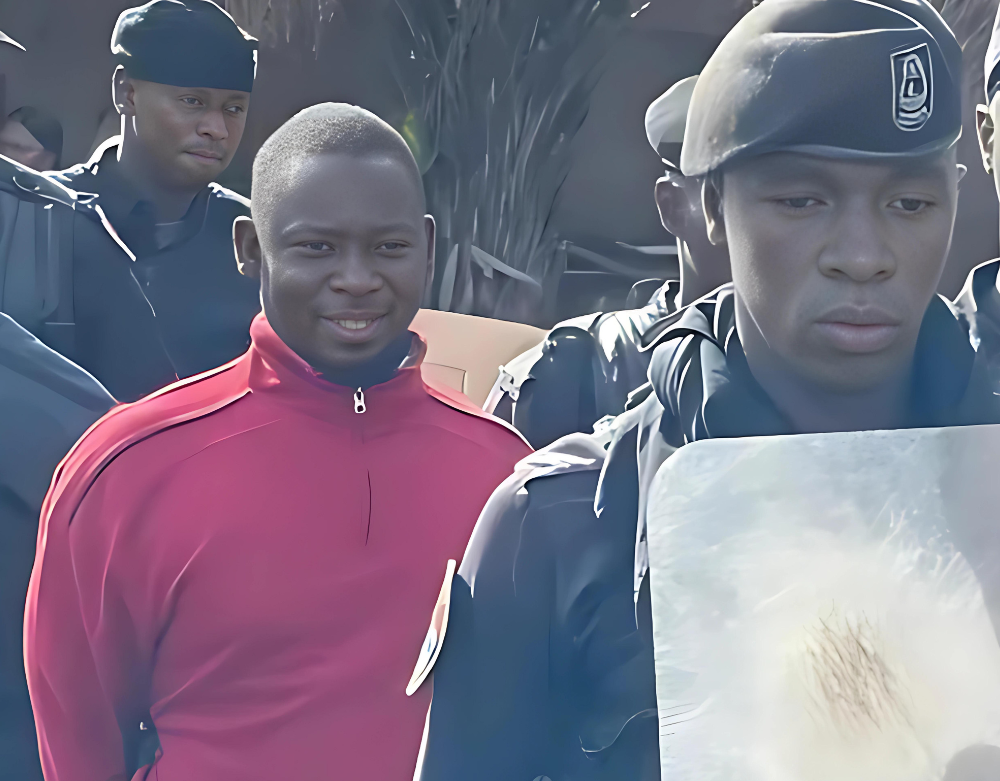
A Senegalese electrician, standing trial for the murder of Fatoumatta Kargbo, denies ever entering the bureau before the day of the incident, says three unknown men attacked him first; the defence argues the prosecution withheld the full CCTV recording.
The murder trial of Arona Tine took a turn at the High Court when the accused took the stand to give his account of the events of 19 January 2024, the day Fatoumatta Kargbo was fatally stabbed at a money transfer bureau in Westfield.
Tine, as the first defence witness before Justice Jaiteh, denied any involvement in Fatoumatta Kargbo’s death and told the court he was himself struck unconscious before she was stabbed. Before his testimony began, a dispute over CCTV footage briefly dominated proceedings.
Counsel Samuel Ade, appearing for Arona Tine, reminded the court that at the last adjourned date, the defence had filed a notice requesting the production of the full CCTV recording from the bureau. Ade told the court he had specifically asked for an extended version of the footage that would show the accused entering the premises.
He argued that the complete recording was in the possession of the prosecution but that only a portion of it had been tendered as evidence, suggesting the prosecution had selectively submitted what suited their case.
The state, represented by Counsel A. Gibba, rejected that characterisation. Counsel Gibba told the court that the prosecution could not produce what it did not have, and that what had been tendered was what the investigation provided.
Counsel Ade pressed the point, telling the court that a CCTV system running continuously for twenty-four hours would necessarily have captured the full sequence of events.
The prosecution maintained its position. Counsel Ade then stated for the record that the defence had formally requested the entire footage, and that request remained unmet.
With the preliminary dispute noted, the defence then called Tine to open his defence. He chose to testify in Wolof. He told the court he lives in Willing Kama and works as an electrical engineer, handling wiring, generators, and solar systems through his own registered company. He said he is married with two children, a daughter aged eleven and a son aged seven.
Tine said he knew the area around the Westfield bureau well, not because he had ever used it, but because a building materials shop nearby was a regular stop for him as part of his work. He told the court that it was the only reason he was familiar with that stretch of road.
On the events of 19 January 2024, Tine said he left a location and went to the bureau to send money to his brother in Senegal. He said he greeted Fatoumatta Kargbo, the female attendant, when he entered and explained that he wanted to send money to Senegal.
She told him she did not handle Wave transfers to Senegal personally, but could contact someone who could assist. While they were arranging that, Tine said three men entered the bureau in quick succession.
He told the court that one man stood to his left, another to his right, and the third positioned himself behind him. The man on his right told him to be patient and allow the woman to attend to them. A separate man then asked Tine for the time. As Tine looked down at his wristwatch, he said he was struck on the eyebrow with a heavy blow and lost consciousness.
“The blow was so heavy that I could not tell whether it was a stone or something else,” Tine told the court
Arona Tine told the court he was disoriented and lying on the ground. He said he saw Fatoumatta Kargbo moving toward the exit before she collapsed. He heard people outside shouting that a woman had been stabbed. He said he then saw a knife on the floor of the bureau.
As he lay there, Tine said a crowd gathered outside and began threatening to kill him. In a state of confusion and fear, he said he picked up the knife and told the crowd he would take his own life before allowing them to harm him.
He said vendors and bystanders outside, including people selling food nearby, moved toward him with hostile intent. He placed the knife blade against his throat and wounded himself, after which the crowd backed away. He lost consciousness again.
Arona Tine said the next thing he knew, he was at Ndemban Clinic. A Police Intervention Unit officer told him he had been involved in an incident and had been brought to the hospital. He said he received stitches for his wound.
Later that same day, he was referred to a hospital in Banjul, where he was told his blood level was critically low. His wife was contacted, and blood was sourced from the Jammeh Foundation. He was transferred to the Serrekunda Police Station.
At the police station, Tine told the court that he was handed over to PIU officers with his medication. He said he was informed he needed to eat before taking his medicine, but that the medicine could not remain with him in the cell and was taken away.
He also noted that he had scars on his wrists from being handcuffed, and said it was the first time in his life he had been placed in handcuffs.
On the question of the D110,000 he said he brought with him to the bureau, Tine told the court that when a CID officer returned his bag to him at the clinic, the officer told him no money had been found inside.
Tine told the court he is Senegalese but described The Gambia as home. He said he first arrived in 2013 and was awarded a contract by Gambega, which led to his settling here permanently. He said he had since worked with the American Embassy and the World Bank, among other organisations, and had never had a problem with the law either in The Gambia or in Senegal. He described the charges against him as a heavy burden.
When reminded of the charges and asked whether he had ever been to the bureau before the day of the incident, Tine said he had not. He acknowledged that he had entered the bureau on 19 January 2024 but maintained that it was his first and only time.
Swearing on the Holy Quran, he denied touching Fatoumatta Kargbo.
“I have sworn on the Holy Quran. I did not touch Fatoumatta Kargbo, and we were not even close. That was the first day I saw her.”
Cross-examination of the accused is scheduled to continue on 1 July 2026 at noon.
See less