President Adama Barrow is leading the latest presidential voting-intention survey conducted by Gambia Participates, but the findings indicate that the race remains open ahead of The Gambia’s December 5, 2026 election.
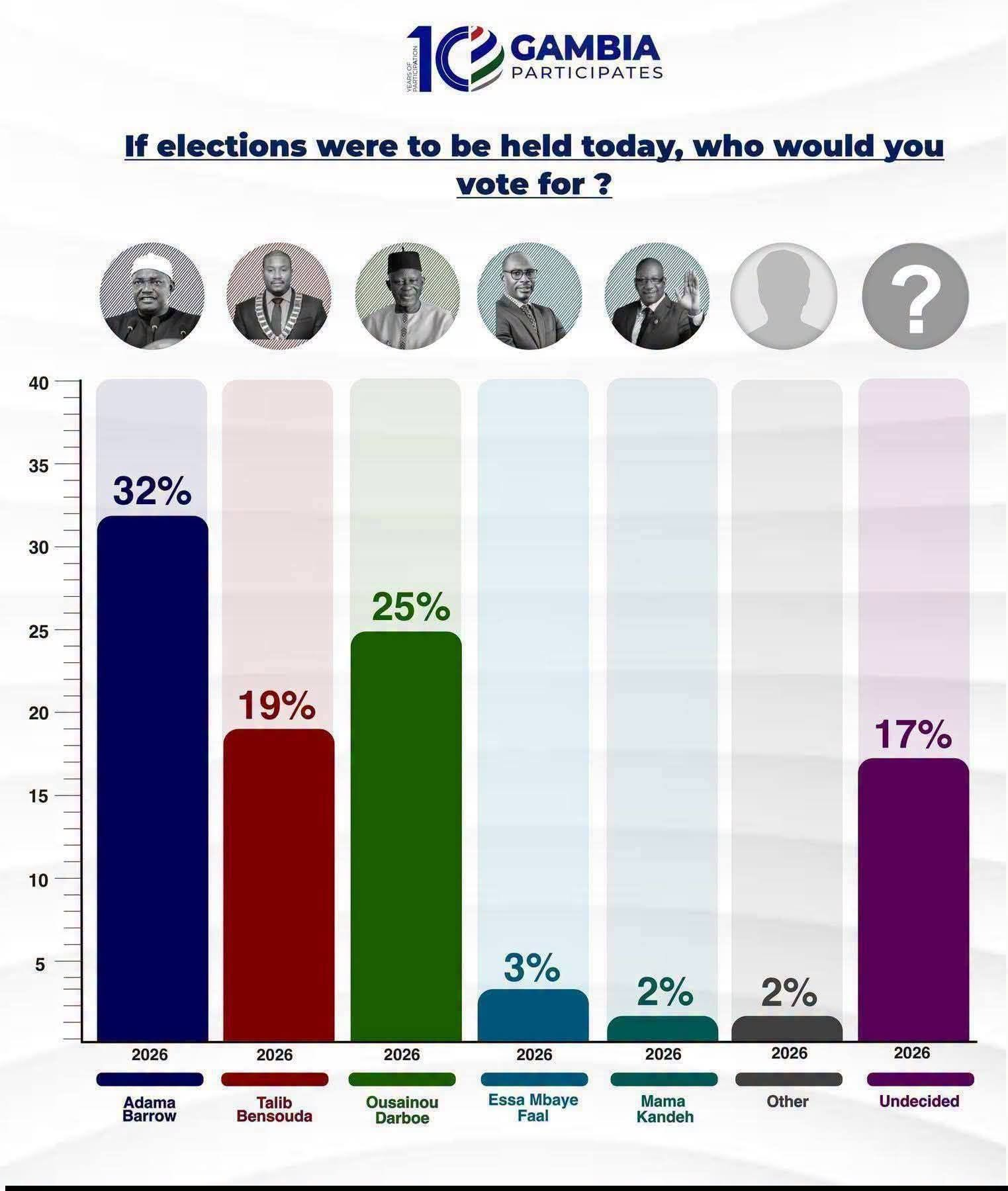
According to the survey, 32 percent of respondents said they would vote for Barrow if the election were held today. United Democratic Party (UDP) leader Ousainou Darboe followed with 25 percent, while Coalition 2026 flag bearer Talib Ahmed Bensouda recorded 19 percent.
The poll also placed former presidential candidate Essa Mbye Faal at 3 percent, while Gambia Democratic Congress leader Mama Kandeh received 2 percent. A further 2 percent said they would support other candidates.
Significantly, 17 percent of respondents remained undecided, representing a substantial portion of the electorate whose eventual choices could have a major impact on the outcome.
The figures suggest that no candidate currently commands a majority of voter support. Barrow leads Darboe by seven percentage points, while Bensouda remains within striking distance of the UDP leader, highlighting the increasingly competitive nature of the presidential contest.
Gambia Participates said its August 2026 poll is the second round of its presidential election opinion polling programme. The organisation said the exercise is intended to track citizen sentiment, monitor candidate performance and examine developments in the political landscape ahead of the election.
The survey comes as opposition parties continue to realign and form political alliances. Coalition 2026 recently formalised its opposition alliance with Bensouda as its flag bearer, adding another major contender to an already crowded presidential field.
The 17 percent undecided figure could become particularly important as campaigning intensifies. Candidates will be competing not only to retain their existing support but also to persuade voters who have yet to make a final decision.
Gambia Participates has stressed that its poll should be understood as a snapshot of public opinion rather than a prediction of the election result.
With more than three months remaining before polling day, the survey points to a potentially competitive three-way contest, while leaving a significant bloc of undecided voters capable of influencing the final outcome.