
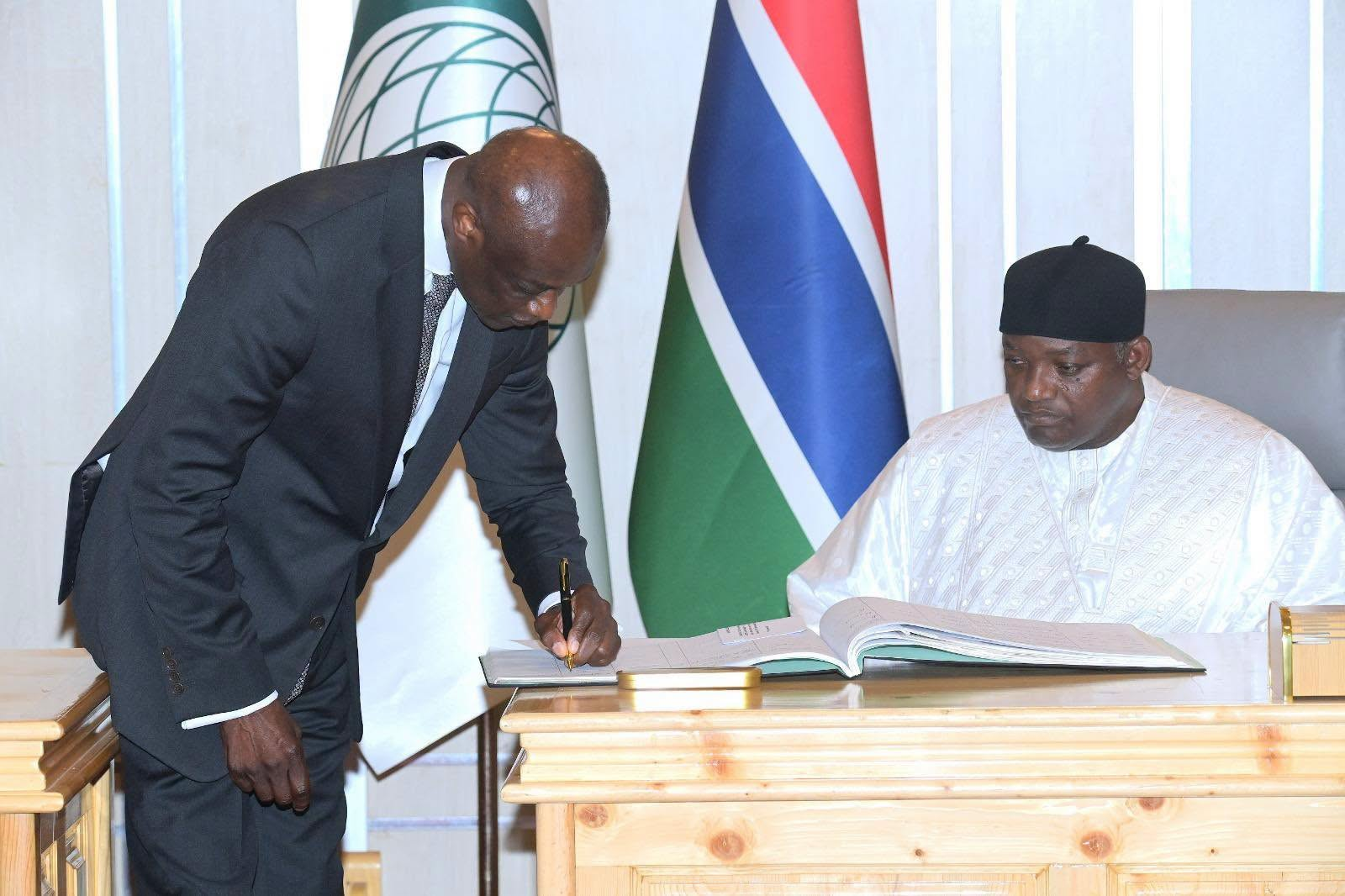
A group of lawyers called the Gambia Law Society today held a press briefing and took a position that the appointment of Edi Faal as Chief Justice is constitutionally correct. The Gambia Law Society represents lawyers in private practice.
The Gambia Law Society has declared that Chief Justice Ediissa M.O. Faal is constitutionally eligible to hold office and is entitled to continue discharging his responsibilities while the constitutional challenge proceeds through the courts.
The statement, issued on August 11, 2026, was read by Counsel L.K Mboge on behalf of the members, disagreeing with the position of the Gambia Bar Association, which filed a constitutional challenge on July 31, questioning whether Edi Faal meets the qualifications in Section 139 of the 1997 Constitution.
The Law Society’s position creates a split within Gambia’s legal institutions; two major bar organisations have reached opposite conclusions on the same constitutional question.
The Law Society states that it has “considered the circumstances surrounding the appointment” and holds “a different view” from the Bar Association. The Law Society’s key arguments during the press briefing are
First, the Judicial Service Commission considered the eligibility question before the appointment was made and “was satisfied that the appointee, Edrissa M.O. Faal, met the applicable constitutional requirements.” The Law Society attaches “due significance” to that institutional determination.
Second, the Society recognises that “membership of the legal profession does not compel unanimity of opinion.” The views advanced by some members of the Bar Association should not be understood as representing every lawyer in The Gambia. “Professional independence permits disagreement, provided that such disagreement is expressed with civility, restraint and respect.”
Third, the Law Society affirms Edi Faal’s eligibility: “It is our considered view that the Chief Justice, Edrissa M.O. Faal, is eligible to hold the office to which he has been appointed, and we support his continuation in office while the constitutional process takes its course.”
The Law Society emphasises that its support for Edi Faal is neither political nor personal: “Our position is neither political nor personal,” the statement reads. “It is not directed against the Gambia Bar Association or against any colleague who has reached a different conclusion.”
The Law Society notes that “reasonable lawyers, approaching the same constitutional provisions conscientiously, may sometimes arrive at different interpretations. Such disagreement is not a weakness of the profession; when conducted responsibly, it is one of the attributes of an independent Bar.”
The Law Society’s statement frames the disagreement as a legitimate constitutional debate, not a conflict of personalities or motives. The Law Society affirms its confidence in the Supreme Court to resolve the constitutional questions.
“Now that the matter has been placed before the Supreme Court, the appropriate forum for the resolution of the constitutional questions raised is the Court itself. We have confidence that the issues will be considered objectively and determined according to the Constitution, the law and established principles of constitutional interpretation.”
The Society reaffirms its commitment to the rule of law, judicial independence, and institutional integrity: “Above all, we reaffirm our commitment to the rule of law, judicial independence, institutional integrity and the right of every lawyer to exercise independent professional judgment.”
The Law Society does not explicitly detail its interpretation of Section 139(5)(b), but suggests that non-Commonwealth common law countries like the United States qualify without requiring Parliament to formally prescribe them first; that Section 139(5)(b) grants Parliament the power to prescribe non-Commonwealth countries, but does not make prescription a mandatory prerequisite.
The Bar Association, by contrast, argues that Parliament must formally prescribe the United States before American legal experience can count toward Chief Justice qualifications.
Edi Faal remains Chief Justice. The Supreme Court has not yet set a hearing date for the Bar Association’s challenge. The Attorney General and Faal’s legal representatives are expected to file responses to the GBA’s petition.
The Law Society’s statement concluded with a supportive message to the Chief Justice
“We therefore respect our support for the Chief Justice and for his continued discharge of the responsibilities of his office while the constitutional process takes its course,” the Society states.
The case will ultimately be decided by the Supreme Court. The legal profession is not united against Edi Faal’s appointment, and lawyers hold different views on the constitutional question at stake.
The Gambia Law Society represents lawyers in private practice. The Gambia Bar Association, which filed the constitutional challenge, represents judges and legal practitioners. Both organisations have now publicly stated their positions on Edi Faal’s appointment