

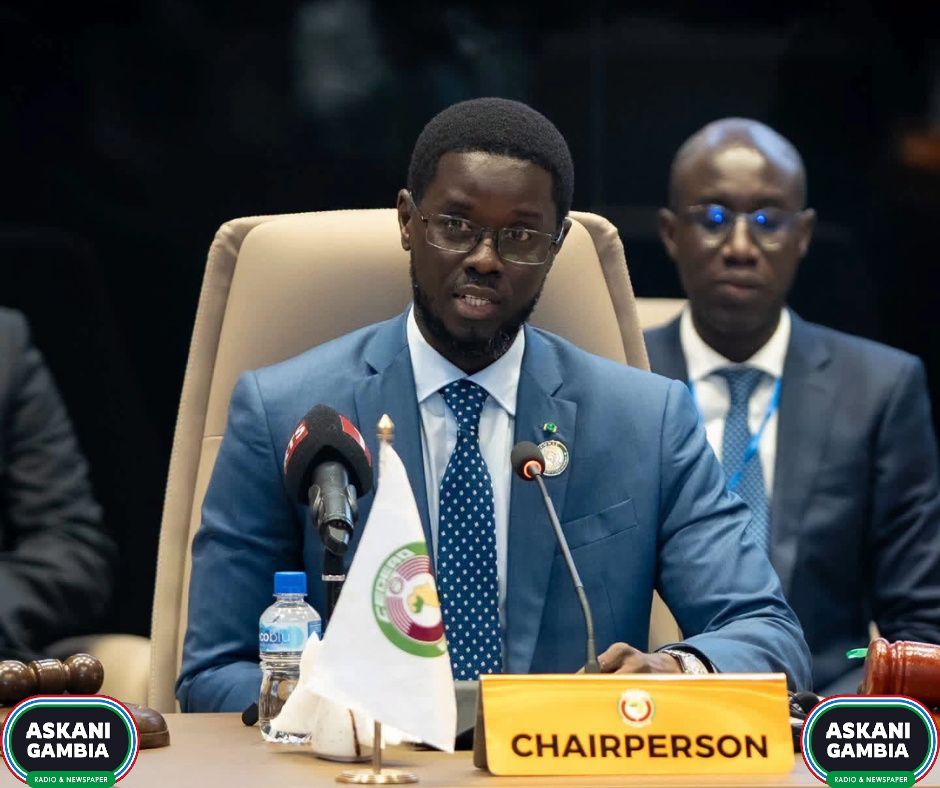

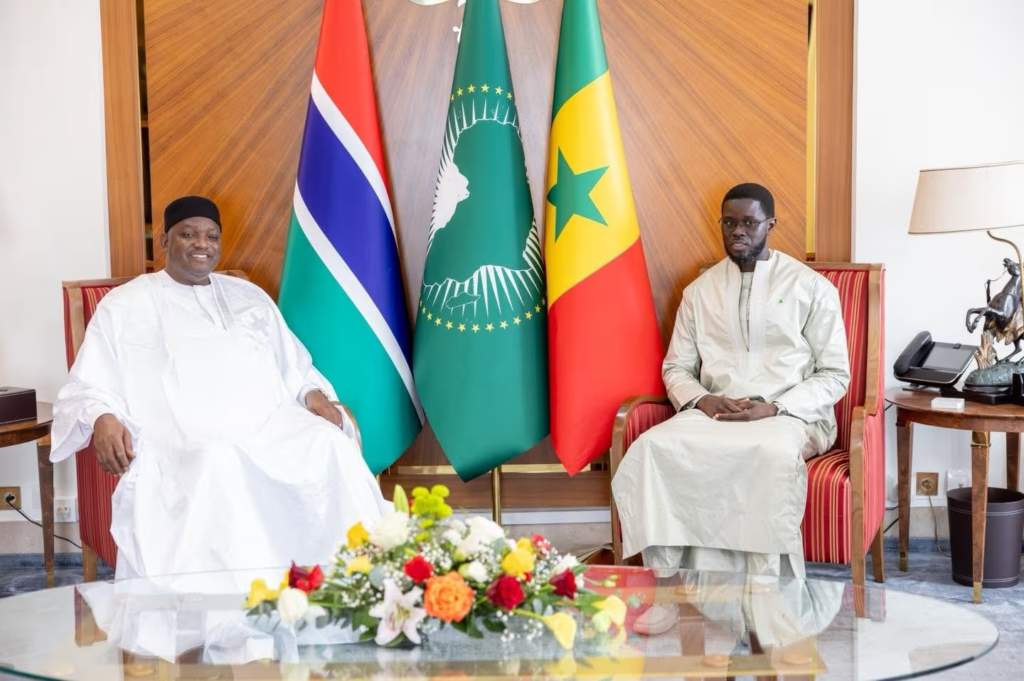
Senegalese President Bassirou Diomaye Faye has been chosen as the new Chairman of the ECOWAS Authority of Heads of State and Government, succeeding Sierra Leone’s President Julius Maada Bio.
The leadership change was announced on Sunday at the 69th Ordinary Session of the ECOWAS Authority in Freetown, where regional leaders considered security, democratic governance, trade and economic integration. General Birame Diop of Senegal is also expected to succeed The Gambia’s Dr Omar Alieu Touray as President of the ECOWAS Commission for the 2026–2030 term.
Faye’s elevation is striking because he has been Senegal’s president only since April 2024, while Gambian President Adama Barrow has governed since January 19, 2017. Barrow has therefore been in office for approximately nine and a half years—not yet a full ten years—compared with Faye’s little more than two years.
President Faye is ECOWAS preferred choice over President Barrow
The ECOWAS chairmanship is normally decided by the regional heads of state within a system influenced by rotation, consensus and diplomatic negotiations. Previous ECOWAS communiqués show leaders being selected for one-year terms, while earlier decisions also recognised the principle of rotating the position among member states. Seniority in office does not automatically entitle a president to become chairman.
There is also no publicly available evidence that Barrow formally presented himself as a candidate and was rejected. The Gambia has already occupied another important regional position through Dr Omar Touray, whose appointment as ECOWAS Commission president for 2022–2026 was approved after that office was allocated to The Gambia.
Faye’s selection should therefore be understood partly as an institutional and diplomatic decision, rather than as a simple judgment that one president is better than another.
Two contrasting leadership styles
Faye represents a younger, more technocratic and reform-oriented generation of West African leadership. Before entering frontline politics, he worked as a tax inspector. He holds a master’s degree in law from Cheikh Anta Diop University and passed the competitive entrance examination for Senegal’s prestigious National School of Administration, where he specialised in taxation. Reuters has described his public personality as austere and restrained compared with the more combative style of his former political ally Ousmane Sonko.
He entered office promising transparency, institutional reform, economic sovereignty and a stronger campaign against corruption. His calm presentation, professional civil-service background and emphasis on African cooperation have helped Dakar market him as a possible bridge between the remaining ECOWAS countries and Burkina Faso, Mali and Niger. Faye was previously assigned a mediation role as ECOWAS attempted to maintain dialogue with the three Sahelian governments.
That does not mean his domestic presidency has been without difficulties. Senegal continues to face debt, unemployment and financial pressures, while political disagreements between Faye and Sonko have complicated the reform programme. His ECOWAS appointment is consequently a vote of regional confidence, but not proof that all his domestic promises have been fulfilled.
Barrow’s leadership has followed a different path. He entered politics as a businessman and compromise candidate selected by an opposition coalition to remove former President Yahya Jammeh. His style has generally been soft-spoken, pragmatic and less ideological.
His administration initially reopened political space, restored relations with international institutions and improved several civil liberties following more than two decades of authoritarian government. However, Barrow has also been criticised over corruption, incomplete constitutional reforms and pressure on journalists and civil-society organisations.
His decision not to honour the coalition’s original three-year transition agreement also changed public perceptions of his leadership. He subsequently established the National People’s Party, contested the 2021 election and secured a second constitutional term. Although Barrow later promised a new constitution containing presidential term limits, the prolonged constitutional reform process has remained a source of political controversy.
Barrow and Faye’s educational backgrounds
The contrast between the two presidents is particularly visible in their formal education.
Publicly documented profiles show that Barrow attended Crab Island Secondary School and Muslim High School before entering employment. He later travelled to London, where he pursued studies or professional qualifications connected to real estate while working to support himself. Available biographical records do not identify an earned university bachelor’s, master’s or doctoral degree.
Faye, by comparison, received university and elite civil-service training directly connected to law, public administration, taxation and the management of government institutions. That academic and professional background may strengthen his confidence when negotiating complicated economic, legal and regional policy issues.
Barrow also has less extensive formal academic training than several other current civilian leaders in the region. Côte d’Ivoire’s Alassane Ouattara holds a doctorate in economics; Liberia’s Joseph Boakai earned a bachelor’s degree in business administration; Ghana’s John Mahama studied history, communications and social psychology; Nigeria’s Bola Tinubu trained as an accountant; and Sierra Leone’s Julius Maada Bio holds a master’s degree in international affairs.
This places Barrow among the less academically qualified civilian presidents in West Africa. Nevertheless, academic qualifications alone do not determine whether someone can govern effectively. ECOWAS does not require its chairman to possess a university degree. Political judgment, integrity, diplomatic influence, institutional credibility and the ability to build consensus are equally important.
Why Faye was an attractive choice
Several factors probably worked in Faye’s favour.
Senegal is one of the region’s most influential diplomatic and military states. It has historically maintained comparatively strong institutions and has played important roles in regional peacekeeping and mediation. Faye also entered office with fresh electoral legitimacy following Senegal’s peaceful 2024 transfer of power.
His administration then conducted an active diplomatic campaign for Senegal to lead the ECOWAS Commission. Senegal’s foreign minister travelled to regional capitals seeking support for General Birame Diop, demonstrating preparation, coordination and a clear regional strategy.
Barrow’s long stay in office was therefore not necessarily an advantage. Regional organisations sometimes prefer a leader with new political energy, strong diplomatic backing and the ability to communicate with governments that have become suspicious of ECOWAS.
The real lesson for The Gambia is not simply that Faye has more academic qualifications. It is that regional influence must be deliberately cultivated through credible institutions, clear foreign-policy priorities, diplomatic engagement and a leadership record that inspires confidence beyond national borders.
Faye now faces the harder task of converting regional confidence into results. His success will be measured by whether he can reunite a fractured West Africa, confront terrorism, protect constitutional government and make ECOWAS more responsive to the economic difficulties confronting ordinary citizens.
By Salieu Njie


