
We wish to first commend the Center for Policy, Research, and Strategic Studies (CepRass) for releasing the National Opinion Poll 2025. We welcome the conduct of such polls as they provide immediate yet tangible, relevant, and timely information about the state of affairs in the country, therefore useful for various stakeholders. The issues raised are relevant to the peace and stability of this country highlighting as they highlight challenges of governance, leadership, constitution building, economy, elections, transparency, and accountability.
These issues are all relevant and central to the mandate of not only EFSCRJ, but also the government, civil society, and citizens alike. The findings indeed concern us which validates our position that the Gambia needs a halt and a reversal from its current trajectory and place itself on the path of good governance and sustainable development.
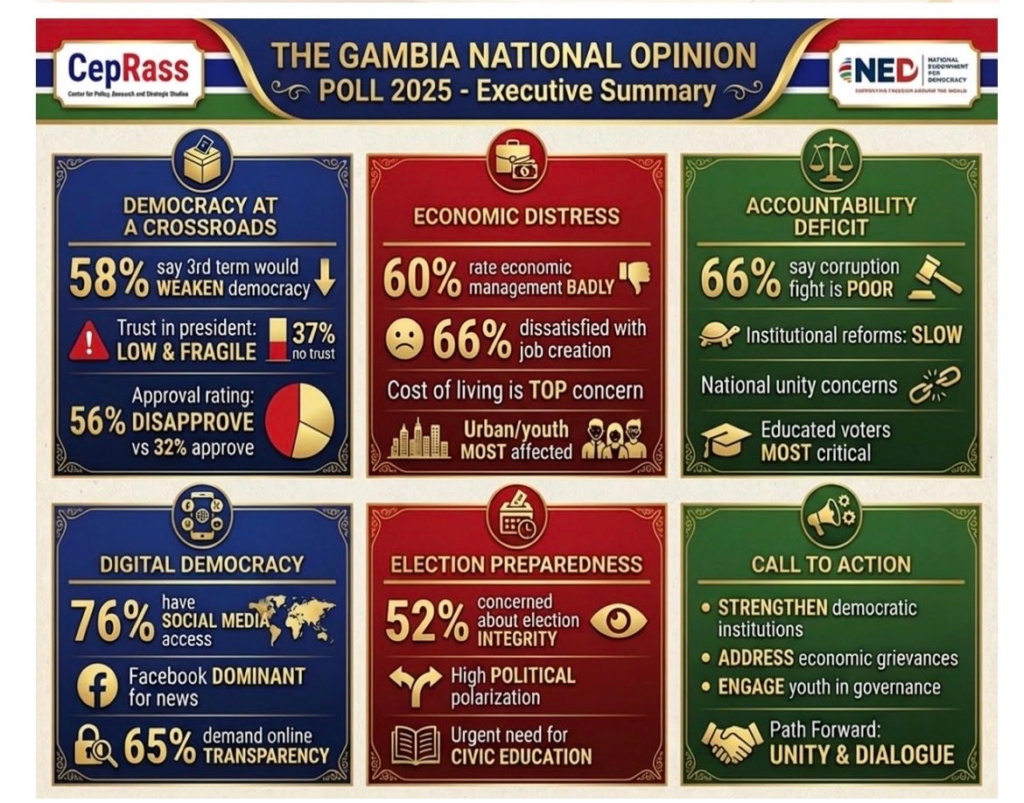
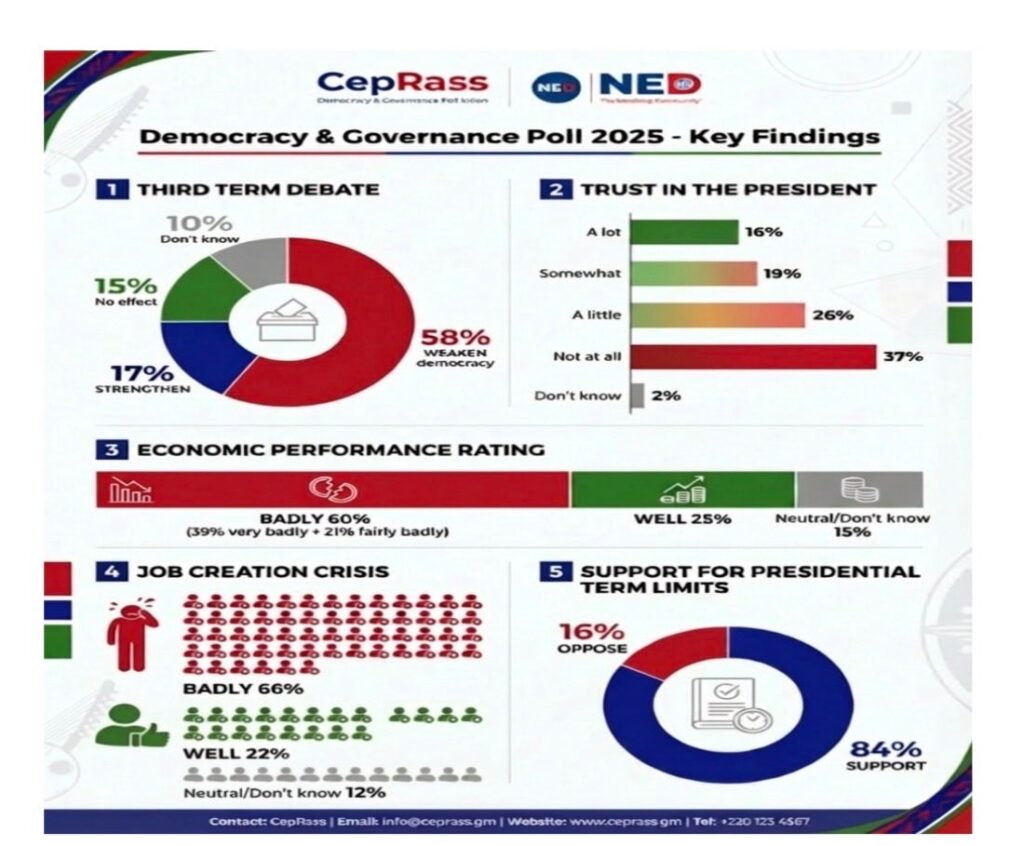
We are concerned that only 16% of Gambians have trust in President Barrow, with 37% lacking any iota of trust, while 45% only trust him ‘somewhat’ or ‘a little’. Trust or the lack of trust in a president is not only a major democratic feature but also it impacts heavily on public trust and confidence in the government itself which is a key requirement for peace and stability. When citizens lose trust in a president it means they perceive him to be not acting in the best interest of the nation but for self and other interests. This does not augur well as it reflects frustration emanating from perceptions of failures, inefficiency, or corruption of not only the president but also of the government that he leads.
We note with concern that most Gambians (60%) say the economy is badly managed with 66% saying the government is doing poorly in job creation, with cost of living featuring as a top concern. Further, two-thirds of citizens say the government is doing badly in fighting corruption. Citizens rate the government’s performance on national unity and institutional reform poorly, citing polarization, uneven development, and slow or ineffective reforms thereby undermining confidence in the democratic transition. In terms of election, more than half of Gambians (52%) have doubts about the credibility of elections, as serious concerns persist around vote-buying, unequal campaign conditions, weak enforcement of electoral laws, and the credibility of the voters’ register.
On the thorny issue of presidential term limits, an overwhelming majority (84%) support a two-term limit citing that “a president seeking a third term would undermine democracy in The Gambia.” Yet Pres. Barrow willfully decides to run for a third term in total disregard of his own 2016 campaign promise, the 2016 Coalition MoU as well as his expressed commitments to two-terms when he inaugurated the Constitutional Review Commission in 2018.
The poll findings send a strong and unambiguous message: Gambians remain politically engaged and committed to democracy, but they are increasingly dissatisfied with governance outcomes.
EFSCRJ views these findings as a democratic early-warning signal. They confirm what citizens, civil society, and independent analysts have long observed that the democratic transition remains incomplete, and public patience is wearing thin. The electorate is informed, demanding, and no longer willing to accept symbolic reforms without tangible outcomes.
EFSCRJ Recommendations
To the Government
- Publicly recommit to presidential term limits and abandon any actions or narratives that undermine constitutionalism.
- Deliver urgent economic relief, especially on cost of living, youth employment, and livelihoods, with transparent and measurable targets.
- Demonstrate genuine political will against corruption by urgently resourcing the Anti-Corruption Commission and all independent bodies and ensure their total independence.
- Accelerate institutional and constitutional reforms, particularly those enhancing checks and balances, oversight, and public sector accountability.
- Promote national unity through inclusive governance, equitable development, and non-polarizing political leadership.
To the Independent Electoral Commission (IEC)
- Strengthen institutional independence and operational transparency ahead of 2026.
- Ensure a credible, accessible, and transparent voter registration process, including public scrutiny of the voters’ register.
- Enforce electoral laws impartially, especially on vote-buying, abuse of incumbency, and campaign finance.
To Political Parties and Candidates
- Respect term limits and constitutional norms as non-negotiable democratic principles.
- Engage citizens on concrete policy alternatives, particularly on the economy, jobs, and corruption.
- Pursue issue-based campaigns and peaceful competition, rejecting divisive, ethnic, or sectarian politics.
- Recognize the importance of coalition-building, as no single political formation commands overwhelming national support
To Civil Society and the Media
- Intensify civic and voter education, particularly among women, youth, and rural communities.
- Use evidence-based advocacy, including opinion polls, to hold duty-bearers accountable.
- Safeguard media freedom and responsible digital discourse, recognizing social media as a key source of political information for over three-quarters of citizens
Conclusion
The National Opinion Poll confirms that Gambians are not disengaged, rather they are demanding results. The 2026 elections will not merely be a contest of personalities, but a referendum on economic justice, integrity, constitutionalism, and the credibility of the democratic process. EFSCRJ calls on all stakeholders to treat these findings with the seriousness they deserve and to act decisively in the national interest.
2026 – Year of Empowered Citizens. Accountable leadership. A Democratic Gambia.