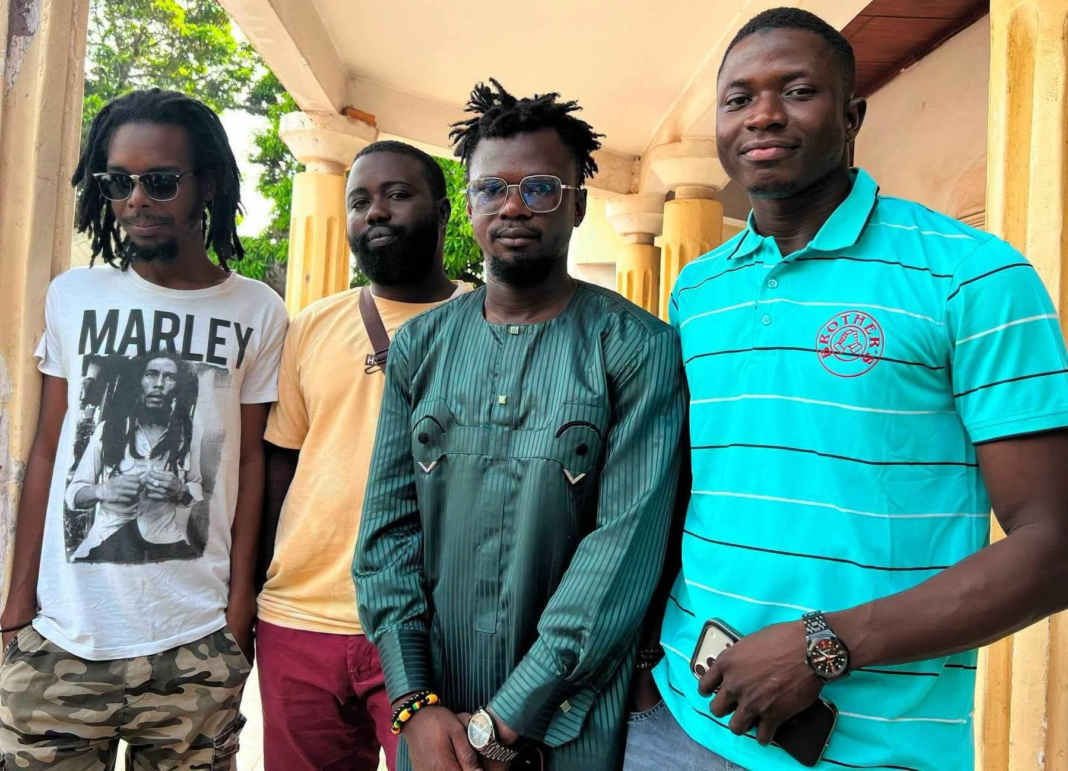
Kanifing Magistrates’ Court rules in favour of a no-case submission on both unlawful assembly and common nuisance charges; orders acquittal and discharge of all accused. Principal Magistrate Sallah Mbai has acquitted and discharged three GALA members by ruling that the prosecution failed to establish a prima facie case against the accused persons, highlighting that criminal liability cannot be built on “suspicion, conjecture, or public perception”.
The case arose from an incident on September 15, 2025, at the National Audit Office. The three accused persons, Kemo Fatty, Alieu Bah, and Omar Saibou Camara, had been charged with unlawful assembly contrary to section 63 of the Criminal Offences Act 2025 and common nuisance contrary to section 137(1) of the same Act.
The case presided over by Her Worship Sallah Mbai, Principal, arose from an incident involving journalists and civil society members who gathered outside the National Audit Office to protest or express public dissatisfaction over the controversial removal of the Auditor General.
Following their arrest, the Inspector General of Police (IGP) arraigned them before the Kanifing Magistrate Court on two criminal counts under the Criminal Offences Act, 2025.
Count One: Unlawful Assembly
The prosecution alleged that on 15 September 2025, at the National Audit, the accused persons conducted themselves in a manner likely to cause a breach of the peace by holding an unlawful protest against the removal of the Auditor General without a permit from the Inspector General of Police.
Count Two: Common Nuisance
The second count alleged that by the same conduct, the accused persons caused annoyance, obstruction, or inconvenience to the public. The accused pleaded not guilty to both counts.
The prosecution called four witnesses to support its case. The first officer (PW1), Superintendent Dawda Jallow, testified that he received information about a gathering at the National Audit Office and proceeded to the scene with approximately fifty police officers. Upon arrival, he found journalists conducting a press conference and instructed them to disperse, which they did. However, PW1 stated that another group later arrived intending to hold a press conference.
When asked whether they possessed a permit, they replied that they did not. PW1 further testified that the accused person, Alieu Bah, returned and insisted on his right to gather and express dissatisfaction.
Under cross-examination, PW1 admitted several critical facts: the accused persons were not present when he initially arrived; none of the accused persons prevented police officers from entering the premises; and the reason for arrest was the accused persons’ insistence on holding a press conference without a permit.
The second officer (PW2), Superintendent Modou Lamin Korta, testified that he proceeded to the National Audit Office and observed a gathering of approximately twenty to thirty persons, including the accused person, Omar Saibou Camara.
He stated that Alieu Bah later returned and remained near the gate, insisting he had a right to be there.
Under cross-examination, PW2 admitted that police officers maintained unrestricted access to the National Audit Office throughout the incident, were stationed both inside and outside the premises, and that Alieu Bah was standing in a public place when arrested.
PW3, ASP Landing Bojang, testified that he was deployed with PIU officers to the National Audit Office and joined efforts to persuade the gathering to disperse. According to his account, the gathering refused to leave, and he eventually ordered the deployment of tear gas.
Under cross-examination, PW3 admitted that he did not personally arrest any of the accused persons, did not know where each accused was arrested, and did not know the specific reason for each arrest.
PW4, Sub-Inspector Ousman Colley, testified as part of an investigation panel headed by ASP Demba Jobe. He stated that the accused persons were asked to disperse but refused and were arrested because they did not possess a permit from the Inspector General of Police.
Under cross-examination, PW4 admitted that his knowledge of the event was derived entirely from information supplied by others during the investigation; he was not present at the National Audit Office on the day of the incident.
At the closure of the prosecution case. Defence counsel L.S. Camara submitted that the prosecution had failed to establish a prima facie case on either count. Counsel Camara argued that none of the prosecution witnesses led evidence establishing the essential ingredients of unlawful assembly as defined under section 62 of the Criminal Offences Act.
He further argued that there was no evidence demonstrating that the accused persons caused annoyance, obstruction, or inconvenience to the public to constitute a common nuisance.
Counsel Camara cited the landmark case R v Galbraith (1962) and other authorities dealing with submissions of no case to answer, submitting that the prosecution had failed to satisfy the legal threshold required to compel the accused to enter their defence.
The prosecution led by Commissioner Sanneh countered that a prima facie case had been established. The prosecution argued that the accused persons assembled in a group, intended to pursue a common purpose, and refused lawful instructions to disperse despite not possessing a permit.
Commissioner Sanneh relied on sections 62 and 63 of the Criminal Offences Act, section 5 of the Public Order Act, and section 25 of the Constitution in support of its case.
Commissioner Sanneh urged the Court to call upon the accused persons to enter their defence.
Legal analysis and her reasoning. Principal Magistrate Sallah Mbai applied the historic common law threshold established in R v Galbraith [1981] and Section 215 of the Criminal Procedure Act. She emphasised that the burden of proof rests entirely on the prosecution and never shifts.
On the unlawful assembly (Count One). Magistrate Sallah Mbye said that to establish unlawful assembly under Section 62, the prosecution had to prove a gathering of three or more persons, a shared common purpose, and conduct creating an objectively reasonable apprehension of violence or disorder.
Magistrate Sallah analysed that while the first two elements were met (an assembly with a shared purpose to address the media), the third element, the crux of the offence, was completely vacant.
Magistrate Sallah Mbye noted that PW1’s claims of a “chaotic” environment lacked any particulars of actual violence, threats, or property damage. Furthermore, Magistrate Sallah Mbye rejected the prosecution’s attempt to use the Public Order Act (regarding missing permits) to satisfy the elements of the Criminal Offences Act.
“An assembly does not become unlawful… simply because it is unlicensed,” Magistrate Sallah Mbai stated. “The absence of a permit under the Public Order Act is not an ingredient of unlawful assembly under sections 62 and 63 of the Criminal Offences Act.”
On Common Nuisance (Count Two). Magistrate Sallah Mbye said that for the charge of Common Nuisance to stand under Section 137(1), the prosecution was required to prove that the accused committed an act not warranted by law that endangered public safety or obstructed public rights.
Magistrate Sallah Mbye’s analysis found that the prosecution fell completely short of that benchmark. Magistrate Mbai highlighted that the prosecution failed to call a single independent witness from the public. No pedestrian testified to being obstructed, no motorist complained of blocked roads, and no employee stated that entry to the National Audit Office was denied. Because police witnesses admitted they maintained unrestricted access to the building, there was no evidential basis to infer public obstruction.
Magistrate Sallah Mbai also threw out PW4’s testimony entirely, ruling that a court cannot rely on inadmissible hearsay to establish a prima facie case.
Before rendering the final orders, Magistrate Sallah Mbai clarified its structural position. Magistrate Sallah Mbai noted that the ruling was not a judicial endorsement of the activists’ behaviour nor a finding that the police acted unlawfully. Instead, it was a strict application of criminal justice principles. She reiterated that calling upon the defence to answer such an empty case would unconstitutionally force the accused persons to “fill a gap in the prosecution’s case”.
Concluding that the prosecution evidence on both counts fell squarely within the first limb of Galbraith, where essential ingredients of an offence are completely unsupported by evidence, the court decisively halted the trial.
“The no-case submission filed by defence counsel, L.S. Camara, on behalf of all accused persons is hereby upheld on both Count One and Count Two. Accordingly, all three accused persons are acquitted and discharged.”
Following the ruling, police prosecutor inspector Baba Jallow took the floor. He informed the court of the prosecution’s intention to appeal the ruling. Inspector Jallow applied to the court to place the acquitted person on bail, requesting that the court seize the sureties’ ID cards for one month. He argued that if the police failed to file their appeal within that timeframe, the accused could then be fully released.
Counsel A. Njie strongly countered the application, pointing out that no charges were pending against three GALA members. Counsel Njie urged the court to throw out the application, emphasising that the accused have a fundamental right to freedom.
Counsel J. Jobarteh added his voice to the resistance, standing firm on the principle that bail is legally impossible when there is no operative charge before a court. Counsel Jobarteh submitted that the prosecution’s strange request is “unknown in law.”
After carefully listening to both parties’ arguments, Principal Magistrate Sallah Mbai overruled the police prosecution’s application to hold the acquitted GALA members on bail pending appeal.
“The prosecution hasn’t quoted any law in its submission and therefore overruled the submission; they’re free, and this is my ruling, and I have no further orders,” Magistrate Sallah Mbai concluded
With those final words, Kemo Fatty, Alieu Bah, and Omar Saibou Camara walked out of the Kanifing Magistrates’ Court as free activists chatting.