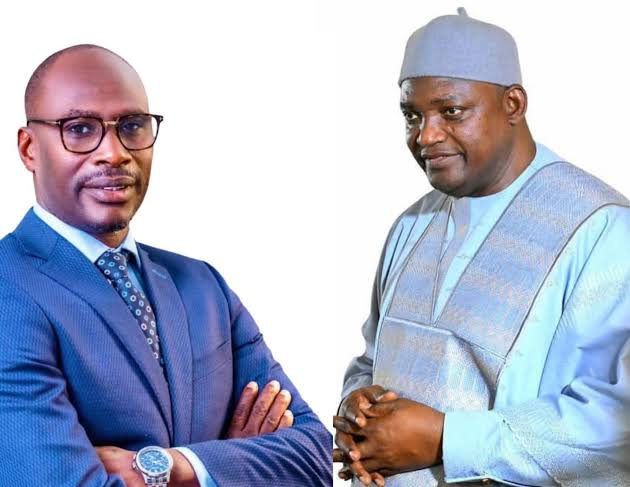
APP-Sobeyaa has confirmed that it is holding discussions with President Adama Barrow’s ruling National People’s Party (NPP) over a possible political alliance ahead of The Gambia’s December 5, 2026 presidential election — a development that could significantly reshape the country’s already fragmented political landscape.
The confirmation also validates reports published last week by Kerr Fatou and other media outlets indicating that the two political formations were exploring the possibility of working together.
At the time, neither APP-Sobeyaa nor the NPP publicly confirmed the reports. The party’s statement on Wednesday, September 9, has now removed much of the uncertainty, acknowledging that the NPP is among the parties and political formations with which APP-Sobeyaa is negotiating.
“The Party Executive has been mandated by Congress to explore and engage in discussions with political parties and formations on possible alliances and coalition arrangements in the national interest and in the interest of APP-Sobeyaa,” the party said.
But while APP-Sobeyaa insists that discussions do not amount to a final political agreement, the revelation raises important questions about the direction of the party and the broader realignment taking place ahead of the election.
From Barrow Critic to Possible Ally?
The potential alliance is particularly striking because of the political history between APP-Sobeyaa leader Essa Mbye Faal and President Barrow.
Faal, who contested the 2021 presidential election against Barrow, has been a vocal critic of the government, raising questions over its governance record and performance on major national issues.
Any decision by APP-Sobeyaa to eventually align itself with the NPP would therefore represent a significant political shift and could expose the party to difficult questions from its supporters and the wider electorate.
Is this a tactical decision designed to maximize APP-Sobeyaa’s political influence, or does it represent a fundamental reassessment of the party’s previous opposition to the Barrow administration?
The answer could become increasingly important as the election approaches.
Politics, however, is rarely static. Parties that once occupied opposing political positions can become allies when electoral mathematics, strategic interests and negotiations converge.
APP-Sobeyaa appears keen to emphasize that no such decision has yet been made.
The party said its executive has merely been authorized to negotiate with potential partners, evaluate proposals and report the outcome to the party. The ultimate decision, it stressed, belongs to Congress.
“The ultimate decision on APP-Sobeyaa’s position ahead of the 2026 Presidential Election rests with the Party’s Congress and not with any individual,” the statement said.
Coalition Politics Getting More Complicated
The development comes at a time when The Gambia’s political landscape is becoming increasingly dominated by negotiations over alliances and coalitions.
For the ruling NPP, bringing another political formation into its camp could strengthen its electoral machinery and broaden its political base ahead of what is expected to be a highly contested presidential election.
For APP-Sobeyaa, meanwhile, an alliance with the ruling party could offer political leverage, access to a broader electoral structure and potentially a greater role in determining the country’s post-election political direction.
But such an arrangement could also carry considerable political risks.
The party could face accusations that it has abandoned its previous opposition posture or compromised principles for political advantage. Whether those criticisms gain traction will depend heavily on the terms of any eventual agreement and what APP-Sobeyaa can demonstrate it has secured from the negotiations.
Congress Holds the Final Card
APP-Sobeyaa has sought to draw a clear distinction between negotiation and commitment.
National spokesperson Ousainou Bobb has been designated as the party’s lead negotiator and focal point for coalition discussions. He is expected to report the outcome of negotiations to the executive before any final decision is presented to Congress.
That means the current talks should not yet be interpreted as an endorsement of Barrow or a formal commitment to the NPP.
However, politically, the mere existence of the negotiations is significant.
It demonstrates that the boundaries between the ruling party and opposition formations are becoming increasingly fluid as political actors calculate their positions ahead of December.
APP-Sobeyaa also rejected suggestions that the party revolves around any individual, insisting that internal disagreements should not automatically be interpreted as evidence of division.
The party further warned against what it described as attempts to pressure or intimidate it through insults, intimidation and social media campaigns.
“We will listen to everyone, but no one will dictate to us,” APP-Sobeyaa said.
A Test of Political Principles
Ultimately, the APP-Sobeyaa–NPP discussions raise a broader question about the nature of coalition politics in The Gambia.
Are emerging alliances being driven primarily by shared political programmes and policy objectives, or increasingly by electoral calculations and the search for political survival?
That question will likely become more prominent as December 5 approaches.
For Essa Mbye Faal and APP-Sobeyaa, the challenge will be to convince their supporters that whatever decision emerges from the negotiations is based on political strategy and the national interest rather than expediency.
For the NPP, successfully attracting a party led by one of President Barrow’s former presidential challengers would provide a potentially valuable political boost.
But it could also create an uncomfortable political narrative: how does a party that has spent years criticizing the government explain its decision to potentially join forces with the very administration it once challenged?
For now, APP-Sobeyaa says no final decision has been taken.
But the confirmation that negotiations are underway means the political question is no longer whether the talks exist.
The real question is what APP-Sobeyaa is prepared to trade, demand or defend at the negotiating table — and whether its supporters will ultimately accept the price of an alliance with the Barrow administration.