
The Independent Electoral Commission (IEC) has begun the judicial review of objections arising from the 2026 supplementary voter registration exercise, opening another critical stage in the preparation for December’s presidential election.
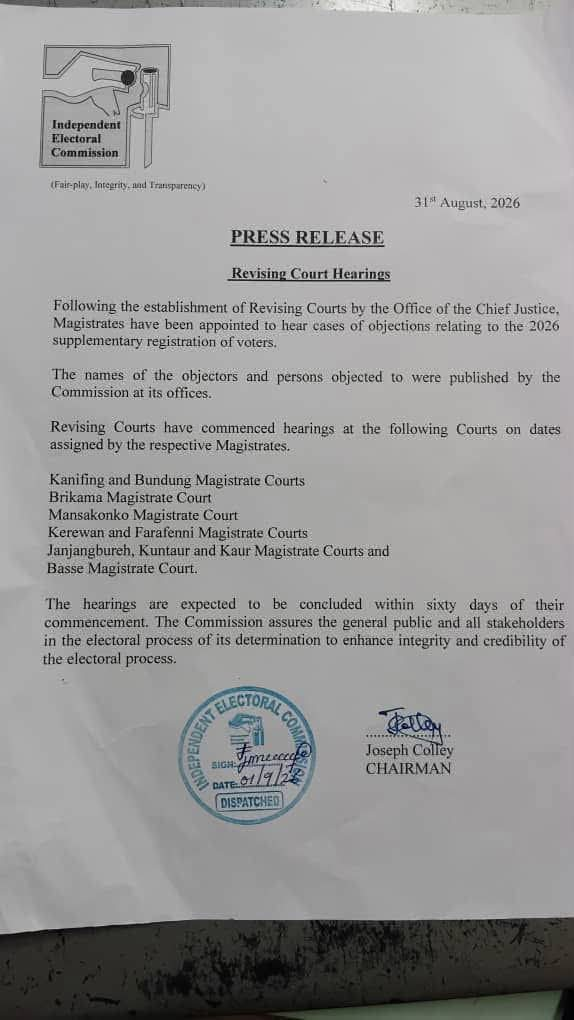
In a press release dated August 31, 2026, signed by IEC Chairman Joseph Colley, the Commission announced that Revising Courts established by the Office of the Chief Justice had commenced hearings into cases involving objections to the supplementary voter registration. The IEC subsequently listed the release among its September 2026 press releases.
The hearings are being conducted at Magistrates’ Courts in Kanifing and Bundung, Brikama, Mansakonko, Kerewan and Farafenni, Janjanbureh, Kuntaur and Kaur, and Basse.
The Commission says the hearings are expected to be completed within 60 days of their commencement.
On paper, the process is an important safeguard. In practice, however, the scale of the objections and the controversies surrounding the 2026 voter registration exercise mean that the Revising Courts face a major test of public confidence.
A Voter Register Under Pressure
The judicial process comes after the IEC received a substantial number of objections to registrations made during the supplementary exercise.
The Commission’s Chief Electoral Officer, Sambujang Njie, disclosed in August that the IEC had received about 1,600 objections during the exercise. The objections included challenges concerning eligibility and residency.
That figure alone should command serious attention.
An objection does not automatically mean that a voter is improperly registered. But when hundreds or thousands of registrations are being challenged ahead of a presidential election, the process must be handled with exceptional transparency.
The issue is not simply how many names are removed.
The bigger question is whether every legitimate objection will be properly investigated while genuine voters are protected from wrongful disenfranchisement.
The Multiple Registration Problem
The Revising Courts are also operating against the backdrop of one of the most contentious developments in the 2026 registration process.
The IEC previously announced that it had identified 14,334 voters who had registered more than once during the 2026 exercise. Following consultations with political parties, the Commission decided to delete those duplicate 2026 registrations while retaining the individuals’ names on the 2021 voter register.
The scale of the problem raises uncomfortable questions.
How did so many multiple registrations occur in a biometric registration system?
Were they deliberate attempts to manipulate the register, administrative mistakes, technical problems, or a combination of factors?
And, most importantly, what lessons has the IEC drawn from the episode before the final register is produced?
The Commission has said that cases of suspected registration fraud could result in legal proceedings.
That commitment will now need to be matched by action.
The 60-Day Question
The IEC’s announcement that the Revising Courts are expected to conclude their work within 60 days is significant because the country is moving steadily towards the December 5 presidential election.
The timetable leaves little room for administrative confusion, prolonged disputes or delays.
The Commission has previously explained that the Revising Courts will ultimately validate the objections and appeals before the provisional register from the supplementary exercise is merged with the existing 2021 voter register.
That merger will effectively determine who appears on the voter roll going into the election.
Consequently, the Revising Court process cannot be treated as a routine administrative exercise.
It is one of the mechanisms through which the electoral system must demonstrate that every eligible Gambian has a reasonable opportunity to vote and that ineligible registrations are removed through due process.
Transparency Must Go Beyond a Press Release
The IEC repeatedly assures the public that it is committed to free, fair, transparent and inclusive elections.
But public confidence requires more than assurances.
The Commission needs to provide meaningful information about the objections being heard, the progress of the cases and, ultimately, the decisions reached.
There is a legitimate public interest in knowing how many objections were upheld, how many were rejected and why.
At the same time, the privacy and legal rights of individual voters must be protected. Transparency should therefore focus on aggregate results, procedures and reasons for decisions, rather than unnecessarily exposing personal information.
This is particularly important given the political sensitivity surrounding the 2026 voter register.
The IEC Has Little Room for Error
The Commission is heading into the final stretch before a presidential election in which the credibility of the voter register will be fundamental to the legitimacy of the result.
The IEC itself has acknowledged that the registration process includes verification, appeals and objections before the final register is established.
That means the Revising Courts are not merely correcting clerical errors.
They are helping determine the integrity of the electoral foundation upon which the December election will be conducted.
Any failure to properly investigate objections could allow questionable registrations to remain. Conversely, excessive or poorly justified removals could disenfranchise legitimate voters.
Both outcomes would damage public confidence.
A Test for the Commission
The current process therefore presents Joseph Colley and the IEC with an important test.
The Commission must demonstrate that it can withstand political pressure, investigate complaints impartially and explain its decisions clearly.
Political parties and candidates also have a responsibility. Objections should be based on genuine evidence rather than partisan attempts to manipulate the voter register.
The courts, meanwhile, must ensure that each case is determined according to the law and evidence rather than political considerations.
The ultimate objective should be straightforward: a voter register that Gambians can trust before they cast their ballots.
The December election will produce a winner and losers at the political level. But the integrity of the process should not be allowed to become another casualty.
For the IEC, the Revising Courts are therefore more than another item on the electoral calendar.
They are an opportunity to demonstrate that the country’s voter register is being cleaned, challenged and validated openly before Gambians are asked to choose their next president.