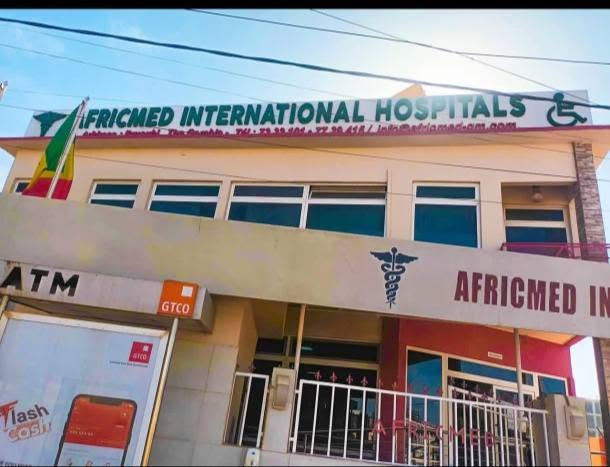
A legal battle between former Africmed International Hospital employee Amadou Kabba and the hospital’s Director, Dr Omar Jagne, has returned to the High Court before Justice Udoma after efforts to resolve the case through Alternative Dispute Resolution (ADR) failed to produce a settlement.
While the civil suit centres on allegations of defamation, the case highlights grave concerns regarding the medical care provided to Mr Kabba’s daughter, Sira Kabba, which the plaintiff asserts was the underlying catalyst for the dispute.
The Statement of Claim a distressing history of medical care regarding Mr Kabba’s daughter, who was treated at Africmed International Hospital when she was two years old for a burn on her palm. The plaintiff alleges that upon arrival at the hospital, the child’s palm was cut with scissors, resulting in an inability to move her fingers.
He further alleged that the child was denied access to a physiotherapist throughout her admission. Three weeks into her admission, the child’s fingers remained immobile.
The plaintiff contends that the child’s permanent hand injury was a direct result of the negligence of Africmed International Hospital staff in performing their duties.
Following that, a doctor at Africmed, Dr Yusuf, later recommended that Sira be taken abroad for specialist treatment. Mr Kabba’s wife, Hawa A. Cham, took the child to Dakar first, but doctors there told her the injury was too complicated for them to handle. The family then had to travel to Turkey, where Sira underwent three separate surgeries on her hand.
After all of that, Kabba wrote to Dr Jagne asking the hospital to help pay for his daughter’s final medical treatment in Turkey. Dr Jagne invited Mr Kabba and his wife to his office to talk about it. He promised to pay for Sira’s education and asked to see the medical bill from Turkey. The bill was sent to him. When he looked at it, he said the amount was too high, and nothing further was done to help the family.
Then, on 13th October 2023, Dr Jagne contacted Mr Kabba by phone and texted a message to say that a file belonging to his wife had gone missing from the hospital and accused Mr Kabba of stealing it. Just two days earlier, Mr Kabba says, Dr Jagne had called him to help move a medical machine from his office, which he did out of respect for Dr Jagne as his boss.
Later that same day, police came to the hospital and arrested Mr Kabba based on Dr Jagne’s accusation. Officers took him to his house and searched it. During the search, Mr Kabba says Dr Jagne himself picked up a file from his home. But it was not the file he was accused of stealing from the hospital; it was Sira’s medical file from Turkey. Mr Kabba objected, and the police told Dr Jagne to return the file, which he did.
Mr Kabba was taken to Brusubi Police Station and gave a statement. After that, he was told to go home. Police found no proof that he had stolen anything from the hospital.
But according to Kabba, the damage was already done. He stated that his workmates at Africmed kept asking him almost every day what he had stolen and why the police came to arrest him at the workplace. His neighbours asked him what he had taken and why the police searched his house.
He further stated that the constant questioning became too much to bear. On 1st November 2023, he resigned from Africmed, ending nearly thirteen years of service.
Kabba is being represented by counsel Adama Sillah of Mari Bantang Chambers. He is asking the High Court to award him a total of D1,650,000.00. D1,500,000.00 as compensation for defamation of character, and D150,000.00 to cover his legal and court fees.
The case was first referred to ADR — an out-of-court process where a neutral person helps two sides reach an agreement. However, no agreement was reached, and the case is now set for a full hearing in the High Court, where the court will weigh the allegations of negligence against the hospital and the defamation claims against its Director.
Dr Omar Jagne has not yet publicly responded to the allegations in court. All claims made by Kabba remain allegations and have not been proven. The court will decide the matter.