
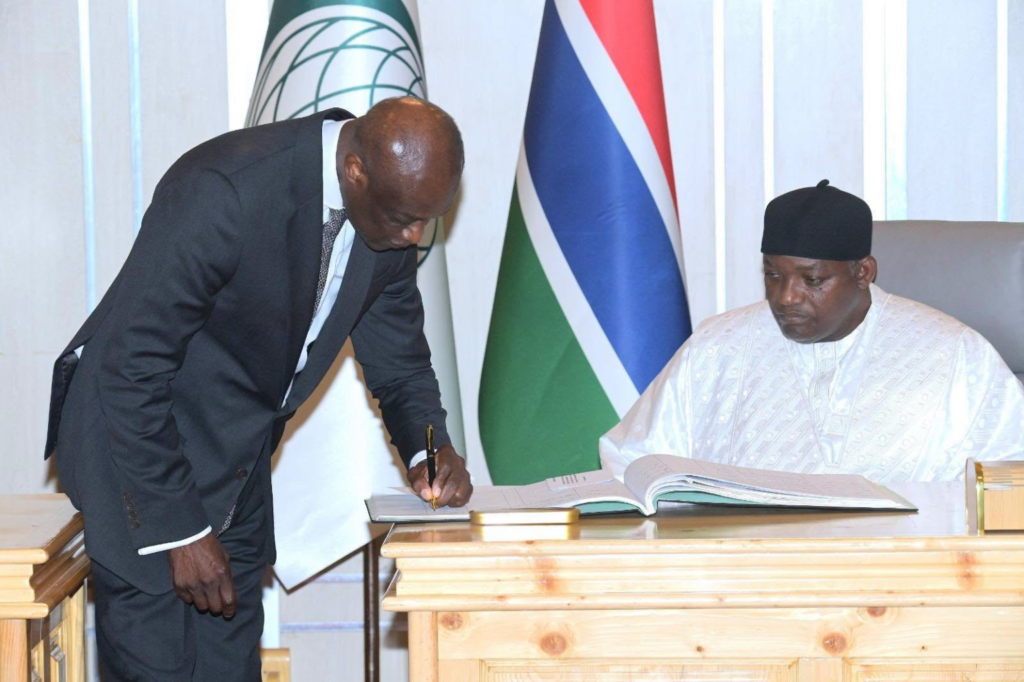
The Edward Francis Small Centre for Rights and Justice notes with grave concern the decision to swear-in Mr. Edi M.O. Faal into office as Chief Justice of The Gambia by President Adama Barrow on 31 July 2026, when the tenure of the outgoing Chief Justice, Hassan B. Jallow, had not yet expired. This unprecedented development effectively created a situation in which The Gambia had two Chief Justices simultaneously.
Our concern is further compounded by the circumstances surrounding Mr. Faal’s appointment. On 13 July 2026, EFSCRJ issued a public statement demanding that the Government provide citizens with full and accurate information about the reported appointment. Our statement followed a press release issued by The Gambia Bar Association (GBA) on 9 July 2026 opposing the appointment on the grounds that Mr. Faal did not meet the constitutional requirements prescribed under Section 139 of the 1997 Constitution.
Our intervention was also informed by the disturbing fact that, despite the constitutional importance of the office of Chief Justice, the Government had made no prior public announcement explaining its decision to appoint a new Chief Justice. EFSCRJ therefore specifically called on the President, “to ensure full transparency regarding the process, the constitutional basis, and the qualifications upon which Mr. Edi M.O. Faal was considered for appointment as Chief Justice.”
Against this background, EFSCRJ reiterates our deep concern that the President proceeded with the appointment without any public explanation to clarify the concerns, and before the expiration of the incumbent Chief Justice’s tenure which was on 1 August 2026. While the Constitution does not require the President to publicly justify such appointments, the office of the Chief Justice is central to the administration of justice and the rule of law. Therefore, transparency and public accountability were essential to maintain public confidence in the Judiciary. We are therefore equally concerned that both the President and the Attorney General and Minister of Justice failed to respond to written requests from The Gambia Bar Association, even though the Bar is an integral stakeholder in the administration of justice.
The Gambia Bar Association has not only opposed the appointment but also announced in its press release of 31 July 2026 that it had “invoked the original jurisdiction of the Supreme Court to challenge the constitutional validity of the appointment.” It is profoundly troubling that an appointment to the highest judicial office should begin under circumstances that trigger immediate constitutional challenge.
From our review of the relevant provisions of the 1997 Constitution and Mr. Faal’s publicly available résumé, EFSCRJ finds that Mr. Faal falls short of satisfying the requirements stipulated under Section 139(1), (2) and (5). His résumé does not indicate that he has ever been appointed or served as a judge in The Gambia or elsewhere. Furthermore, we have seen no evidence that he practised as a legal practitioner for at least 12 years in a common law country as contemplated by the Constitution.
Although Mr. Faal spent much of his legal career practicing in the United States and undoubtedly possesses an extensive and distinguished legal background, the United States is not a member of the Commonwealth. Nor has the National Assembly prescribed it as a common law country for the purposes of Section 139. Consequently, EFSCRJ concurs with The Gambia Bar Association that, notwithstanding his sterling legal career, Mr. Faal does not meet the constitutional requirements for appointment as Chief Justice of The Gambia. EFSCRJ therefore stands in solidarity with The Gambia Bar Association in opposing this appointment. We urge the President to uphold and abide by the Constitution in accordance with his oath of office.
We consider the President’s decision to fall short of the fundamental requirements of constitutionalism and the rule of law. While the Constitution vests the power to appoint the Chief Justice in the President, that power is not unlimited. Like all public powers, it must be exercised within the constitutional boundaries, in good faith, and for the purpose for which it was conferred. The President’s decision to appoint Mr. Faal also directly contradicts the Commonwealth Latimer House Principles, which require judicial appointments, tenure, discipline, and removal to be governed by transparent, lawful, and objective procedures.
President Barrow participated in the first-ever Tripartite Conference on the Commonwealth Latimer House Principles, held from 22 to 24 July 2026 at the Sir Dawda Kairaba Jawara International Conference Centre and convened by the National Assembly. It is therefore deeply troubling that barely one week after this important gathering, the President would act in a manner that contradicts the commitments he made at the conference to safeguard democracy, uphold constitutionalism, and protect the independence of the Judiciary.
We accordingly call on President Adama Barrow to:
- Rescind the appointment of Mr. Edi M.O. Faal as Chief Justice, or take all necessary steps to preserve the integrity of the judicial process pending determination of the constitutional challenge brought by the GBA before the Supreme Court;
- Disclose the process, advice, and constitutional basis upon which the appointment was made; and
- Ensure that all future appointments of judicial officers strictly comply with the letter and spirit of the Constitution.
EFSCRJ reminds President Barrow that he has both a legal and ethical obligation to uphold the rule of law. Within 10 years of his presidency, the Supreme Court has ruled twice, that decisions taken by his administration were unconstitutional: first, the unlawful removal of nominated National Assembly Member, Ya Kumba Jaiteh in 2019, and second, the unlawful removal of former Auditor General Momodou Ceesay in 2025.
These are not minor administrative errors. Repeated disregard for the Constitution is a hallmark of authoritarian rule and clear grounds for impeachment. The Gambia endured 22 years of dictatorship until citizens rejected misrule in December 2016 and elected Adama Barrow with the expectation that the country would henceforth be governed according to the rule of law and constitutionalism. The promise of the new dispensation was to end lawlessness, abuse of power and impunity, and not to reproduce them.
This development must concern every citizen. EF Small Centre calls on civil society organisations, political parties, the media, professional bodies, religious and traditional leaders, and all sectors of Gambian society to stand firmly in defence of the Constitution against infringement from any quarter. When citizens tolerate disregard for the Constitution, especially by the President, we risk returning to the authoritarianism, lawlessness, and impunity that Gambians decisively rejected in 2016. The Constitution is supreme. No President, public official or institution is above it.
2026 – The Year of Empowerment: Empowered Citizens. Accountable Leadership