The ongoing female circumcision trial involving three women accused of performing female Circumcision that led to the death of a one-year-old child continued today before Justice I. Jammeh with the testimony of a medical doctor.
The defendants are Fatou Camara, Hawa Conteh, and Oumie Sawaneh. The State alleges that the trio performed a circumcision on the minor, which resulted in her death.
When the case was called, State Counsel W. S. Madu appeared for the state, while Counsel L. S. Camara represented the first accused, F. K. Darboe, and Counsel J. Jeng appeared for the second and third accused.
State Counsel Madu informed the court that the state had filed a notice of an additional witness statement and served the defendants’ counsel. Counsel L. S. Camara acknowledged receipt of the notice but was quick to inform the court that the state had cited the wrong law. He pointed out that the state counsel relied on the Criminal Procedure Code, which is no longer in existence, instead of the Criminal Offences Act 2025.
Counsel Camara noted that the defence did not mind a textual amendment to correct the error.
The State Counsel agreed and requested the amendment, which was granted by the court following no objections from the defence.
Following the amendment, State Counsel Madu called the witness to the stand. After taking an oath to speak the truth, she introduced herself as Dr Stephanie Awa Mendy, a resident of Lamin village. She testified that she is a Gynaecologist and the Deputy Head of the Department of Surgery at the Bundung Maternity Hospital.
Dr Mendy informed the court that she holds a Bachelor of Medicine and Surgery from the University of The Gambia (2009). She explained that her role includes supervising the department, conducting daily ward rounds, attending to vaginal deliveries, and performing surgeries.
When asked by State Counsel Madu why she was before the court, Dr Mendy replied that she was there to testify regarding the death of a one-year-old baby. She stated the infant was brought to the facility already deceased due to hemorrhagic shock resulting from female circumcision.
“The baby was brought dead into the facility due to hemorrhagic shock through female circumcision,” Dr Mendy told the court.
When pressed on how she reached this conclusion, Dr Mendy responded that when the baby was brought to the hospital, a clinical history taken from the family revealed the child had been circumcised two days prior and had been bleeding until the second day. The father asked the mother to take the child to the hospital by the time the mother reached the hospital.
“When we checked, the baby wasn’t breathing,” Dr Mendy testified. “We conducted a test, and a physical examination confirmed the presence of excessive blood in the child’s vaginal area. The baby was circumcised and was bleeding, which led to her death.”
Dr Mendy further testified that the doctor on shift at the time, Dr Irma Font, discussed the case at their morning routine meeting, where she got the information. She confirmed that taking a history and diagnosing based on that history is the standard procedure. She noted that the details were documented in hospital records by Dr Font, who is currently in Cuba.
State Counsel Madu asked Dr Mendy if she would recognise the report if she saw it, to which she replied positively, noting she would recognise it through the hospital form. However, when the document was handed to her, the witness identified that it was not a hospital report but a police report. She explained that normally, in such incidents, the police arrive with their own report, which is distinct from the hospital’s internal records.
State counsel W.S. Madu then substituted the earlier report for the hospital report. Counsel Madu applied to tender the report into evidence, relying on section 3 of the Evidence Act.
Counsel L. S. Camara for the first accused objected. He argued that the application was fundamentally wrong under Section 40 of the Evidence Act. He pointed out that Dr Mendy was not the author of the report, nor had she stated she was authorised by the Head of Department to present it. Furthermore, he noted the witness had not confirmed if the document bore Dr Font’s signature, and Counsel Camara urged the court to reject the report.
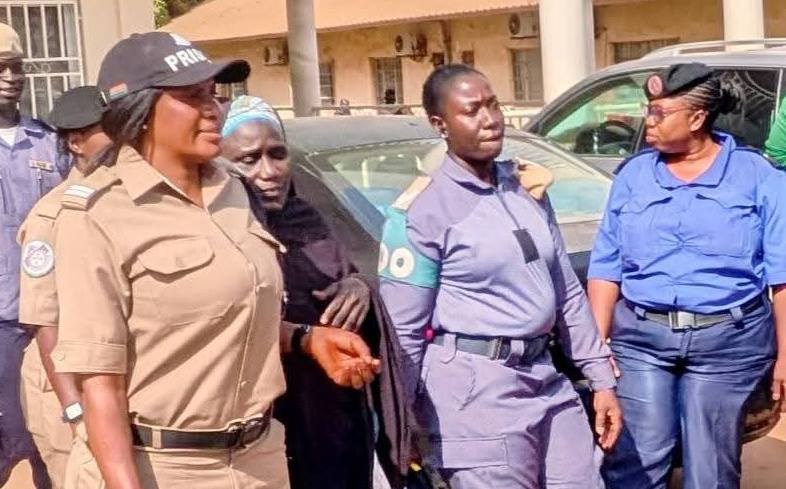
As Counsel F.K. Darboe for the second and third accused rose to object, the court realised the first accused, Fatou Camara, had lost consciousness and was about to fall from the witness box. Security personnel rushed to secure her from the witness box, and the judge stood down the matter for a few minutes.
Upon resuming, Counsel Darboe (representing the second and third accused) objected to the tendering of the document. He argued that a proper foundation had not been laid and that the witness had no personal knowledge of the document, as the examination was performed by Dr Irma Font and only narrated to her during a briefing. He argued that the witness could not be cross-examined on a document she did not prepare and sought for the court to reject.
State Counsel Madu countered that defence argument. He argued that the witness had testified to the cause of death and that it was logical for her to be familiar with the handwriting of her colleague, Dr Font. He maintained the document was relevant pursuant to Section 3 of the Evidence Act and urged the court to accept the report
In reply, Counsel Camara and Counsel Darboe argued that relevance is not the only instrument for admissibility and that Section 3 does not override other sections, like Section 40 and others.
The presiding judge, I. Jammeh, adjourned the case to February 10, 2026, for a ruling on the admissibility of the report.