

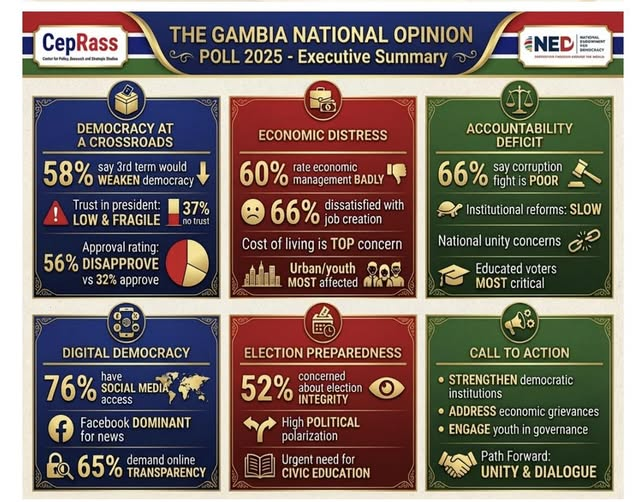
A new national opinion poll indicates that President Adama Barrow would be defeated in a presidential election if it were to take place at this time. The study also indicates that there is widespread discontent with his performance, the current state of the economy, and fears regarding the possibility of a third term.
CepRass, which stands for the Center for Policy, Research, and Strategic Studies, had a news conference in Banjul on Thursday, where they announced the conclusions that they had determined. A total of 1,245 individuals from around the country participated in the survey, which was carried out in November 2025 in collaboration with the National Endowment for Democracy. The purpose of the study was to investigate the public’s perspectives on democratic institutions, electoral procedures, and governance in advance of the election in 2026.
According to the survey, only 34 percent of respondents said that they would vote for Mr. Barrow if he had to compete against another candidate, while 49 percent indicated that they would prefer someone else. In light of the fact that the country is getting closer to a crucial election year, the results indicate that the incumbent would have a challenging electoral route.
The poll also found that major voting blocs were expressing a significant amount of unhappiness. A considerable portion of the public is looking for political change, as seen by the fact that more than half of young voters and more than half of women voters have stated that they want to vote for the opposition.
In a similar vein, the overall evaluations of Mr. Barrow’s term were not positively received. Fifty-eight percent of those who participated in the survey stated that Barrow had performed worse than prior presidents, and the economy emerged as the primary source of displeasure. One of the most powerful predictors of electoral outcomes, according to the findings of the researchers, is continued to be economic unhappiness.
There was also a significant emphasis placed on concerns regarding democratic governance. A sizeable proportion of respondents voiced their opposition to any attempt by Mr. Barrow to run for a third term in office. Many of these individuals viewed such a move as a potential threat to the constitutional order and democratic norms.
The results of the study revealed that there is a significant amount of suspicion regarding the “Meet the People Tour” that the president is now on. The majority of respondents perceived the tour as a political exercise rather than a neutral government project. Many people voiced their worries regarding the usage of public resources that went beyond the authorized expenditures.
Furthermore, the poll brought to light the public’s desire for structural improvements, which goes beyond electoral preferences. The respondents stressed the need of having a complete integrity framework that is founded on robust institutions, constitutional safeguards, and efficient enforcement. In terms of popular priority, constitutional term limitations and voting rights for diasporas were ranked far higher than reforms to electoral procedures that were technical in nature.
Additionally, the findings indicate that voters consider opposition unity to be of utmost importance. A unified coalition is largely seen as the most credible strategy of defeating the incumbent president, as shown by the survey by the majority of respondents.
During his remarks at the press conference, Dr. Lamin B. Jammeh, the chief executive director of CepRass, emphasized the study’s independence as well as the scientific rigor that it possessed. He also emphasized that the study was not designed to support any political goal.
“Perceptions matter because they influence legitimacy,” he said. “Disregarding them is often the first step toward democratic decline.”
Noting that perceptions impact political behavior, civic participation, and trust in institutions, he cautioned that disregarding public opinion could be an early symptom of democratic decline. He also mentioned that perceptions shape political behavior.
According to what he said, “Perceptions are important because they influence legitimacy.” Disregarding them is frequently the initial step toward the downfall of democratic institutions.
Dr. Jammeh underlined CepRass’s commitment to conducting research that is not biased and urged the media to engage with the findings in a responsible manner, highlighting the importance of evidence-based reporting in democratic accountability.
According to what he said, “the media are central to democratic oversight.” In the event that you communicate these findings in a responsible manner, you contribute to ensuring that public discourse is founded on facts rather than speculation.