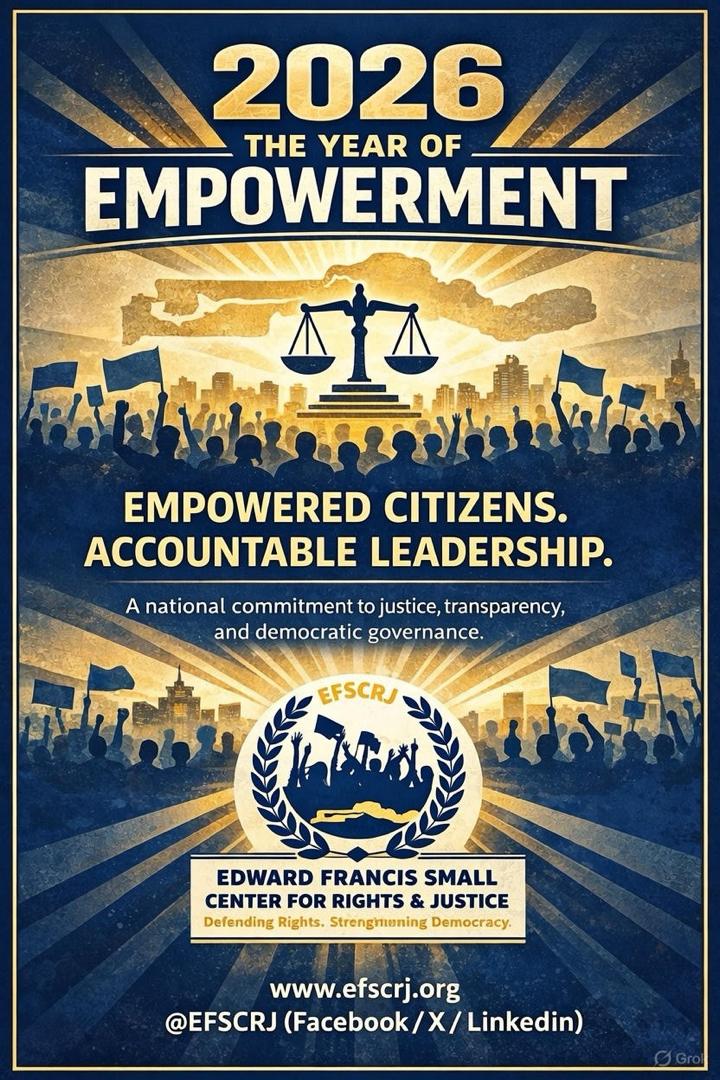
The Edward Francis Small Centre for Rights and Justice has declared 2026 as the Year of Empowerment, with a strategic focus on empowering citizens and ensuring accountable leadership. This resolution is grounded in our conviction that democracy thrives only when citizens are informed, organized, and active, and when leadership is subject to the law, public scrutiny, and the will of the people.
This declaration comes at a defining moment in the Gambia’s democratic journey. As the country approaches the 2026 presidential elections, the choices citizens make and the conditions under which those choices are exercised will shape the Republic’s governance trajectory for years to come. Empowerment in this context is therefore not symbolic but a democratic necessity.
What Empowerment Means
For EFSCRJ, empowerment is the process of equipping citizens with knowledge, skills, confidence, and organizational capacity to meaningfully participate in public life. It entails enabling citizens to understand their constitutional rights and duties, the functions and limits of public institutions, the content and implications of public policies, and the lawful avenues available to demand accountability, justice, and services.
Section 26 of the 1997 Constitution guarantees the right of all citizens “to take part in the conduct of public affairs, directly or through freely chosen representatives,” and “to vote and stand for elections at genuine periodic elections for public office….”
Empowerment is not limited to individual awareness, rather it extends to collective organization and solidarity. An empowered society is one in which communities can organize peacefully, speak freely without fear, engage institutions constructively, and resist the erosion of democratic norms. Empowerment transforms citizens from passive recipients of governance into active custodians of the Republic.
Accountable Leadership as a Democratic Imperative
Accountable leadership is inseparable from citizen empowerment. Leadership becomes accountable only when citizens are informed, vigilant, and prepared to demand justification for decisions, actions, and omissions. In an election year, accountability includes respect for constitutionalism, adherence to electoral laws, transparent use of public resources, equal application of the law, and the protection of fundamental rights and freedoms.
EFSCRJ underscores that self-perpetuating leadership undermines democratic governance, weakens institutions, entrenches corruption and impunity, and fuels inequality and social discontent. The 2016 democratic transition was anchored on a collective rejection of indefinite rule by any individual. Where political actors fail to uphold this principle, it is incumbent upon citizens to defend it through peaceful civic engagement and the ballot.
Why Empowerment Matters in the 2026 Elections
Elections are not merely events. They are processes that require an informed electorate, a free civic space, credible institutions, and accountable political actors. Without empowerment, elections risk becoming exercises in manipulation, patronage, misinformation, and voter apathy. With empowerment, elections become instruments for democratic renewal, peaceful change, and legitimate authority.
In 2026, empowerment is essential to:
• Enable citizens to critically assess political messages, promises, and records.
• Counter misinformation, disinformation, and hate speech.
• Encourage peaceful participation and rejection of violence.
• Strengthen public oversight of electoral processes and institutions.
• Safeguard constitutionalism, term limits, and democratic values.
EFSCRJ’s Commitment and Planned Interventions
In pursuit of this resolution, EFSCRJ will intensify its work across the country through peaceful, inclusive, and democratic means. Our interventions will include:
- Civic and Voter Education: Community-based and digital programs to educate citizens on constitutional rights, electoral processes, governance, and democratic participation.
- Capacity Building and Community Engagement: Training and dialogues with youth groups, women, community leaders, persons with disabilities, and grassroots organizations to strengthen civic agency and collective action.
- Advocacy for Accountable Leadership: Public advocacy, policy engagement, and strategic communication to promote adherence to the rule of law, efficiency in service delivery, transparency, and institutional accountability.
- Coalition-Building and Solidarity: Collaboration with civil society organizations, the media, professional bodies, and community networks to amplify citizen voices and protect civic space.
- Monitoring and Accountability Actions: Continued use of lawful tools, including access to information, public interest litigation, peaceful protest, and oversight advocacy, to hold public authorities accountable before, during, and after the elections.
All EFSCRJ activities will be conducted in strict adherence to non-violence, inclusivity, independence, and respect for democratic norms.
A Call to Action
EFSCRJ calls on all Gambians and stakeholders to embrace empowerment as a shared responsibility. Democracy cannot be outsourced to leaders alone. It must be exercised daily by citizens. An empowered people are the strongest defense against authoritarianism, corruption, and democratic backsliding.
Empowered Citizens. Accountable Leadership. This is not only our slogan for 2026, but also our collective democratic obligation.
2026 – The Year of Empowerment.