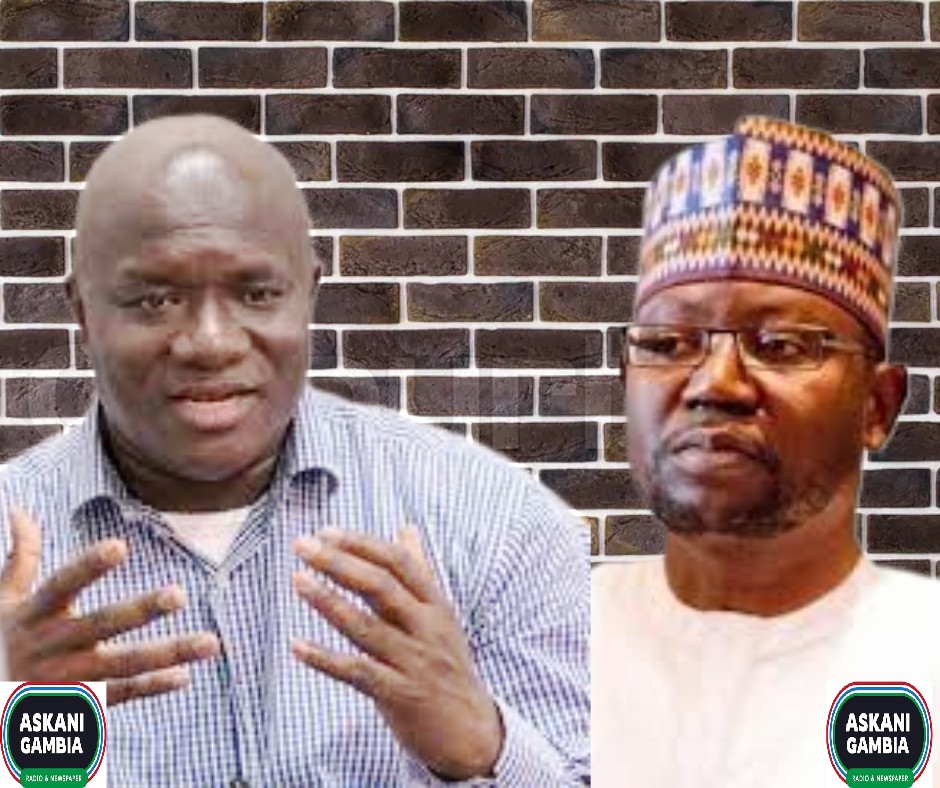
The interview conducted by Mai Ahmad Fatty on Kerr Fatou on Thursday December 11 is deeply troubling given the kinds of arguments he advanced. His comments pose a clear and present danger to democratic consolidation and political stability in the Gambia. Anyone who defends self-perpetuating rule or downplays blatant corruption, especially a political leader, is not serving society. Unfortunately, this is exactly what Mai chose to do.
Mai engaged in a deliberate attempt to rationalize the abandonment of presidential term limits. He cited several countries, China among them to argue that term limits are unnecessary. This claim is factually wrong and politically misleading.
China did in fact have presidential term limit until Xi Jinping engineered its removal in 2018. It was Deng Xiaoping who first introduced presidential term limits in 1982 to prevent lifelong leadership to centralize power. Moreover, China is not a multi-party political system. The existence of eight so-called “parties” is purely symbolic. None of those small parties has independent power or the ability to challenge the Chinese Communist Party, which maintains total control. To use China as an example of a country without term limits is to distort reality to justify authoritarian tendencies.
Mai also asserted that no scientific study supports term limits. This statement is either reckless or profoundly uninformed. Political science is replete with research and historical evidence demonstrating why term limits emerged: to prevent self-perpetuating rule, curb incumbency abuse, strengthen democratic rotation, and guard against personalist dictatorship.
To claim that some countries do not have term limits, and therefore the Gambia does not need them, is a false equivalence. If Mai were sincere, he would also reference the dozens of countries including African nations that have adopted term limits precisely because of their painful experience with authoritarian entrenchment.
Presidential term limits are not an abstract ideological preference rather they emerged as a democratic necessity. The United States introduced term limits formally in 1951 after more than a century of adhering to the practice because they understood the risks of prolonged incumbency.
In contrast, Western European parliamentary democracies evolved socio-politically in ways that limit the dangers of entrenched executive power.
Africa’s history is different. Since independence, the continent has suffered from leaders who overstay, abuse office, and weaken institutions. Longevity in power has correlated directly with corruption, repression, and underdevelopment.
The Gambia is a textbook example. Pres. Jawara ruled for 30 years while poverty, weak institutions, and corruption remained pervasive. Next, Yahya Jammeh entrenched himself for 22 years, producing unprecedented autocracy, rights violations, and a legacy of institutional decay.
Given The Gambia’s low political awareness, widespread poverty, weak checks and balances, sociocultural deference to authority, and ready abuse of incumbency, term limits are not only relevant, but they are also essential. For Mai to dismiss them as unnecessary is either a demonstration of intellectual dishonesty or a willful disregard for the country’s political experience.
Equally alarming is Mai’s attempt to rationalize corruption in order to exonerate President Barrow. He conveniently ignores that the President is the chief enforcer of the law. When multiple state institutions including the National Audit Office, National Assembly, commissions of inquiry, and investigative journalists have exposed corruption, the president has a constitutional duty to act.
Instead, Barrow decides to promote or redeploy officials cited in corruption findings or ignored audit revelations. He has shielded allies implicated in malpractice thereby demonstrating no intention to enforce accountability. Yet Mai defended this behaviour, thereby enabling impunity and weakening democratic norms. This is the exact pattern seen across Africa where political elites use sophistry to justify governance failures.
Thus, Mai’s performance mirrors a disturbing tradition among sections of Africa’s political elite; those who use intellectual arguments to defend corrupt or authoritarian leaders. For example, in Cameroon, elites defended Paul Biya’s 8th term with empty rhetoric. In Senegal, some intellectuals endorsed Macky Sall’s unconstitutional third-term bid. In Côte d’Ivoire, others rationalized Alassane Ouattara’s fourth-term extension. This behaviour fuels democratic collapse across the continent. The Gambia is no exception.
If President Barrow announced tomorrow that he wanted to become “King of The Gambia,” I can guarantee that Mai would almost certainly craft an argument to justify it, citing countries with monarchs as examples of “successful governance models.” His political reasoning is not driven by faith, conscience, or patriotism. It reflects opportunism wrapped in selective intellectualism.
Therefore, one may ask, what or who is driving Mai? Mai knows that Barrow is a failed leader. That the government is corrupt and incompetent. That institutions are collapsing, and the rule of law is routinely disregarded. In essence, Mai knows more than anyone that the Gambia is in a governance crisis. Yet he chooses to defend and sanitize these realities.
What, then, motivates him? Whose interests is he protecting? Certainly not the national interest, governance integrity, or democratic principles. No one can preach moral politics, claim religious conviction, or build a party on ethical foundations while simultaneously endorsing a regime marked by corruption, incompetence, and impunity. The contradiction is glaring.
I urge Mai Ahmad Fatty to return to the values he proclaims, and stand with the issues, concerns, and interests of his people. There is no choice between the people and a leader. Every citizen is expected to align his or herself with the best interests of the people and not betray one’s conscience and faith for a single leader. An intellectual does not sell his soul for a mess of pottage.
For The Gambia, Our Homeland