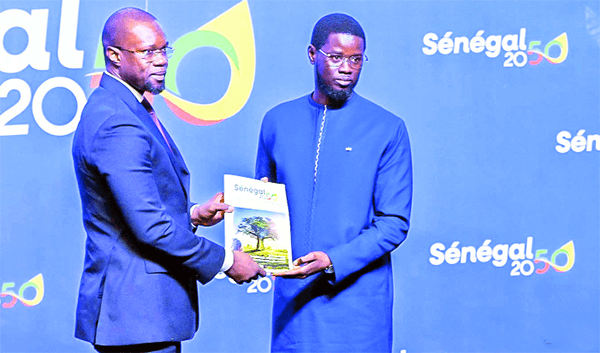
Senegal’s president and prime minister unveiled the government’s 25-year development plan on Monday, pledging to build the foundation for economic sovereignty by focusing on competitiveness, sustainable resource management, and good governance.
Titled “Senegal 2050”, the plan’s objective is to increase per capita income by 50 percent in five years and to extend life expectancy by three years, while reducing the deficit and debt.
The goal is also to improve livelihoods in the West African nation.
“We aim to build a diversified and resilient economy,” President Bassirou Diomaye Faye said at the launch ceremony, on Monday.
The plans aim to triple income per capita by 2050, and ensure annual growth of more than six percent by developing competitive sectors, including a strong private sector.
“This requires the development of our natural resources, whether agricultural, mining, oil or gas, through ambitious industrialisation,” the Senegalese president said.
“We will integrate our raw materials into global value chains and we will transform our wealth, locally, in particular, thanks to digital technologies and artificial intelligence,” he also said.
Jobs for young people
Among the concrete promises announced are the one to train 700,000 young people in the next five years, to help boost job creation and fight unemployment.
“Our young talent is in desperate search of opportunities,” the president also said.
The government also wants to reduce the cost of electricity thanks to the exploitation of gas and oil, and to make Senegal energy self-sufficient as soon as possible.
Senegal became an oil producer in June, while gas production is due to begin by the end of the year.
The government aims at investing in research and innovation, all for a cost of 11.1 billion euros.
But the main challenge will however be to bring a credible budget plan to support all these promises.
“If you fight corruption effectively, you will gain a lot,” Mamadou Diop Decroix, former minister of commerce under Abdoulaye Wade, told RFI.
He did not sound worried therefore, and also suggested taxing more income and increasing the tax base.
But for Elimane Haby Kane, of the Legs-Africa think tank, the authorities must work harder to really offer reliable economic development solutions that are different from previous authorities.
“Their vision can be very ambitious, but now what’s important is how to translate that vision into reality!” he told RFI.
“Much more audacity is needed in implementation to achieve these ambitions,” he insisted.