In the hours after a joint U.S.–Israeli military offensive struck deep into Iranian territory, including leadership and strategic sites, the Islamic Republic of Iran unleashed a broad campaign of retaliatory attacks across the Middle East on Saturday and into early Sunday. The strikes mark one of the most dramatic escalations in decades and signal Tehran’s intent to confront its adversaries on multiple fronts.
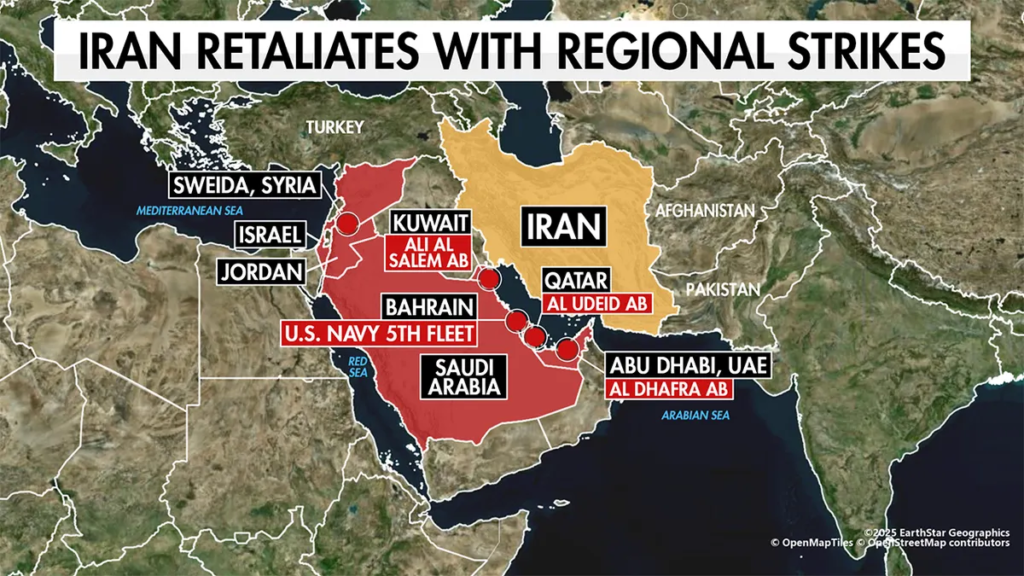
Iran’s Islamic Revolutionary Guard Corps (IRGC) confirmed it had launched waves of missiles and drones targeting military installations linked to both the United States and Israel. These included bases in Bahrain, Kuwait, Qatar, the United Arab Emirates, Saudi Arabia, Iraq, Jordan and other Gulf states that host U.S. forces, according to regional officials and state media reports.
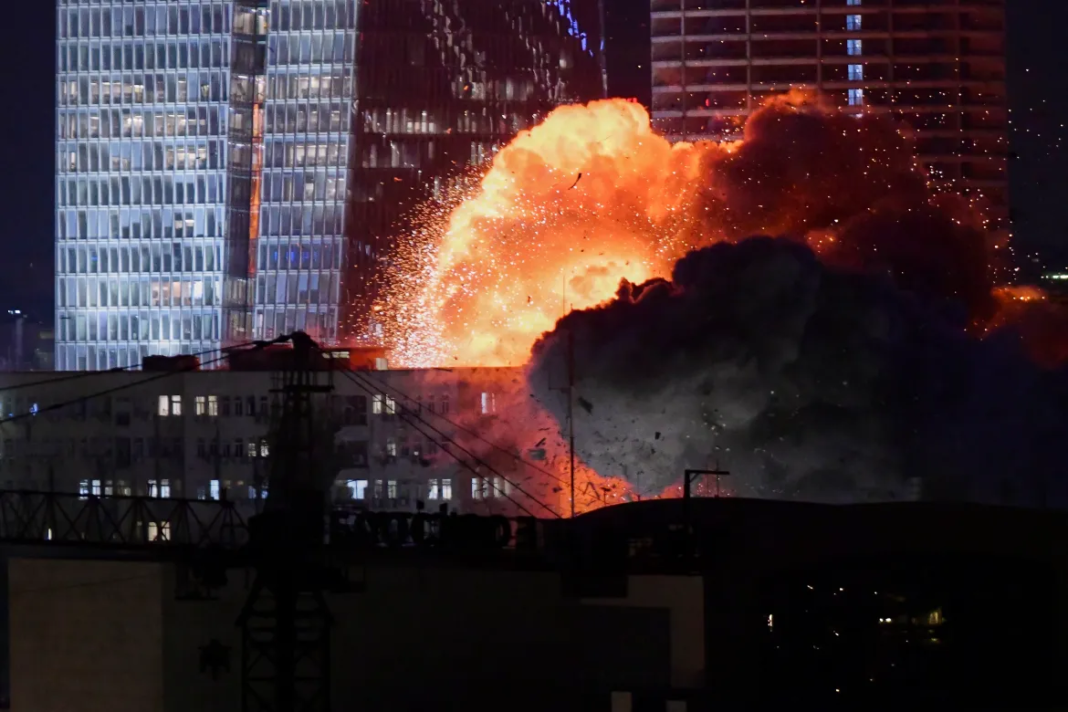
While many of the projectiles were intercepted by defensive systems, explosions and air-raid sirens were reported in capitals such as Manama (Bahrain) and Abu Dhabi (UAE), where at least one civilian was killed during an intercept operation. Iranian ballistic missiles also flew toward Israeli territory, prompting nationwide alerts and shelter orders.
Iranian leaders framed the campaign — dubbed “Truthful Promise 4” by some military voices — as a justified act of national defence in response to what they described as an unlawful assault on Iranian sovereignty. Official statements repeated that all American and Israeli assets in the region are legitimate targets, a stance reinforced by Foreign Ministry messaging at the United Nations.
Despite the scale of launches, large-scale damage to U.S. bases has not been independently confirmed, and U.S. officials reported minimal American casualties so far. Many Gulf states, while previously critical of U.S. actions, condemned Iran’s strikes as violations of their airspace and sovereignty, warning of further consequences if attacks continue.
The rapid escalation has triggered heightened global concern. The United Nations Security Council held emergency briefings, and Secretary-General Antonio Guterres called for an immediate cessation of hostilities and renewed diplomatic efforts to avert a wider conflagration.
Analysts warn that Iran’s multi-directional retaliation — spanning missile barrages, drone operations and regional threats — could entrench a prolonged conflict with no clear path to de-escalation. With major powers engaging both militarily and diplomatically, the Middle East now faces a volatile chapter that may reshape regional security for years to come.