Political analyst and commentator Bun Dawda has argued that the recurring divisions within Gambian politics are not a new phenomenon, but part of a political culture stretching from the First Republic through the Yahya Jammeh era and into the administration of President Adama Barrow.
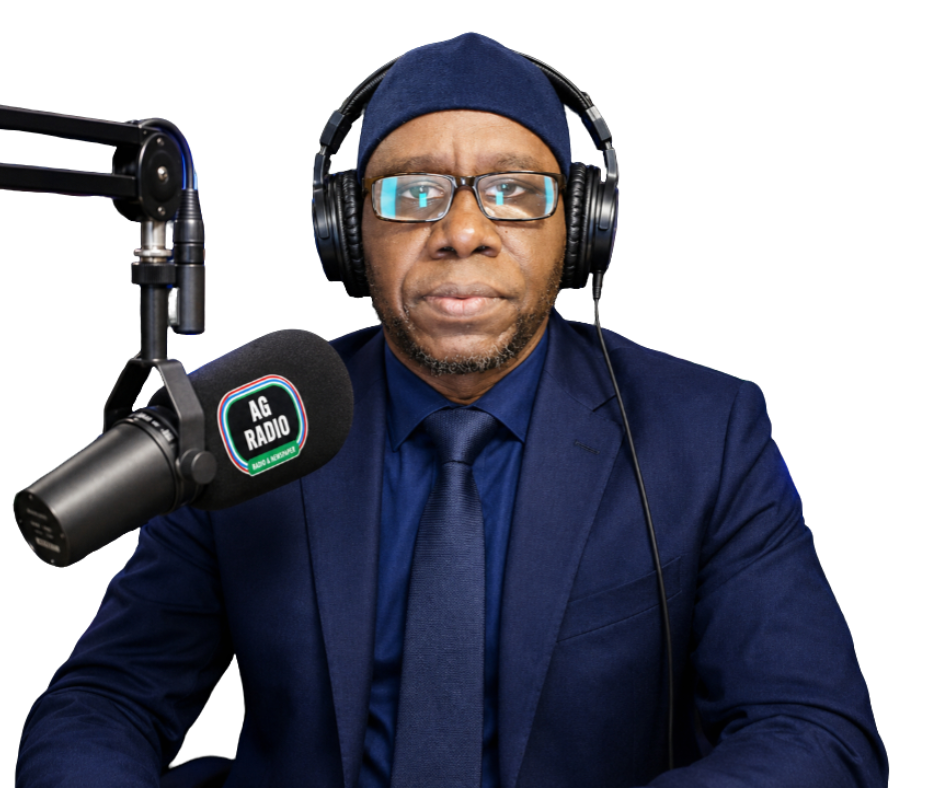
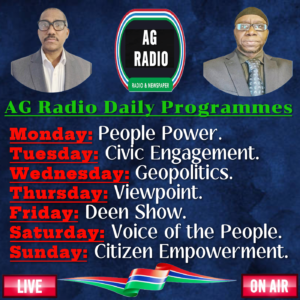
Speaking as the guest on AG Radio’s weekly Saturday edition of Voice of the People, Bun Dawda delivered a wide-ranging assessment of political alliances, opposition failures and what he described as decades of political opportunism.
The programme began with host Salieu Njie asking Bun Dawda about the circumstances and experiences that shaped his political consciousness, patriotism and outspoken commitment to national affairs.
The discussion later shifted to the history of political alliances in The Gambia and why opposition movements have repeatedly struggled to maintain unity.
According to Bun Dawda, one of the central weaknesses of Gambian politics has been the inability of political actors to subordinate personal ambition to broader national objectives.
“The reason why Gambian politics is frustrating is because of selfish political opportunism dating back to the days of the PPP era during the administration of President Sir Dawda Jawara,” he said.
“Unfortunately, this continued during the Jammeh era and up to this day under Adama Barrow.”
A History of Failed Opposition Unity
There is considerable historical evidence supporting Bun Dawda’s broader argument that opposition fragmentation has repeatedly benefited incumbents.
Ahead of the 2006 presidential election, five opposition parties formed the National Alliance for Democracy and Development, commonly known as NADD, in an effort to confront President Yahya Jammeh with a united opposition.
However, disagreements over leadership, candidate selection and strategy eventually weakened the alliance.
The United Democratic Party and National Reconciliation Party went into the election supporting Ousainou Darboe, while the remaining NADD parties selected Halifa Sallah.
Jammeh eventually secured another term against a divided opposition.
A similar pattern emerged in 2011, when opposition forces again failed to build the level of unity necessary to seriously threaten Jammeh’s hold on power.
The contrast came in 2016.
Seven opposition parties eventually rallied behind Adama Barrow under Coalition 2016. Barrow defeated Jammeh with approximately 43 percent of the vote, bringing an end to Jammeh’s 22-year rule.
The lesson from those elections is difficult to ignore: opposition cooperation can fundamentally change electoral outcomes.
Yet Bun Dawda argued that opposition divisions were not always accidental.
Claims of Political Manipulation
Bun Dawda stated that Jammeh understood the weaknesses of opposition politicians and deliberately exploited their rivalries.
He noted that veteran politician Hamat Bah and GDC leader Mama Kandeh were at different periods used politically by Jammeh to weaken and divide opposition forces.
According to Bun Dawda, Jammeh’s strategy was to encourage rival centres of political influence so that no single opposition movement could become powerful enough to threaten his government.
However, these claims require careful qualification.
The divisions among opposition parties during the Jammeh era are well documented. So describing Bah or Kandeh as covert political agents of Jammeh are not only Bun Dawda’s statements but rather an established historical fact.
Hamat Bah spent much of the Jammeh era as an opposition politician and was himself involved in anti-Jammeh political alliances.
Mama Kandeh, on the other hand, was previously an APRC parliamentarian before breaking away and forming the Gambia Democratic Congress ahead of the 2016 presidential election.
Barrow and the Jammeh Comparison
Bun Dawda nevertheless believes similar political tactics are being deployed under President Barrow.
He stated that the Barrow administration adopts what he described as Jammeh’s political playbook of division, ethnic calculation and strategic alliances.
According to Bun Dawda, Barrow has learned that a fragmented opposition is easier to defeat than a unified one.
He pointed particularly to Barrow’s political relationship with Mama Kandeh.
Kandeh, once one of Barrow’s most prominent political opponents, has now formally aligned the GDC with the NPP-led political alliance.
The development has dramatically changed the political landscape ahead of the 2026 presidential election.
Bun Dawda argued that those familiar with Kandeh’s political history should not have been surprised by the decision.
“The revelations that Kandeh used to meet the president came from President Barrow’s own mouth, who said that they used to contact each other secretly,” Bun Dawda stated.
He suggested that contacts between the two leaders were taking place even while Kandeh was associated with opposition political discussions.
Nevertheless, the eventual NPP-GDC alliance has inevitably raised questions about when political discussions between the two camps began and how advanced those discussions were while wider opposition negotiations were taking place.
Personalities Versus Institutions
Beyond the allegations, Bun Dawda’s argument points to a deeper structural weakness in Gambian politics.
Political alliances have frequently been constructed around personalities rather than institutions.
Parties may agree that an incumbent government should be removed, but disagreements quickly emerge over who should lead, who should become presidential candidate, how political positions should be distributed and which party should dominate a coalition.
That problem undermined NADD.
It later created major disagreements within Coalition 2016 after Jammeh had been removed from office.
And similar tensions have again emerged ahead of the 2026 presidential election.
The fundamental question, therefore, may not simply be whether Gambian opposition parties can form coalitions.
History demonstrates that they can.
The more difficult question is whether they can create durable structures capable of surviving disagreements over leadership, ambition and political power.
Without such structures, opposition unity risks remaining a temporary arrangement built around elections rather than a lasting political project.
Bun Dawda’s wider argument is therefore that The Gambia’s democratic difficulties cannot be blamed exclusively on one president.
From Jawara to Jammeh and now Barrow, political opportunism, defections, shifting alliances and personality-driven politics have remained persistent features of the country’s political landscape.
Until those weaknesses are addressed, the same cycle of alliances, disagreements, defections and political fragmentation may continue regardless of who occupies State House.