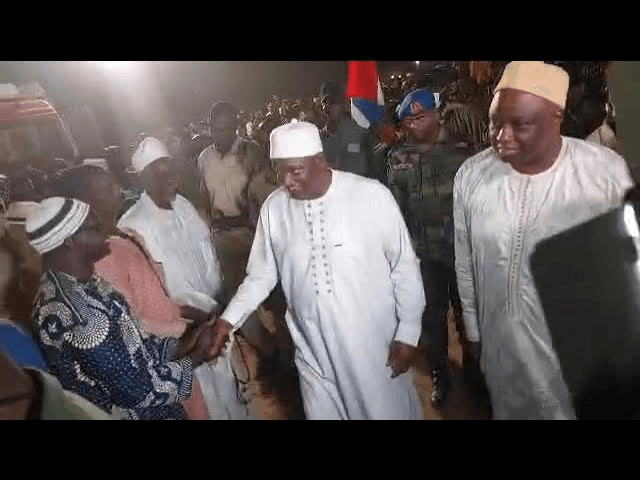
The “poor groundnut harvest” from this year’s cropping season was the main topic of discussion at the President’s 2024 Meet the People’s Tour, which is starting in Bantanding Wollof in the Jokadu District of the North Bank Region (NBR) and aims to gather first-hand information from citizens nationwide. Every speaker at the gathering bemoaned their peanut crops’ incredibly poor harvest.
Ousman Jallow, who represented the Alkalo, urged for the community’s school to be upgraded to a senior secondary in his welcome address. To go to the nearest senior secondary school, their children must walk seven km, he said. He also pleaded for the availability of potable water.
Jokadu District Chief Alpha Mariam Khan praised the president for bringing energy to his district. However, he informed the president that this year’s farming season has been unsuccessful, especially with regard to groundnuts, and he urged the government to help.
“We have planted everything we own in the hopes of a better result, but there are no groundnuts. And as farmers, we rely on this,” the Chief stated. Since Jokadu hasn’t had a road built since 1987, the Chief also demanded that good roads be provided.
Due to an issue with the ambulance, the Kuntaya hospital is currently functioning without one. In his demands, the Chief added, “We also want the Dasilameh and Karantaba health centres to be upgraded.”
“Even though the government has done its part in ensuring that fertiliser was affordable and accessible to all farmers, and we [farmers] have also done what we can, groundnut production has woefully failed,” said Amat Sarr, regional chairperson of the National People’s Party (NPP), echoing similar demands.
He pleaded for additional assistance to reduce farmers’ burdens, pointing out that in addition to the lack of rainfall, their produce becomes tainted with bugs and illnesses.
“Inadequate medications have been a frequent complaint in NBR hospitals. We want the government to provide hospitals with enough prescription drugs. “Amat Sarr said.”
Reiterating the subpar peanut crop yield, Anta Secka, speaking for the district’s women, called for more gardens with appropriate fencing, seeds, and boreholes, stating that women rely mostly on these gardens.
On behalf of the youth, Modou Lamin Sarr expressed gratitude to the government for signing the migration accords with Saudi Arabia and the Kingdom of Spain. He claims that this will lessen the nation’s problem with irregular migration.
In his response to the concerns expressed by the meeting’s speakers, Dr. Demba Sabally, Minister of Agriculture, Livestock, and Food Security, said his ministry would investigate the reasons for the subpar groundnut harvest.
But according to their projections, this year’s cropping season would yield a higher harvest than last year; more than 24,000 hectares have been cultivated this year, compared to more than 178,000 hectares last year, he said.
The Minister stated, “Our projection also shows that the harvest for both maize and millet has increased.” However, the Minister reminded the audience that the government has supported communities in Jokadu, Lower Niumi, and Upper Niumi, and that the President has given seeds to farmers nationwide.
Along with other communities including Jurunku, Kerr Ngonage, and Karantaba, the government gave them a thirteen-hectare rice field in Sitanuku along with fertiliser. In Lower Niumi, the government has also supplied 12,000 kilogrammes of rice, the minister stated.
Regarding women’s gardens, the Minister stated that the GIRAV project in NBR is building nine gardens, which are being built in the communities of Ndoffan, Tambana, Sare Chikam, Kerr Omar Saine, Ndofen, and Touba.
The Minister of Lands and Local Government, Amat NK Bah, urged religious leaders to speak more about the government’s obligations to the youth as well as each person’s role and responsibility in the advancement of their nation. He claimed that because young people submit to the government, the government has an obligation to them. He urged young people to acquire skills that will make them employable wherever they go and pledged that the government would expand TVET facilities nationwide to support skill development.
He cautioned Area Councils, Alkalolus, and Chiefs against selling land without following the proper procedures, stating that the government would void the deal if they didn’t.
He said, “The president gave land for investment to GIEPA with policies, so let’s protect our lands for your children because we have limited land size in the country.” Let the land be leased in the community’s name and provided to GIEPA if someone want to come and work on it. The community or the owners may retake the land when the lease period is ended, he stated.
He claims that hiring community members to complete any project work is one of the requirements of this type of land acquisition, as long as they are capable of completing the assigned tasks.
“The president gave instructions two years ago for anyone selling up to one hectare of land to follow the proper procedures, which include going through the governor’s office, the Ministry of Justice, the Ministry of Local Government and Lands, and finally to the Alkalo and Chief,” Mr. Bah stated.
President Adama Barrow stated that without communication, progress would be challenging and assured the populace that he would consider all of their issues. “You people have hired me to do a task for you,” President Barrow declared. However, he stated that since “everything begins with a plan, and we have one budget for all sectors for the same year,” they are unable to complete everything at once. He said that his government had successfully negotiated agreements with the governments of Saudi Arabia and Spain to send certain young people there to work and then return.
Our youth are our power, thus we want our people to go out and work and return. Even while we want our people to go work and support their families, I want you to exercise caution. Take extreme caution. Our strength is in you [youth]. If we take all our youth to Spain, there will be a problem in our work sector. That is why everyone cannot go. People will sometimes only want to go abroad because their friends are there, with the concept that going to Europe is everything. Saying that so and so has built his or her compound because they live abroad. But how many are there and cannot build a house?’’ the president said.
He said it is hard work that matters irrespective of one’s location. and challenged everyone to come together and develop the country.
“I was in Europe but after three years, I decided to come back to the Gambia, which many of my co-workers thought I was not in my right senses,’’ the president said.
He assured that efforts are underway to ensure that the concerns raised in the hospitals are addressed. He however said that it is expensive to run a hospital.
“Every year, we have a budget for medications for sectors in the country. How can we estimate how many people will get ill in the year? That is why everyone cannot have medicine in hospitals.’’ the president said. He reported that the government is working on a project to provide health insurance for all citizens.
On the demands for good roads, the president said: “We are working on road projects throughout the country. However, road construction is expensive. The cheapest road construction costs 20 million Dalasi per kilometre. Knowing the importance of good road infrastructure was one of our priority areas when we came into office,” he said. He said the government paid from 30 to 40 Million Dalasi per kilometer on the Hakalang road but promised to complete the road by next year.
“The work is difficult because it [Hakalang Road] has up to 75 bridges and the area has a lot of water. We have other road projects in the pipeline and Jokadu, Lower and Upper Niumi are part of this project,’’ the president said. He also pledged to upgrade the community’s School to grade twelve level and concluded with a call for unity and development for the country.