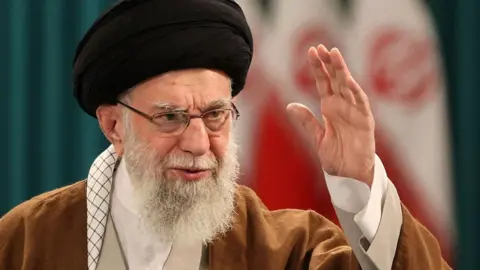
I just got up this early morning, for my Ramadan pre-dawn meal to learn that Ayatolla Ali Khamenie, Supreme Leader of Iran has indeed been killed.
Yes, Ayatollah Ali Khamenei, the Supreme Leader of the Islamic Republic of Iran, has been confirmed dead in yesterday’s joint U.S.-Israeli attack illustrating a historic and highly dangerous turning point in an already volatile theatre of war.
This development , following statements by President Donald Trump and Prime Minister Benjamin Netanyahu immediately raises the central question of what comes next. Must the world now brace for unabated escalation, or is there a way back to de-escalation and diplomacy?
The two competing logics confronting the world are (1) escalation through continued targeting-akin to the case of Hezbollah’s leadership, where neutralizing an enemy’s figurehead has to be maintained by relentless pressure on potential successors until the US-Israel strategic objective of regime change is realized. In that scenario, every successor could be systematically targeted, fueling endless cycles of violence.
Certainly, this approach threatens a broader conflagration, potentially provoking more ferocious counter-attacks on U.S. and Israeli assets across the Middle East and beyond.
Or (2) de-escalation through diplomatic engagement with the hope that weakening Iran’s leadership will trigger internal political shifts similar to the Venezuela operation, where the successive leader acceded to external pressures. History however counsels us that weakening or oblitrating of a country’s military forces does not reliably yield peaceful and orderly political transformation. Iraq and Libya are typical examples where externally-induced fractures led not to stable democracy but to power vacuums, failed states, and dominance by warlords and criminal actors.
A wholesale decapitation strategy risks plunging not only the Middle East but the global economy into deeper instability. We must keep on reminding ourselves that a war of this magnitude, with oil markets, trade flows, and international security at stake, can quickly generate cascading economic and humanitarian disasters.
In this context, I am compelled to ask whether the successor to the late Supreme Leader will be appointed through Iran’s constitutional framework, and if so, will that successor adopt a posture of retaliatory escalation or diplomatic restraint?
Iran has announced a 40-day mourning period, but the composition, ideology, and inclinations of its next leadership remain uncertain.
What role will the international community play now?
Yesterday’s United Nations Security Council emergency session ended with the Secretary-General issuing a communique condemning both the U.S.-Israeli pre-emptive action and Iran’s retaliation. Such equivocation, a symmetrical condemnation without proportionality, reads like a diplomatic ambivalence. It reflects an organization struggling to exercise meaningful influence over superpower conflict, rather than shaping its resolution.
In my view, that is not mere nuance, but hypocrisy presented as diplomacy. A world body that issues balanced statements yet lacks mechanisms to enforce peace is reduced to symbolism when it is needed most for conflict prevention and resolution.
We cannot afford to repeat the mistakes of the past by assuming that military decapitation will yield orderly political transition. Nor can we surrender to the notion that only force can bring about change. Diplomatic negotiation, even amid serous mistrust, remains the only viable route to prevent further escalation that could engulf the region and destabilize the world.
The international community, guided by multilateral institutions, must insist on immediate cessation of hostilities, humanitarian access, and renewed dialogue involving all stakeholders. Anything less risks transforming a dangerous regional war into a global crisis.
Retired Lt Colonel Samsudeen Sarr
Former Commander, The Gambia National Army