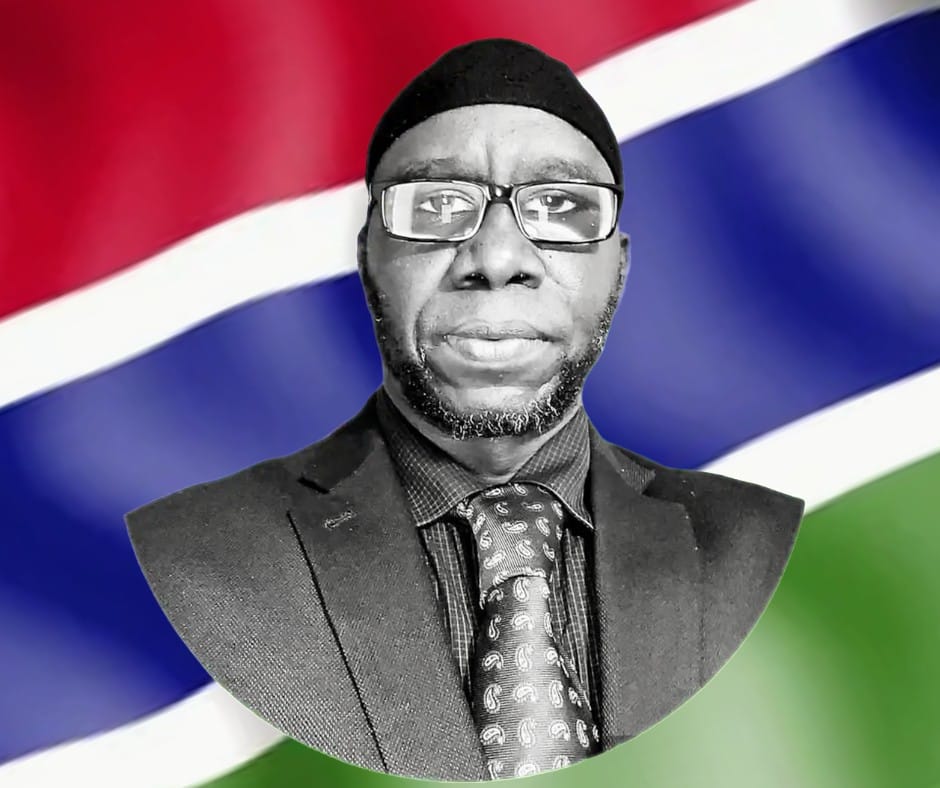
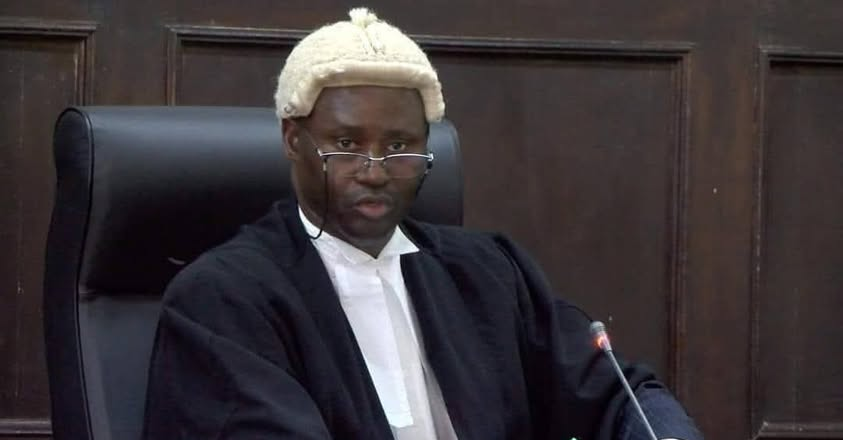
The count-by-count breakdown of the judicial reasoning for the acquittal of Ousainou Bojang (1st Accused) and Amie Bojang (2nd Accused) in the judgment delivered on March 30, 2026, by Justice Jaiteh.
Count 1 & Count 2: Murder (Police Constables Sang J. Gomez and Pateh Jallow). Justice Jaiteh found that the prosecution failed to establish beyond a reasonable doubt that Ousainou Bojang was the person who shot the officers.
Justice Jaiteh identified “numerous contradictions, inconsistencies, and evidential gaps” in the prosecution’s case regarding the identification of the shooter. He established that the evidence on the crucial issue was “fraught with serious doubt,” which must legally be resolved in favour of the accused.
Justice Jaiteh also highlighted that Ousainou Bojang (DW1) testified that at the time of the shooting (approx. 9:00 p.m. on September 12, 2023), he was at his workplace, Smiling Coast Residence in Brufut, performing his night shift as a security guard.
He maintained that he was at his post from 7:00 p.m. until 7:00 a.m. the following morning, except for a brief trip to a nearby shop at 11:00 p.m.
Failure to investigate an alibi, Justice Jaiteh emphasised that when an alibi is raised with sufficient particulars, the prosecution has a legal duty to investigate and disprove it. Justice Jaiteh found the state’s investigation was “selective, coercive, and ultimately indifferent to the truth”.
Justice Jaiteh stated that investigators failed to verify the alibi through objective means such as duty rosters or neutral co-worker interviews, instead using “pressure, intimidation and detention” against witnesses who supported it. This failure was deemed “fatal to the prosecution’s case”.
Inadmissibility of extra-Judicial statements, while the prosecution relied on out-of-court statements, Justice Jaiteh ruled their “probative weight” was “substantially diminished” because they contradicted oral testimony and lacked independent corroboration. Justice Jaiteh concluded they could not form the sole basis for a finding of guilt.
Count 3: Acts of Terrorism. The charge alleged that the attacker attacked the officers with a firearm, resulting in their deaths. Justice Jaiteh found that because the prosecution failed to prove that Ousainou Bojang was the shooter in the murder counts, this charge “necessarily fails”. No credible evidence was produced to identify him as the perpetrator of the alleged terrorist act.
Count 4: Attempt to Commit Murder (Constable Ansey Jawo) Justice Jaiteh stated that the prosecution had to prove Ousainou Bojang had a direct intention to kill and performed an overt act toward that goal.
Justice Jaiteh highlighted that the alleged victim, Police Constable Ansey Jawo, admitted under cross-examination that she could not identify Ousainou and had only seen images of Ousainou Bojang on social media and without identification from the victim, Justice Jaiteh found the evidence insufficient.
Count 5, Grievous Bodily Harm (Constable Ansey Jawo) Justice Jaiteh States that the count required proof that the 1st Accused unlawfully caused “grievous harm” to the victim.
Justice Jaiteh cited the same “evidential deficiency” as in Count 4. He noted there was “simply no credible evidence” identifying Ousainou Bojang as the person who caused the injuries to Constable Jawo. Justice Jaiteh applied the fundamental principle that any reasonable doubt must be resolved in favour of the accused.
Count 6: Accessory After the Fact to Murder (Amie Bojang). The acquittal of Amie Bojang was based on both a legal principle and the court’s assessment of her testimony.
Justice Jaiteh highlighted that the liability of an accessory is “fundamentally dependent upon the existence of a proven principal offence”. Since the court had already acquitted Ousainou Bojang of murder, the foundational element for the charge that a murder had in fact been committed could not be established.
Justice Jaiteh applied the legal maxim that “where the principal offence collapses for want of proof, the superstructure of accessory liability built upon it must necessarily fall”.
Justice Jaiteh found Amie Bojang’s evidence to be “consistent, credible, and corroborated by independent witnesses” regarding her movements and she did not know any criminal activity of her brother.
Verdict: Both Ousainou Bojang and Amie Bojang were acquitted and discharged on all counts.