
In diplomacy, as in war, opportunities are rarely lost in dramatic fashion. More often, they are quietly abandoned, filed away, deprioritized, or sacrificed at the altar of caution. The story of The Gambia’s 2015 initiative at the United Nations is a textbook example of how history can be surrendered not by defeat, but by hesitation.
At a time when much of the world was still reluctant to elevate the question of slavery and colonialism beyond moral lamentation, The Gambia chose a different path. It moved to formalize the issue within the framework of international law, seeking recognition of these historical injustices as crimes against humanity and laying the groundwork for reparative justice. This was not an act of rhetorical activism but a calculated diplomatic intervention at the United Nations General Assembly.
The Mission in New York, under Ambassador Mamadou Tangara, understood the gravity of the undertaking. Reinforcements were requested, and, to the credit of Banjul, promptly dispatched. Two legal experts and a policy officer joined us in New York for the effort, transforming a national position into a structured international campaign. By 2016, the initiative had begun to gather continental and transatlantic momentum, drawing in the African Union and CARICOM, no small accomplishment for a small state operating within the intricate hierarchies of global diplomacy.
Then came the change of government in 2017.
What followed was not a purge of capacity. On the contrary, continuity prevailed, at least on paper. The principal actors including the ambassador and the legal advisor remained in place. Institutional memory was intact. The machinery of diplomacy did not collapse but simply… idled.
The explanation later offered was that pursuing the resolution risked antagonizing European development partners which has the distinct quality of sounding reasonable while being historically unpersuasive. It invites a deeper question of when the pursuit of justice require prior approval from those potentially implicated in its claims.
One is left to wonder whether the calculation was strategic prudence or an overestimation of external sensitivities. After all, if diplomacy is the art of balancing interests, it is also, at critical moments, the test of whether a state can distinguish between dependence and submission.
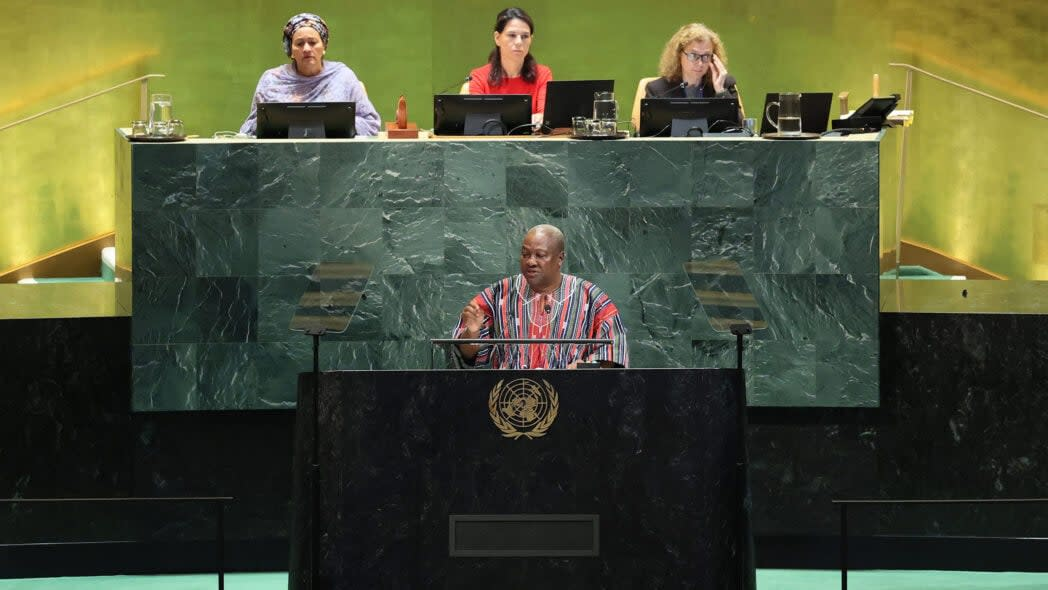
Nearly a decade later, the very same idea, stripped of its Gambian origin but intact in substance, re-emerges with remarkable force. Under the leadership of John Dramani Mahama, Ghana successfully shepherded Resolution A/80/L.48 through the United Nations General Assembly on March 25, 2026. Timed with the International Day of Remembrance of the Victims of Slavery and the Transatlantic Slave Trade, the resolution achieved what The Gambia had once set in motion, a global acknowledgment of the transatlantic slave trade as the gravest crime against humanity, accompanied by a structured call for reparative justice.
The resemblance between the two initiatives is not merely coincidental but almost archival.
And yet, in the official narratives surrounding this diplomatic milestone, The Gambia is conspicuously absent, as though the earlier effort had never existed, or worse, had never mattered. International diplomacy, it would seem, has little tolerance for unfinished initiatives.
This silence raises uncomfortable but necessary questions.
Why did those entrusted with continuity choose not to continue? Why was an initiative that had already secured continental backing allowed to dissipate without resistance? And perhaps most curiously, why is there so little trace of it today within the institutional memory of the very system it sought to influence?
It would be easy, too easy, to attribute this to the shifting priorities of a new administration. But that explanation, while convenient, is insufficient. States do not lose historic opportunities merely because governments change; they lose them when those who remain fail to recognize their enduring value.
There is, in this episode, a quiet lesson in the politics of omission. Not every failure announces itself. Some simply recede into the background until another actor, more persistent or less cautious, carries the idea across the finish line.
To its credit, Ghana demonstrated that persistence. But the question that lingers for The Gambia is more introspective: how does a state move from being an early architect of a global normative shift to an uncredited spectator of its eventual success?
History, after all, is not only written by those who act, but by those who finish what they begin.
By Lt. Colonel Samsudeen Sarr
Former Commander of The Gambia National Army