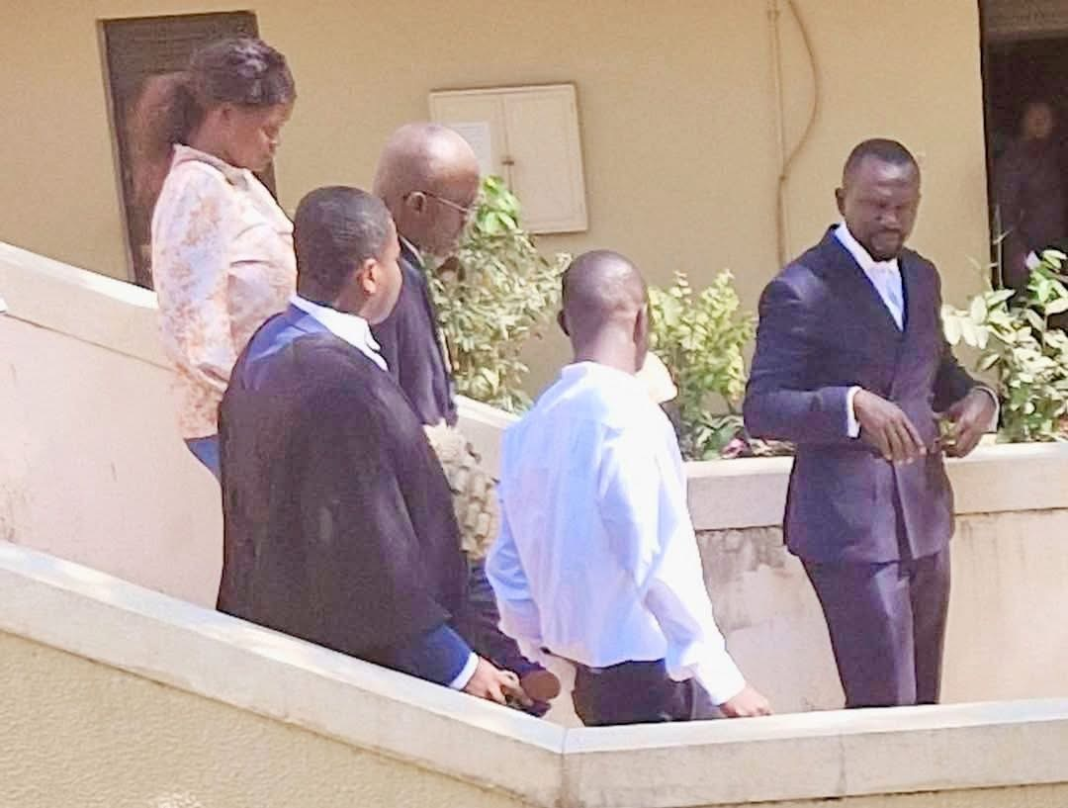
Lawyer L.K. Mboge continued the cross-examination of Abdoulie Ceesay, an officer of the Drug Law Enforcement Agency, The Gambia (DLEAG), in the ongoing trial concerning former Magistrate Ebrima Janko Colley, Kanifing Magistrate Court Registrar Ridwan Othman, and Court Clerk Mariama Jankey Tamba. The individuals in question are confronted with allegations of theft, fraud, breach of trust, involvement with prohibited substances, and neglect of their official responsibilities.
During the proceedings, Lawyer Mboge presented two documents—a letter addressed to the Chief Justice and a response regarding an exhibit of 52 blocks of cocaine—and asked the witness to confirm whether they were the same documents he had sent to the Chief Justice. Ceesay acknowledged the validity of the documents, recognising one as his letter and the other as the response from the Chief Justice’s office.
Mboge subsequently sought to submit the documents as evidence, a motion that faced no opposition from the prosecution. Justice Aryee accepted the documents as evidence and designated them as exhibits D1 and D2.
The defence attorney subsequently showed the charge sheet to the witness, requesting verification of the arrest date for one of the accused, Babucarr Muhammed Sallah. Ceesay confirmed the charge sheet, noting that Sallah was arrested on September 6, 2023, and officially charged on September 23, 2023.
Lawyer Mboge enquired, “Do you remember the plea of the accused?” The witness stated, “As I remember, the accused first pleaded not guilty but subsequently changed it to guilty.” Lawyer Mboge asked, “Do you know why he changed his mind?” The witness responded, “No, I do not know.”
The lawyer enquired, “Did you confirm to the court that the drugs were analyzed?” The witness replied affirmatively, “Yes, that is the reason the analytical report was issued.”
“Do you recall the date of the analytical report?” Lawyer Mboge asked. The witness replied, “I’m afraid I cannot remember the date, as I do not have the analytical report with me at this moment,”
“My lord, with the court’s permission, I request to present the analytical report to the witness for confirmation,” Lawyer Mboge stated.The application was approved by the presiding judge, and the document was presented to the witness. Upon review, the witness stated, “I cannot verify the document as it did not originate from our office; instead, it was provided by a defence lawyer.” Our analytical report is stamped and ready in the office.
Lawyer Mboge continued, “You referenced the two documents that are pertinent to the case: the weighing report and the analytical report.” Could you submit it to the court? The witness responded, “My lord, I am not the agency, and the document can be found at the agency (DLEAG).” I am presently on leave.
Lawyer Mboge stated, “This letter addressed to the Chief Justice is dated October 15, 2023.” The duration between the conclusion of the case and your request is nearly 20 days. What caused the delay? The witness replied, “I am unable to respond to that; the directive originated from the authority.”
Lawyer Mboge then enquired, “From the date of October 4, 2023, when the exhibit was analysed, where was the drug stored?” The witness stated, “It was at the exhibit management unit at the DLEAG.”
Lawyer Mboge remarked, “Thus, it was the DLEAG officer who carried the drug from your office for laboratory testing and subsequently returned it to your office.” The witness affirmed, “My lord, I am aware that the DLEAG office is responsible for the storage of drugs.”
Lawyer Mboge stated, “I am asserting that it was the officer who took the 52 blocks for testing.” The witness responded, “No, the 52 blocks were not taken; only a sample was.”
“Lawyer Mboge suggested that the DLEAG officer could not tamper with the drug.” The Director of Public Prosecutions, A.M. Yusuf, raised an objection, stating that the court is meant for evidence rather than assumptions, and the Judge upheld this objection.
Lawyer Mboge continued, “So, when it was analysed, the results turned out to be inconclusive?” The witness responded, “I’m not an analyst, so I can’t say.”“Were the 52 blocks of drugs tested prior to being entered into evidence?” Mboge, the lawyer, enquired. The witness stated, “In court, when the exhibit management presented the 52 blocks, I verified them. If that is what you are referring to as testing, then yes.
“Are you aware of the colour of the blocks inside the carton?” Lawyer Mboge asked. The witness remarked, “I am unable to identify the colour; they were enclosed in a taped carton.”
“Could you inform the court if the 52 blocks were tested individually?” Mboge, the lawyer, enquired. The witness stated, “I cannot remember, as I was not the officer in charge of testing.”
“On the initial day of the case, when the accused entered a guilty plea, did you return to verify the drugs?” Lawyer Mboge urged. The witness clarified, “It wasn’t on the first day of the case when the accused entered a plea of guilty.” On the second day of the trial, he changed his plea to guilty, and the drugs were presented for fact and forfeiture.
“Have you provided a statement regarding this matter to the police?” Mboge, the lawyer, enquired. The witness replied, “Yes, I provided a statement.”
“My lord, I respectfully request that his statement be provided by the state,” Lawyer Mboge stated, observing that there are two statements available. The application received approval, and Director of Public Prosecutions, A.M. Yusuf, was requested to supply it; meanwhile, Lawyer Mboge persisted in posing another question.
“Could you please confirm to the court whether there was a single analytical report concerning the 52 blocks?” The witness replied, “Indeed, my lord, for the case I prosecuted, there existed only one analytical report; however, subsequent to the case, another analytical report was produced.”
“Did you really combine all 52 blocks into a single test?” Lawyer Mboge asked. The witness emphasised, “As I mentioned, I am merely a prosecutor, not an analyst.”
Lawyer Mboge stated, “So, in your 19 years of experience, you don’t know that samples are extracted from all the 52 blocks.”The presiding judge observed that the designated time had run out before giving a response. The case has been postponed to Tuesday for further proceedings.
The case pertains to state charges brought against Ebrima Janko Colley and Ridwan Othman for conspiracy to commit a felony, in violation of Section 368 of the Criminal Code. The prosecution claims that in October 2023, at the Kanifing Magistrate’s Court, the two individuals conspired to steal 45 blocks of cocaine that had been presented as evidence in a criminal case.
Colley and Othman face charges of theft on the second count, in violation of Section 245 and subject to penalties outlined in Section 257 of the Criminal Code. They are accused of stealing the 45 blocks of cocaine from the court.
The third count encompasses allegations of fraud and breach of trust, in violation of Section 112 of the Criminal Code, along with involvement in prohibited drugs, in contravention of Section 33 of the Drug Control Act.
Mariama Jankey Tamba is also facing a charge of neglect of official duty, in violation of Section 113 of the Criminal Code. She is accused of failing to mark 52 blocks of cocaine that were tendered as exhibits in a criminal case.
Magistrate Colley and his co-accused have all pleaded not guilty, denying the allegations against them.