
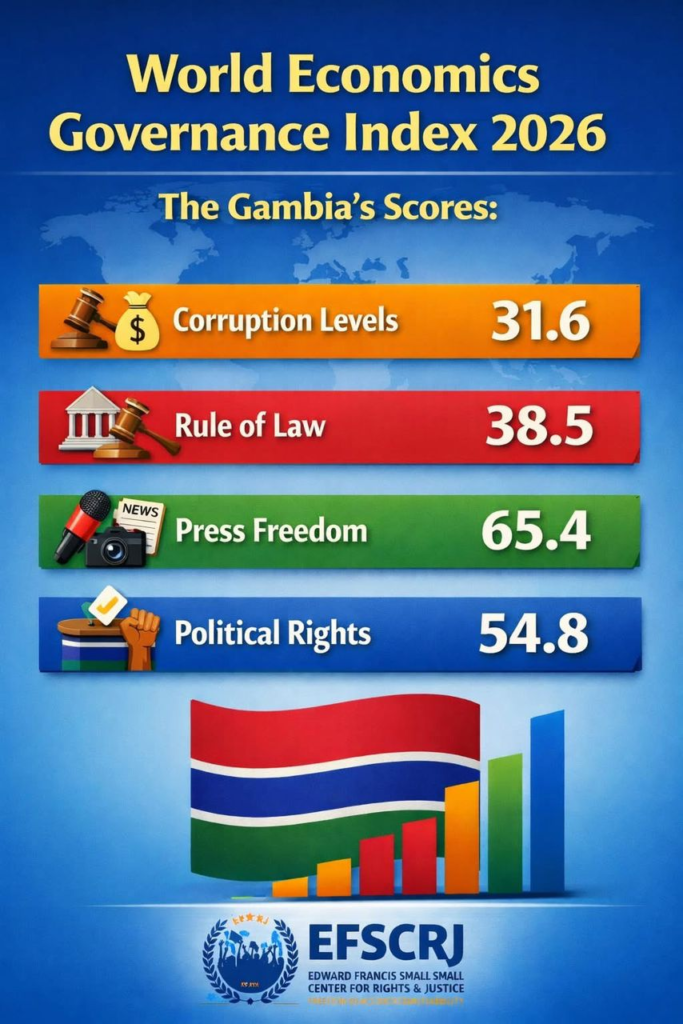
The Edward Francis Small Centre for Rights and Justice has received with grave concern the findings of the World Economics Governance Index 2026 regarding the Gambia’s governance performance. The report evaluates governance across four core indicators: corruption perception, rule of law, press freedom, and political rights, measured on a scale of 0 to 100. The Gambia’s overall score stands at 47.6, earning the country a Grade C (Average).
The Gambia’s Scores:
- Corruption Levels: 31.6
- Rule of Law: 38.5
- Press Freedom: 65.4
- Political Rights: 54.8
The relatively higher scores in press freedom (65.4) and political rights (54.8) indicate that civic space remains comparatively open. Since 2017, media houses, civil society organizations, and political parties have expanded and are generally operating without systematic repression.
However, these scores also reflect persistent vulnerabilities. Recent cases of arbitrary arrests, detentions, and charges against journalists, activists, and opposition figures demonstrate that civic freedoms remain fragile. For civic space to be genuinely open, safe, and resilient, we hold that the Gambia should not score below 80 out of 100 in these indices.
Corruption and Rule of Law: An Alarming Deficit
The most troubling findings lie in:
• Corruption (31.6)
• Rule of Law (38.5)
These scores are deeply concerning and reinforce findings from civil society monitoring, national surveys, and international assessments. EFSCRJ has consistently documented and raised alarms over rising incidents of corruption, abuse of office, weak enforcement of accountability mechanisms, and disregard for legal and constitutional standards. A country cannot sustain democracy where corruption flourishes and the rule of law is selectively applied.
Political analysts have long observed that a country may enjoy relatively open civic space while simultaneously suffering from entrenched corruption, weak institutions, and systemic abuse of power. the Gambia increasingly reflects this paradox.
We lament that while the end of dictatorship in 2017 expanded freedoms, this democratic transition has not yet produced strong, rules-based governance capable of controlling corruption, ensuring institutional discipline, guaranteeing equal application of the law, and delivering equitable development.
EFSCRJ therefore urges Pres. Adama Barrow to treat this report as a governance warning signal. Strengthening adherence to the rule of law and demonstrating measurable, sustained commitment to combating corruption must now become central priorities of his government.
We urge the President to realize that corruption and disregard for the rule of law remain the greatest threats to national stability, economic growth, and social justice. If left unchecked, they undermine public trust, deepen inequality, and weaken democratic institutions.
EFSCRJ’s Commitment
In light of these findings, EFSCRJ will intensify its accountability work focusing on:
• Abuse of power
• Corruption and illicit enrichment
• Institutional inefficiency
• Violations of human rights
• Enforcement of transparency laws
The future of the Republic depends not merely on electoral democracy, but on disciplined constitutional governance grounded in transparency, accountability, and justice.
Our Independence. Our Democracy. Our Responsibility.
2026 – Year of Empowered Citizens.