
Former Coalition-2026 secretary Ebrima S. Bah has opened up about his resignation from the Coalition Mediation Committee (CMC), saying prolonged disagreements between opposition parties over whether to adopt a candidate-led or party-led coalition model had pushed the negotiations towards an increasingly difficult deadlock.
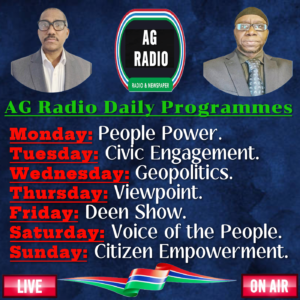
Bah, who resigned alongside CMC deputy chairperson Momodou Satou Dibba, was a guest on AG Radio’s weekly Thursday Viewpoint programme, where host Salieu Njie and panelists questioned him extensively about the internal difficulties confronting the coalition initiative.
Until their departures, Professor Yerro Mballow served as chairperson of the CMC, Dibba as deputy chairperson, Lawyer Assan Martin as spokesperson and Bah as secretary.
Bah strongly rejected suggestions that the mediation committee was established to advance the interests of any particular political party.
“Gambians should not harbour a sinister mindset against Coalition-2026. There is nothing sinister behind the formation of the Coalition Mediation Committee,” he said.
According to Bah, the CMC was established as a neutral platform to bring opposition parties together and ensure that both larger and smaller political organisations felt respected during negotiations.
He said smaller parties were concerned that joining forces with larger opposition parties could result in their political identities and influence being swallowed up, while larger parties also wanted to avoid appearing interested only in dominating the coalition.
Bah said more than 20 political parties and groups initially expressed interest in the negotiations because of a shared belief that opposition cooperation would strengthen their chances of defeating President Adama Barrow in the December 5 presidential election.
However, after about 14 negotiating sessions, the parties remained divided.
“So it was as if the coalition talks became fragmented into two camps. One camp favoured a candidate-led model while the other favoured a party-led model,” Bah explained.
Under a party-led coalition arrangement, an established political party would effectively lead the alliance and provide its presidential candidate. Supporters of the candidate-led model, however, favour selecting an individual who would represent the coalition as a whole rather than contest primarily under the identity of one political party.
Bah said the CMC repeatedly attempted to mediate between the two camps but neither side appeared willing to make sufficient concessions.
“The main issue why the opposition political parties could not agree was because the two camps disagreed on the candidate-led and party-led models of coalition flagbearership,” he said.
According to Bah, time was running out while negotiations continued without a breakthrough, eventually convincing him that the competing positions were becoming irreconcilable.
His account raises an important question about the structure of Coalition-2026 itself.
The disagreement is not merely about personalities. It concerns how political strength should be recognised within an opposition alliance.
Supporters of equal voting rights among participating parties argue that such a system prevents larger political organisations from overwhelming smaller partners. But larger parties can equally argue that a political organisation commanding hundreds of thousands of voters should not necessarily have the same influence as a party with little demonstrated electoral support.
That tension appears to have been at the heart of the Coalition-2026 dispute.
Despite his resignation, Bah insisted that the remaining coalition partners would proceed with their planned flagbearer selection on Saturday, August 8.
“There will be a flagbearer this Saturday,” he said.
Bah predicted that two opposition alliances could eventually emerge to challenge President Barrow and expressed confidence that one of them could defeat the incumbent.
Whether that prediction proves correct will depend not simply on the creation of alliances but on whether opposition leaders can convince voters that their coalitions are built around a coherent political programme rather than merely opposition to the incumbent.
For Coalition-2026, Bah’s resignation is therefore more than an internal personnel change.
It is another indication that the central challenge facing Gambian opposition politics remains unresolved: how to unite competing political interests around one leadership structure without making either large or small parties feel that they have surrendered too much.