
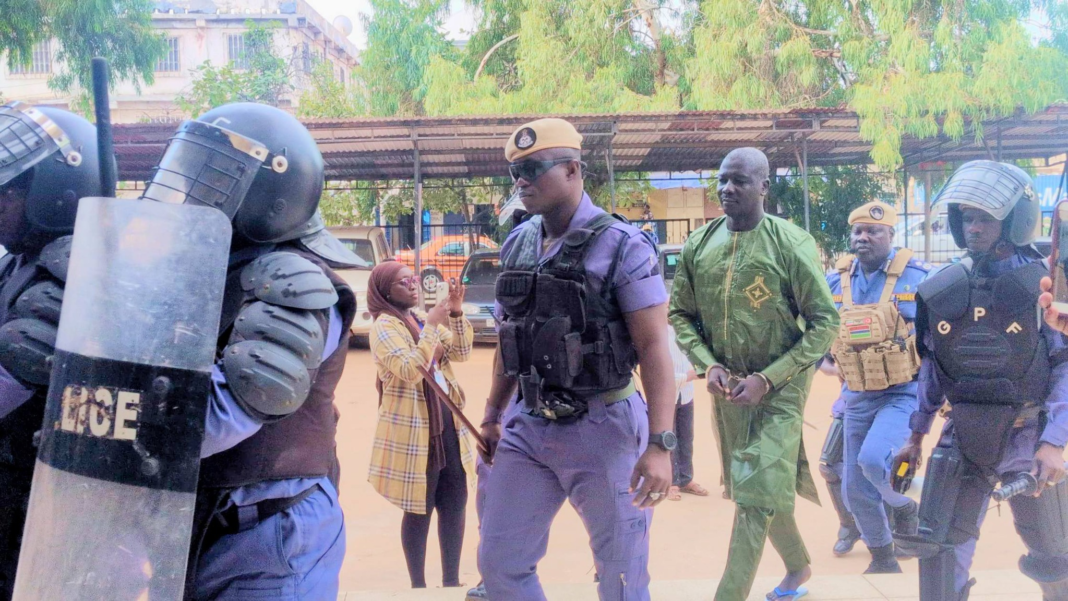
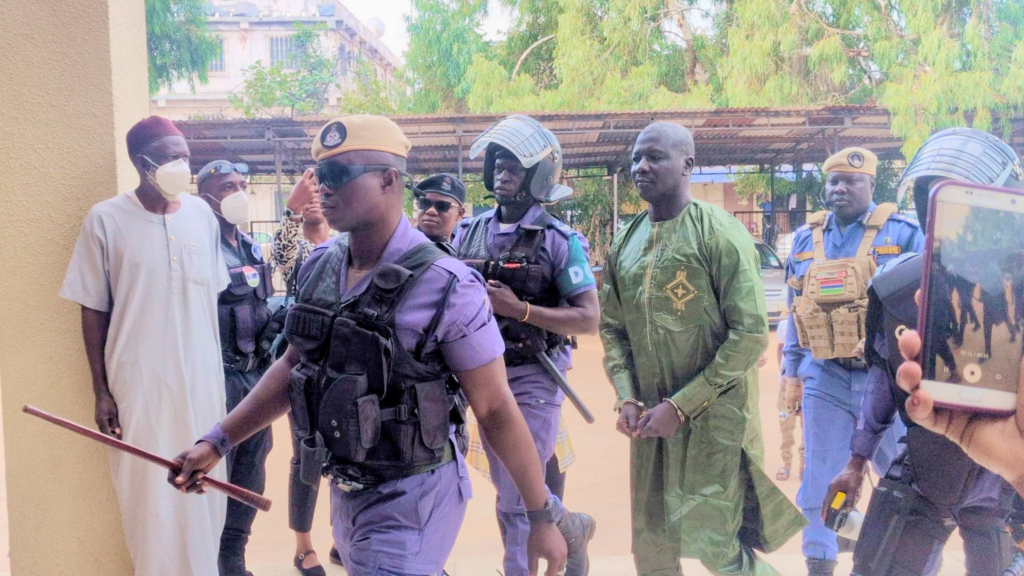
The High Court presided by Justice Sidi K. Jobarteh has dismissed a preliminary objection by defense Counsel S.K. Jobe, who sought to declare the murder charges against Sanna Manjang null and void.
Counsel Jobe argued that the prosecution’s charge was built on a dead and non-existent law.
Following the ruling, Manjang pleaded not guilty to two counts of murder relating to the deaths of Kajali Jammeh (alias “Le Cock”) and Samba Wurry in 2006.
When the case was called, a team of lawyers appeared for the State, led by Deputy DPP E.R. Dougan, alongside P. Gomez, F. Drammeh, M. Jammeh, and A. Badjie. The accused, Sanna Manjang, was represented by Counsel SK. Jobe and F. Jammeh.
The presiding Judge Justice Sidi K. Jobarteh informed the court that the proceedings are for plea taking and ordered the clerk to read the bill of indictment.
The court clerk read the charge sheet stating that the Attorney General charged that Sanna Manjang of Murder, contrary to Section 187 of the Criminal Code, for unlawfully causing the death of Kajali Jammeh in 2006 at Kanilai by cutting his neck with a knife.
Before the clerk read the second count, Counsel S.K. Jobe immediately raised an objection to the competence of the charges filed on 12th January, 2026, by the state.
Counsel Jobe argued that the charges, brought under Section 187 of the Criminal Code, Cap 10, Volume III, were legally invalid because the National Assembly had repealed that law through Section 344 of the Criminal Offences Act, 2025.
“My lady, it is submitted that once a law is repealed, it ceases to exist and its effect is that it is erased from our statute book,” Counsel Jobe stated. “Like a dead person, it cannot be revived or resurrected.”
To support his argument, Counsel Jobe cited landmark cases such as the case of ONAGORUWA V. I.G.P. (1991): Holding that a non-existent statute is dead and cannot be salvaged by the court. Counsel Jobe
Also cited is the case of Madumere v Onuoha (1999), which states that a repeal obliterates a statute as if it had never been passed.
Jobe concluded that since the Criminal Code is no longer recognised under Section 7 of the 1997 Constitution, the entire information was null and void, stripping the court of its jurisdiction.
“Therefore, it is submitted that no person, including the accused person, could be charged with any offence under the said Criminal Code, cap 10.01. The information filed by the prosecution being grounded and built on a dead law renders the entire information null and void, and that being an issue of competence goes to the roots of the jurisdiction of the court to entertain, hear and determine this matter,” Counsel Jobe concluded.
State Counsel E.R. Dougan countered Counsel Jobe’s submission, arguing that the alleged crimes occurred in 2006, making the charges competent.
During her submission, Counsel Jobe objected, accusing Counsel Jobe of giving evidence, but Justice Jobarteh allowed her to continue.
State Counsel Dougan argued that the law in effect at that time must apply, asserting that the new 2025 Act cannot be applied retroactively. She urged the court to disregard the defence’s “application” and proceed to the plea.
In her ruling, Justice Sidi K. Jobarteh identified the core issue as whether the 2025 repeal rendered the current charges incompetent. She ruled that while Section 344 repealed the old Code, it must be read alongside the savings clause in Section 2(1)(c).
“Nothing in this Act shall affect the liability or trial of a person… in respect of an act done or commenced before the commencement of this Act.” Justice Sidi K. Jobarteh noted
Justice Jobarteh emphasised that acts committed before the 2025 Act remain governed by the previous law. Justice Jobarteh explained that criminal liabilities attach at the time of the offence, not the trial, and that applying the new Act retrospectively would violate the accused’s constitutional right to a fair trial.
In his final decision, Justice Jobarteh dismissed the objection and declared the charges competent.
“The repeal of the Criminal Code by Section 344 of the Criminal Offences Act 2025 does not invalidate prosecution for offences committed before the commencement of the Criminal Offences Act 2025. The preliminary objection is dismissed, and the accused should take his plea,” Justice Jobarteh concluded.
Following the ruling, Counsel Jobe requested an adjournment, noting they were served with the bill of indictment yesterday at 15:00 and had not yet consulted with his client (Sanna Manjang).
Justice Jobarteh refused to adjourn the plea taking but stood the court down for 20 minutes for Counsel Jobe to consult his client (Sanna Manjang) in the court library.
After a private consultation in the court library, the charges were read to Sanna Manjang in English by the court clerk.
Count 1: Murder, contrary to Section 187 of the Criminal Code, Cap 10, 2009, you, Sanna Manjang, unlawfully caused the death of Kajali Jammeh in 2006 at Kanilai by cutting his neck with a knife.
Count 2: The murder of Samba Wurry, you, Sanna Manjang, aforethought killed Samba Wurry by stabbing him in the chest with a knife.
Sanna Manjang pleaded not guilty to both counts. State Counsel E.R. Dougan requested an adjournment to prepare the state’s first witness. Justice Jobarteh granted the application and adjourned the matter to 9th February, 2026, for the commencement of the hearing