Political commentator Bun Dawda has warned that President Adama Barrow could benefit significantly from the continuing fragmentation of The Gambia’s opposition ahead of the 2026 presidential election, even as he maintains that the incumbent remains politically beatable.
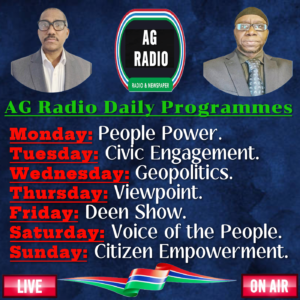
Appearing on AG Radio’s weekly Saturday Voice of the People programme, Bun Dawda argued that opposition parties must stop attacking one another and concentrate on building the strongest possible electoral challenge against Barrow.
According to him, a single opposition coalition would provide the clearest route toward defeating the incumbent.
“Preferably, one single opposition camp would have been better to easily unseat the incumbent,” Bun Dawda said.
However, he rejected the suggestion that the failure to establish one grand opposition coalition automatically guarantees Barrow another term.
“Since this is not possible and the opposition is divided, this is not necessarily bad. I believe that one single party could also beat Barrow,” he said.
That argument raises one of the most important strategic questions of the 2026 presidential election.
Does the Opposition Need One Candidate?
Unlike electoral systems that require a candidate to secure more than 50 percent of the vote, Gambia’s presidential election is determined by plurality.
The candidate who receives the highest number of votes wins, even without an absolute majority.
The 2016 presidential election offers the clearest example.
Adama Barrow defeated Yahya Jammeh with roughly 43 percent of the national vote. Jammeh received arround 40 percent, while Mama Kandeh secured about 17 percent.
That means opposition fragmentation does not automatically determine the outcome.
What matters is how those votes are distributed.
If several opposition candidates compete primarily for the same anti-Barrow voters, fragmentation could strongly favour the president.
But if one opposition party becomes clearly dominant and emerges as the principal alternative government, it could theoretically defeat Barrow even without securing the formal backing of every opposition party.
The problem for the opposition is that without reliable nationwide polling, it is difficult to determine which party currently possesses that level of electoral strength.
Claims by individual political parties that they can defeat Barrow alone therefore remain political assertions until tested at the ballot box.
The 2016 Lesson
The strongest argument in favour of opposition unity remains the experience of 2016.
For years, Yahya Jammeh had benefited from opposition fragmentation.
That changed when seven opposition parties agreed to support Adama Barrow as a coalition candidate.
Despite disagreements within the coalition, that cooperation achieved something opposition parties had repeatedly failed to accomplish: removing Jammeh through an election.
The lesson for 2026 is therefore powerful.
Political parties do not necessarily have to agree on every ideological or policy issue.
But when their principal objective is to defeat an incumbent, excessive competition among themselves can undermine that objective.
Bun Dawda said the opposition risks repeating the mistakes of previous elections if political leaders spend more time attacking one another than presenting a credible alternative to the government.
The Kandeh Factor
One major change in the 2026 electoral landscape is Mama Kandeh’s decision to align his Gambia Democratic Congress with President Barrow’s NPP-led alliance.
Kandeh previously occupied an important position within the opposition and received approximately 17 percent of the presidential vote in 2016.
His political movement has also maintained substantial support in parts of the country, particularly in regions where the NPP will hope to strengthen its electoral position.
For Barrow, therefore, bringing Kandeh into his political camp potentially offers two advantages.
First, it removes a significant presidential challenger.
Second, it allows the governing alliance to compete for voters who might otherwise have supported an opposition candidate.
Bun Dawda went further, saying that Barrow has deliberately used Kandeh to weaken opposition unity and attract Fula voters.
That remains a political interpretation rather than an established fact.
However, the electoral significance of the NPP-GDC alliance is undeniable.
The opposition must now reassess its calculations without assuming that Kandeh’s traditional supporters will automatically remain outside the governing coalition.
Bun Dawda Disputes Past Election Results
During the programme, Bun Dawda also made claims regarding the credibility of elections under Yahya Jammeh and President Barrow.
He said that Jammeh had access to approximately 300,000 illegal voter cards and therefore never won what Bun Dawda considered a genuinely credible presidential election.
Bun Dawda also said that Barrow did not legitimately win the 2021 presidential election and alleged that the poll was rigged.
That election results remain disputed.
Barrow was officially declared the winner of the 2021 presidential election with approximately 53 percent of the vote.
The United Democratic Party challenged the result before the Supreme Court, but the petition was dismissed.
International election observers broadly described the election as peaceful and credible, although observer missions also identified shortcomings in aspects of electoral administration.
Concerns over voter registration, campaign financing, use of state resources and the independence of electoral institutions remain legitimate areas for scrutiny.
What Happens If the Opposition Fails?
BunDawda concluded his analysis with a warning.
“If the opposition fails to unseat Barrow in this year’s presidential election, the consequences could be dire,” he cautioned.
The precise consequences he envisages may be politically disputed, but his warning raises a broader question for opposition parties.
If they genuinely believe another Barrow presidency would be damaging to the country, how much political compromise are they prepared to make to prevent it?
That question goes directly to the continuing disagreements over coalition models, presidential candidates and leadership arrangements.
The opposition has repeatedly declared that defeating Barrow is its priority.
But declarations alone do not constitute an electoral strategy.
Political parties will have to decide whether their greatest threat is the incumbent — or one another.
For Barrow, every opposition dispute potentially reduces the pressure on his government.
For opposition parties, every public confrontation risks reinforcing perceptions that they are incapable of governing together.
Gambian political history offers contrasting examples.
In 2006 and 2011, divided opposition movements failed to remove Jammeh.
In 2016, unprecedented cooperation succeeded.
But 2026 will not necessarily reproduce either election.
Barrow is no longer the coalition candidate who challenged an entrenched dictator. He is now the incumbent defending his own record.
Meanwhile, the opposition is more fragmented, with competing alliances and several parties believing they possess sufficient strength to lead the challenge.
The election may therefore come down not simply to whether the opposition forms one coalition, but whether one credible alternative emerges strongly enough to convince voters that it can replace the NPP government.
Bun Dawda’s central warning is nevertheless difficult to dismiss: an incumbent does not always need overwhelming popularity to remain in power.
Sometimes, he simply needs his opponents to remain divided.