President Adama Barrow has accused the United Democratic Party (UDP) of being responsible for the failure to adopt a new constitution, saying UDP lawmakers voted against the proposed constitutional bill in the National Assembly. But his comments have reignited questions over the respective responsibilities of government and opposition in the country’s protracted constitutional reform process.
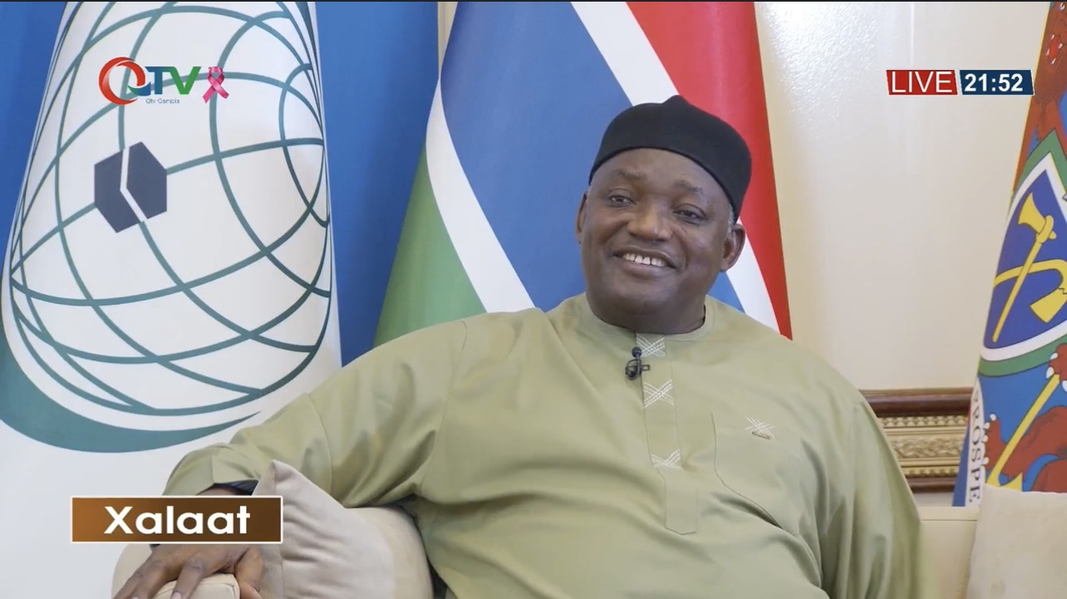
Speaking in an interview with QTV on Wednesday, Mr. Barrow rejected suggestions that his administration lacked the political will to deliver a new constitution, insisting that his government initiated the reform process and made efforts to secure the necessary parliamentary support.
The president was responding to a question about what steps his administration intended to take to ensure that adopting a new constitution became part of his government’s legacy.
Describing suggestions that he opposed constitutional reform as offensive, Mr. Barrow argued that his administration had spearheaded the process from its inception and that the failure to secure the required parliamentary votes could not fairly be attributed to his government alone.
He recalled that the first attempt to introduce a new constitution failed in the National Assembly at a time when his National People’s Party (NPP) had no lawmakers elected under its banner. Following subsequent elections, his political camp secured a parliamentary majority, which he said created an opportunity to revive the reform process.
According to Mr. Barrow, his administration subsequently revised the draft following consultations with stakeholders, including engagements facilitated by former Nigerian President Goodluck Jonathan. He said the consultations helped address contentious provisions and establish common ground before the revised document was returned to the National Assembly.
However, despite commanding a parliamentary majority, the government failed to secure the two-thirds majority required to pass the bill.
Mr. Barrow said the legislation needed more than 40 votes but received approximately 35, falling short of the required threshold.
The president blamed opposition lawmakers, especially those who had openly supported constitutional change, for voting against the proposed law.
When asked to identify the party he considered responsible for the bill’s defeat, he singled out the UDP, claiming that all its lawmakers voted against it.
“UDP. They voted 100% against it. So who killed it there? Is it us or the UDP who killed it? I will answer it; UDP killed it there,” he said.
However, the president’s accusation represents his administration’s interpretation of the bill’s defeat and does not, on its own, settle the broader question of political responsibility for the stalled reform process.
But the government’s duty to negotiate, build consensus and resolve disagreements among lawmakers is also a key part of the debate, though votes from the opposition were vital to securing the required two-thirds majority.
The failure of the NPP-led government to muster the constitutionally required support despite its parliamentary majority is a reminder of the limits of political numbers and the failure of political actors to find adequate agreement on the proposed framework.
The UDP’s opposition to the bill also makes one wonder about the rationale behind its stance, particularly in light of the party’s public position that the 1997 Constitution should be replaced. It is germane to why the reform effort failed to know what its specific objections to the draft are, not just its vote.
One of the key pieces of unfinished business of the political transition in The Gambia since the end of Yahya Jammeh’s rule in 2017 is the process of constitutional reform. The new constitution on offer was seen by many as an opportunity to consolidate democratic institutions, clarify the separation of powers, provide checks against executive excesses and pave the way for presidential term limits.
So the failure to pass the bill is more than just a disagreement between the ruling party and the opposition. It reflects the difficulties of reaching consensus for basic governance reforms in a politically polarized National Assembly.
The Gambia is still operating under the 1997 Constitution. The question is not only which political party should bear the blame for the defeat of the bill, but whether the political leadership of the country can show the willingness to put constitutional reform ahead of partisan interests.