African leaders must stop pretending that Russia’s recruitment of African migrants to fight and die in Ukraine is an unfortunate accident of global politics. It is not. It is the logical outcome of poverty, disunity, and the unfortunate habit of facing world powers one by one instead of as a continent.
This is not a Kenyan tragedy or a Gambian tragedy and certainly not a Senegalese tragedy. It is an African tragedy manufactured by neglect and sustained by silence.
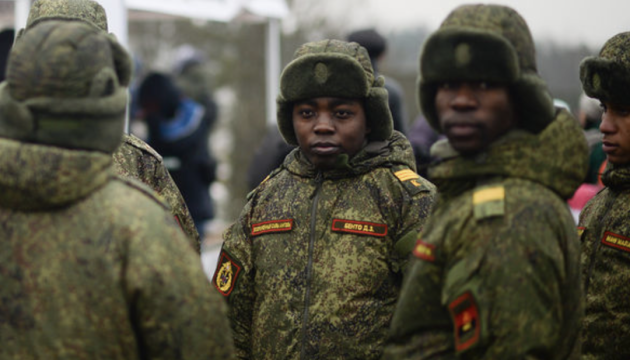
I first encountered this horror through a viral video of Kenyan parents describing how their son migrated to Europe and fell into a trap disguised as opportunity. He was promised a well-paying civilian job in Russia. Instead, he was marched into a military camp, handed a uniform, given rushed training, and dumped on the fiercest frontline in Ukraine. He was dead within a month. Not by accident, but by design. He had been placed on what we call in the military the “contact line,” where soldiers are sent to absorb bullets so others can advance.
At the time, I assumed it was an East African anomaly. I was wrong. Today, Gambians, Senegalese, Ghanaians and other Africans are being harvested the same way. According to an investigation by INPACT, out of 56 Gambians recruited, 26 are already dead. Nearly half wiped out. That is organized disposal of unwanted lives.
And what has been the political response? Kenya’s Foreign Minister, ‘Musalia Mudavadi’, spoke of handling the matter bilaterally with Russia. Bilaterally! One African state negotiating alone with a nuclear power, as if history had taught us nothing. This is the same colonial formula imposed after the Berlin Conference of 1884–1885 which was to break Africa into weak pieces and deal with each piece separately. Our leaders inherited independence but kept the colonial mindset.
Meanwhile, the African Union meets, and ECOWAS meets. They issue communiqués. They smile for cameras. They fly home. And African boys keep dying in Ukrainian mud.
Africa has perfected the theatre of concern and abandoned the discipline of action.
I don’t think migration is the disease but the symptom. The disease is hopelessness coupled with adventurism. Young Africans flee because their societies cannot offer work, dignity, or future. And where desperation goes, predators follow. If Libyan militias sell migrants into slavery, Russian recruiters can definitely sell them into war. Different market but the same rationale that African suffering is profitable.
We all know that Africa is not poor by nature. It is made poor by bad leadership and foreign extraction. This continent has oil, gas, gold, uranium, cobalt, lithium and rare earth minerals. It has rivers powerful enough to light cities. It has land fertile enough to feed continents. It has sun enough to power civilizations. It has a young population bursting with labor and ideas.
Yet Africa cannot power its factories because it barely powers its homes. Nigeria, with about 227 million people and massive oil and gas reserves, cannot guarantee electricity. The Gambia, with barely 2.8 million, also lives in darkness. Different sizes, same misery. Without energy, there is no industry. Without industry, there are no jobs. Without jobs, there is flight for Russian recruitment pipeline.
But why can’t African leaders act together on three emergencies that are killing their youth?
First, the US visa restrictions imposed on more than 25 African countries, which criminalize mobility while doing nothing to fix poverty.
Second, the mass migration of African youth toward a West whose “greener pastures” have become metaphorically barren soil.
Third, the recruitment of desperate African migrants by Russia to fight and die in the Ukraine war.
If young Africans no longer fear drowning in the Mediterranean, starving in the Sahara, or being enslaved in Libya, then dying in a foreign war becomes just another gamble. When U.S. President Donald Trump called African countries “shithole countries,” he obviously insulted us. But he also exposed a brutal truth about millions of Africans who see their homelands as traps, not homes.
That is the psychology of this tragedy. When life feels disposable, war looks like employment.
This is why radio warnings and embassy protests are useless. This is why bilateral diplomacy is a joke. No single African state can intimidate a global power. No lone president can dismantle an international recruitment network. Only a united Africa can do that.
Imagine if Africa spoke with one voice and said no African shall be recruited through deception; any state that does so will face coordinated diplomatic consequences; any African government that ignores this trade in human bodies will be named and shamed. That would be power. But unity frightens African elites more than foreign exploitation, because unity demands sacrifice of personal glory and private deals.
Until that changes, Africa’s youth will remain export goods, exported as migrants, soldiers, and as corpses. Their graves will lie in seas, deserts, and foreign battlefields. Their mothers will mourn in silence. Their presidents will attend summits.
The deaths of 26 Gambians in Ukraine are not just Russian crimes. They are African indictments. They reveal what happens when leaders prefer speeches to strategy and sovereignty without solidarity.
History will not care how many conferences African leaders attended. It will care whether they defended their youth. Right now, they are not defending them. They are abandoning them.
And a continent that abandons its youth is already at war with its own future.
By Lt. Colonel Samsudeen Sarr (Rtd)
Former Commander of The Gambia National Army