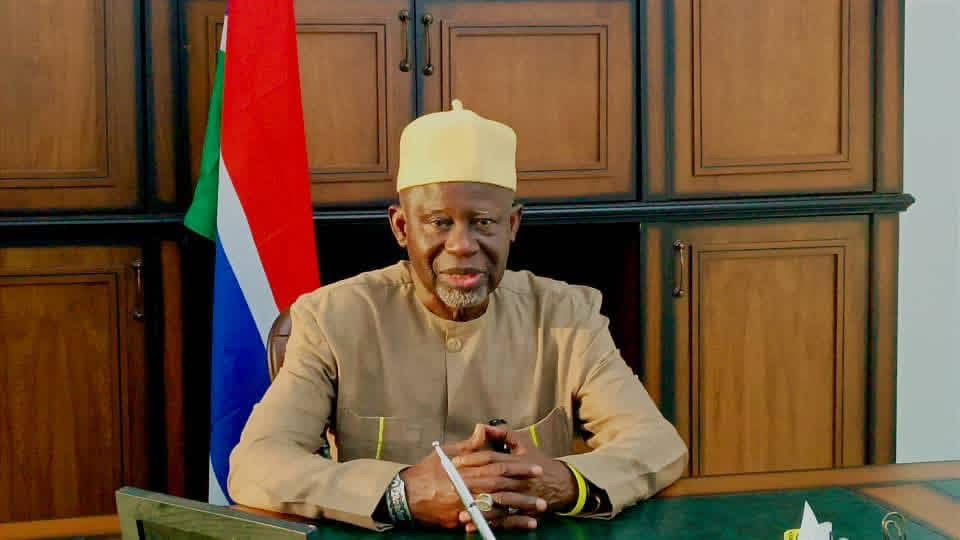
United Democratic Party (UDP) leader Ousainu Darboe has predicted that President Adama Barrow will lose the December 5 presidential election
, arguing that access to state resources and government-funded development projects will not be enough to secure him another term.
Darboe, the UDP secretary general and presidential candidate, made the remarks in an interview with Hill Top FM, dismissing claims from supporters of the ruling National People’s Party (NPP) that the election was already decided in Barrow’s favour.
He pointed to what he described as a contradiction between the governing camp’s confidence and Barrow’s own warnings to supporters not to underestimate the opposition.
“Someone who said ‘game over’ will not say, ‘Don’t underrate me,’” Darboe said. “He knows what is facing him.”
The opposition leader also questioned the purpose of Barrow’s repeated nationwide tours, suggesting that they reflected concern within the governing camp about the strength of the opposition and the level of public dissatisfaction with the administration.
Darboe argued that the president’s political fortunes would ultimately be determined by voters rather than the resources available to his campaign. He expressed confidence that Gambians seeking what he described as progress and peace would support his candidacy on December 5, adding that he believed “God has already done his part.”
He also challenged the NPP’s reliance on road construction and expanded electricity access as evidence of the administration’s achievements. While the ruling party has highlighted these projects in defending its record, Darboe maintained that they would not automatically translate into electoral victory.
The UDP leader was particularly critical of what he described as the use of public resources for political campaigning. Although he acknowledged the president’s right to travel across the country, he argued that state-funded activities should not be used to give the governing party an unfair advantage over its opponents.
Darboe drew a comparison with the administration of former president Yahya Jammeh, saying he was disappointed that some people who had previously condemned the use of state resources for electioneering now appeared willing to accept similar practices under Barrow.
“Even if he goes with the Central Bank on your side, he will lose this year,” Darboe said, using the remark to underline his confidence that access to state resources would not determine the outcome of the election.
On the recent movement of politicians into the NPP, Darboe said individuals were free to make their own political choices. He maintained that he would not attack those who had decided to support the president, even as he continued to challenge the administration’s record.
However, he accused some NPP supporters of using ethnic divisions to undermine his candidacy, alleging that attempts were being made to portray the UDP as a Mandinka-dominated party and turn members of other ethnic communities against Mandinkas.
Darboe rejected the approach, arguing that intermarriage, family relationships and shared national experiences had created strong connections between Gambians from different ethnic backgrounds. He suggested that efforts to exploit ethnic identity for political gain would struggle to overcome those ties.
He also questioned Barrow’s failure to publicly condemn the ethnic rhetoric he attributed to some governing-party supporters. Darboe suggested that the silence raised concerns about how such statements were being addressed within the ruling camp, although he presented no evidence that the president had personally authorised an ethnic-based political strategy.
Responding to criticism over his age and calls for him to leave politics, Darboe said he had not forced himself on the party or its supporters. He maintained that his continued leadership reflected the choice of those who wanted him to represent them.
He added that parties and prominent political figures had joined the coalition backing his candidacy because of their shared objective of defeating the Barrow administration, which he accused of poor governance.
With the December 5 election approaching, Darboe’s remarks signal a determined opposition campaign focused on state resources, governance and ethnic politics.The Gambian electorate will ultimately decide Barrow’s fate and a defeat is a political forecast.”