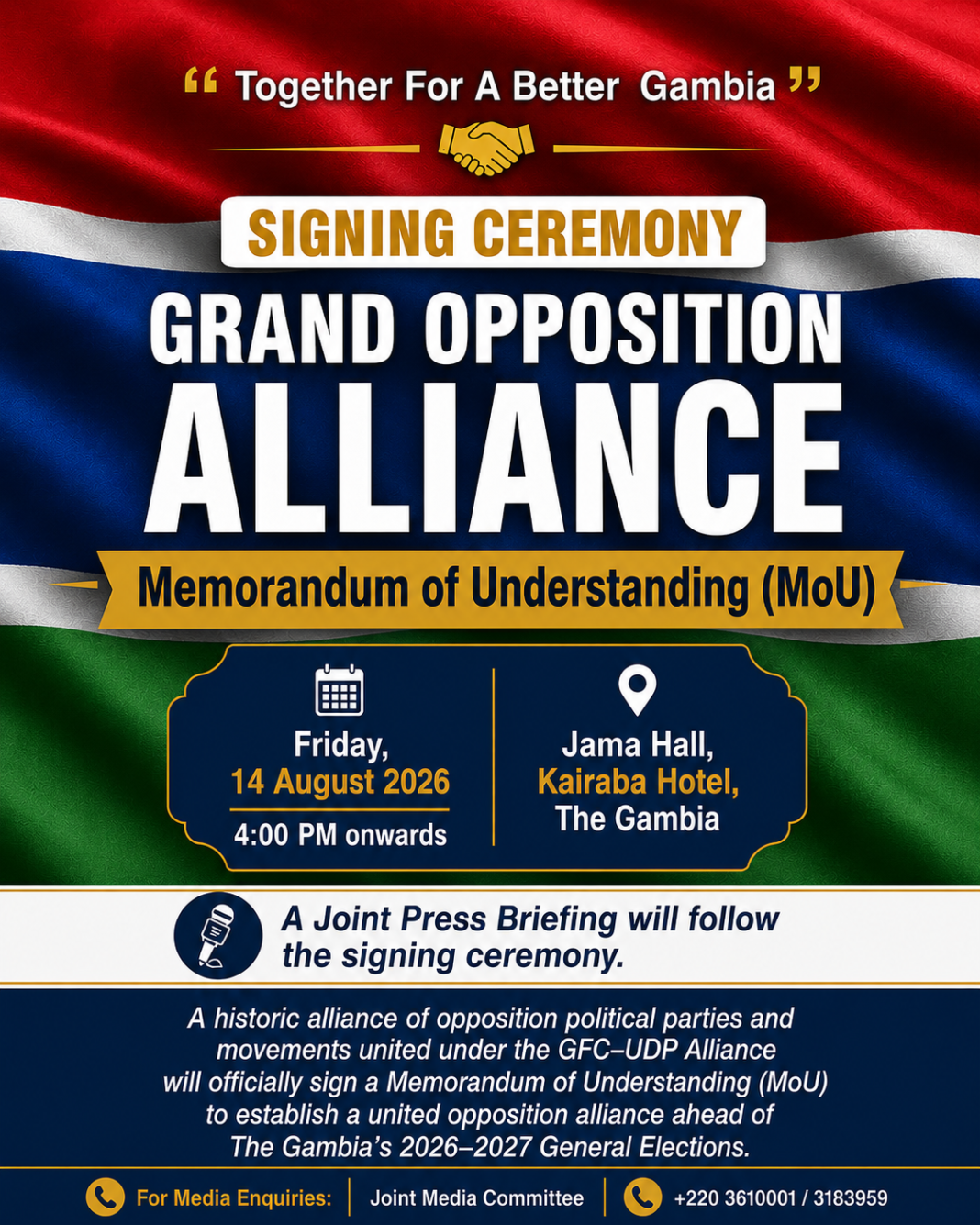
The Gambia First Coalition (GFC) and the United Democratic Party (UDP) are set to take a significant step towards building a new opposition front on Friday, 14 August 2026, when political parties and movements associated with the initiative formally sign a Memorandum of Understanding establishing what organisers have described as a Grand Opposition Alliance.
According to a media invitation issued by the UDP Media and Communications Team on behalf of the GFC, the signing ceremony is scheduled for 4:00 p.m. at Jama Hall, Kairaba Hotel, and will be followed by a joint press briefing.
While the ceremony is being presented as a milestone in opposition cooperation, its political significance goes beyond the signing of another document. The central question is whether the GFC–UDP arrangement can succeed where several previous opposition coalition efforts have struggled: transforming agreements among political leaders into a disciplined and electorally effective national movement.
The timing is particularly important. The Independent Electoral Commission has fixed the presidential election for 5 December 2026, leaving political parties with less than four months to consolidate their structures, mobilise voters and clarify their electoral strategies.
The new initiative also emerges against the backdrop of serious disagreements within the separate Coalition 2026 process. The UDP recently withdrew from those negotiations following disputes surrounding the structure and candidate-selection process. Party leader Ousainou Darboe subsequently maintained that leaving that process did not mean the UDP had abandoned the broader objective of opposition unity.
The GFC–UDP alliance could therefore represent an attempt to construct an alternative centre of opposition cooperation around the country’s largest established opposition party.
The 2016 Lesson
There is an obvious historical precedent.
In October 2016, seven opposition parties united behind Adama Barrow as their presidential candidate against then-President Yahya Jammeh. That decision fundamentally changed the electoral arithmetic and helped produce one of the most consequential elections in Gambian history.
But 2026 is not 2016.
Barrow is no longer the relatively unknown opposition candidate challenging a government that had ruled for more than two decades. He is now the incumbent president, seeking another term and heading a political establishment with the advantages that normally accompany incumbency.
The opposition, meanwhile, is fragmented across several parties, alliances and presidential ambitions.
That fragmentation matters considerably under The Gambia’s simple-majority presidential electoral system. A candidate does not necessarily need more than 50 per cent of the national vote to win; he only needs to receive more votes than any other candidate. In 2021, Barrow was re-elected with about 53 per cent of the vote, while Darboe finished second with roughly 28 per cent.
Consequently, multiple opposition presidential candidates potentially divide the anti-incumbent vote and make the task of defeating Barrow considerably more difficult.
An MoU Is Only the Beginning
For that reason, Friday’s signing may be politically important — but the real test will begin after the signatures are placed on the document.
Opposition alliances in The Gambia have rarely collapsed because political leaders disagreed about the desirability of defeating the incumbent. They have generally struggled over a much more difficult question: who should lead the coalition and under what conditions?
The GFC–UDP alliance will eventually have to confront those same questions.
Will all participating parties accept a UDP-led arrangement?
Will they support Darboe, should he remain the alliance’s presidential candidate?
What concessions will smaller parties receive?
How will campaign structures, government positions and policy commitments be shared?
And perhaps most importantly, can the alliance attract political organisations currently operating outside the UDP-led bloc?
These questions will determine whether the agreement becomes an electoral force or merely another memorandum in The Gambia’s long history of opposition negotiations.
Barrow Could Benefit From Opposition Rivalries
For President Barrow and the ruling National People’s Party, continued divisions among opposition parties would arguably represent the most favourable electoral scenario.
Every significant opposition party that contests the presidential election independently potentially reduces the possibility of concentrating the anti-government vote behind one challenger.
The opposition therefore faces an unusual contradiction. Almost every major opposition organisation speaks about unity, yet those organisations continue to differ over the mechanism through which that unity should be achieved.
The Coalition 2026 process attempted to resolve that problem by bringing different political actors into a common selection framework. The UDP’s withdrawal demonstrated how quickly disagreements over procedure, representation and leadership can undermine even an initiative built around a shared objective.
The GFC–UDP alliance must now demonstrate that it can avoid the same fate.
From Ceremony to Political Reality
Friday’s event will undoubtedly provide powerful images of opposition leaders signing an agreement and declaring their commitment to political change.
But voters will ultimately judge the alliance not by the ceremony at Kairaba Hotel, but by what happens afterwards.
A credible opposition alliance will require more than leaders standing together behind a table. It will require an agreed political programme, clear leadership, disciplined messaging, functional grassroots structures and a mechanism for resolving disputes before they become public confrontations.
The history of 2016 demonstrates that opposition cooperation can transform Gambian politics. But subsequent coalition disputes also demonstrate that unity cannot simply be declared — it has to be negotiated, protected and maintained.
The GFC–UDP MoU signing on Friday could therefore mark the beginning of a significant realignment in the opposition landscape.
Whether it becomes the foundation of a formidable challenge to President Barrow or another chapter in The Gambia’s recurring struggle to unite opposition forces will depend on what its members do after the applause, speeches and signatures have ended.