The crisis confronting Coalition-2026 has once again raised an uncomfortable question in Gambian politics: why do opposition parties repeatedly agree on the need for unity but struggle to agree on who should lead that unity?
Former Coalition-2026 secretary Ebrima S. Bah, speaking on AG Radio’s Thursday Viewpoint programme, said the latest coalition negotiations became divided between two camps — those supporting a candidate-led arrangement and those insisting on a party-led coalition.
According to Bah, repeated mediation failed to bridge the differences.
His account bears striking similarities to previous opposition coalition efforts.
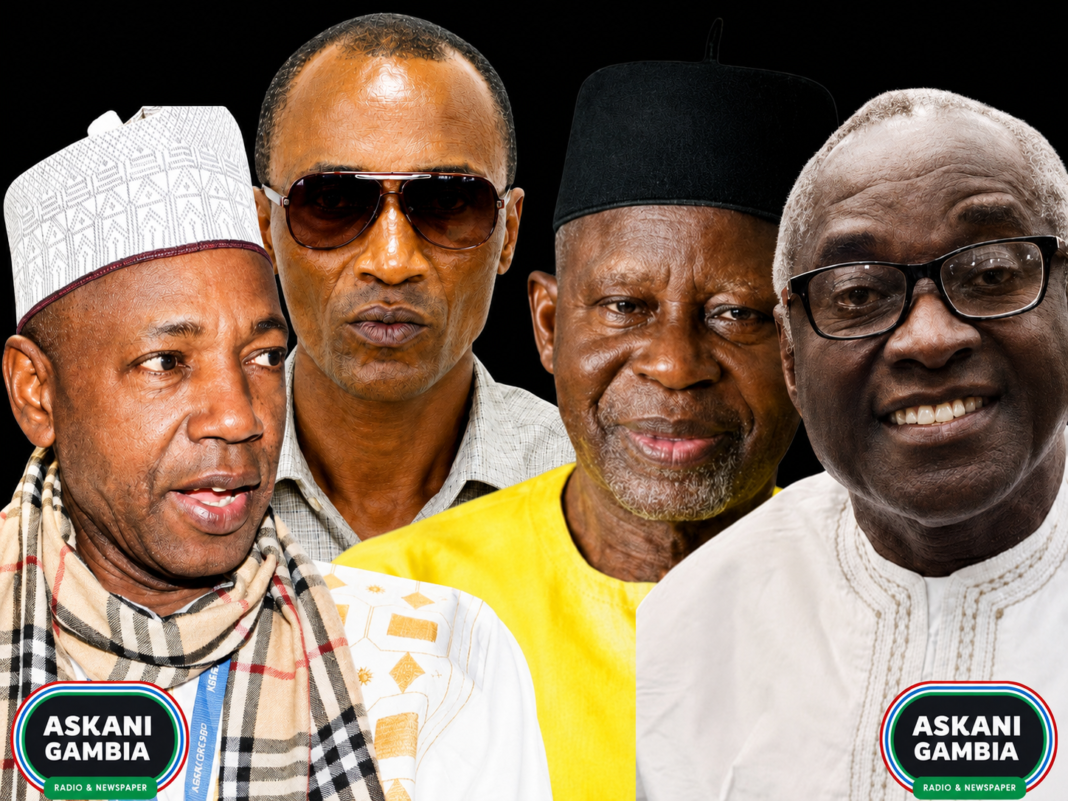
One of the most important examples was the National Alliance for Democracy and Development (NADD), established in 2005 by several major opposition parties, including the United Democratic Party, People’s Democratic Organisation for Independence and Socialism, People’s Progressive Party, National Reconciliation Party and National Democratic Action Movement.
NADD was formed with considerable optimism as opposition parties sought to build a united challenge against former President Yahya Jammeh.
But the alliance became embroiled in disagreements over leadership, organisational structure and the selection of a presidential candidate.
The UDP’s Ousainu Darboe and NRP leader Hamat Bah eventually withdrew, while NADD selected Halifa Sallah as its presidential candidate.
Instead of entering the 2006 presidential election behind a single opposition candidate, the opposition became divided.
Jammeh benefited from that fragmentation and retained the presidency.
Similar difficulties emerged ahead of the 2011 presidential election.
Once again, opposition parties discussed presenting a common candidate but failed to achieve complete unity. Darboe contested under the UDP banner while Hamat Bah represented a separate United Front coalition.
The opposition vote was divided and Jammeh won another term.
The historical exception came in 2016.
That year, opposition parties succeeded where previous attempts had failed. A group of political parties and an independent aspirant agreed on a mechanism for selecting a single presidential candidate.
Rather than insisting beforehand that the leader of the largest party must automatically become flagbearer, the participating groups agreed to a convention.
Adama Barrow, then associated with the UDP, emerged victorious from the selection process and later contested as an independent coalition candidate.
The result changed Gambian history.
Barrow defeated Jammeh, ending more than two decades of APRC rule.
But even the success of Coalition 2016 contains lessons for today’s opposition.
The coalition’s unity weakened after taking office, particularly over disagreements concerning the transition period and Barrow’s continued stay in power beyond the three-year arrangement that coalition partners said had initially been agreed.
Former allies eventually became political opponents.
The lesson is therefore more complicated than simply saying “coalitions work.”
A coalition must first agree on how leadership will be selected, then agree on how power will be exercised after victory.
Coalition-2026 appears to be struggling with the first of those challenges.
Bah said negotiations became trapped between supporters of a candidate-led model and advocates of a party-led arrangement.
This presents a genuine political dilemma.
If every party receives equal influence, regardless of electoral strength, larger parties may feel that their supporters are being underrepresented.
If the largest party automatically assumes leadership, smaller parties may conclude that the coalition is merely a vehicle for expanding the influence of one dominant political organisation.
Neither concern is unreasonable.
But history demonstrates that when Gambian opposition parties fail to resolve such questions, the greatest political beneficiary is often the incumbent.
NADD’s fragmentation in 2006 and the divided opposition challenge of 2011 remain powerful reminders.
Coalition 2016, meanwhile, demonstrates what can happen when competing political leaders agree in advance to a process and accept its outcome.
The real challenge for Coalition-2026 is therefore not simply choosing between “candidate-led” and “party-led.”
It is whether political leaders can agree on rules they are prepared to respect even when those rules do not produce their preferred candidate.
With the December 2026 presidential election approaching, Gambian opposition leaders may soon discover whether they have learned from the country’s coalition history — or whether they are preparing to repeat it.