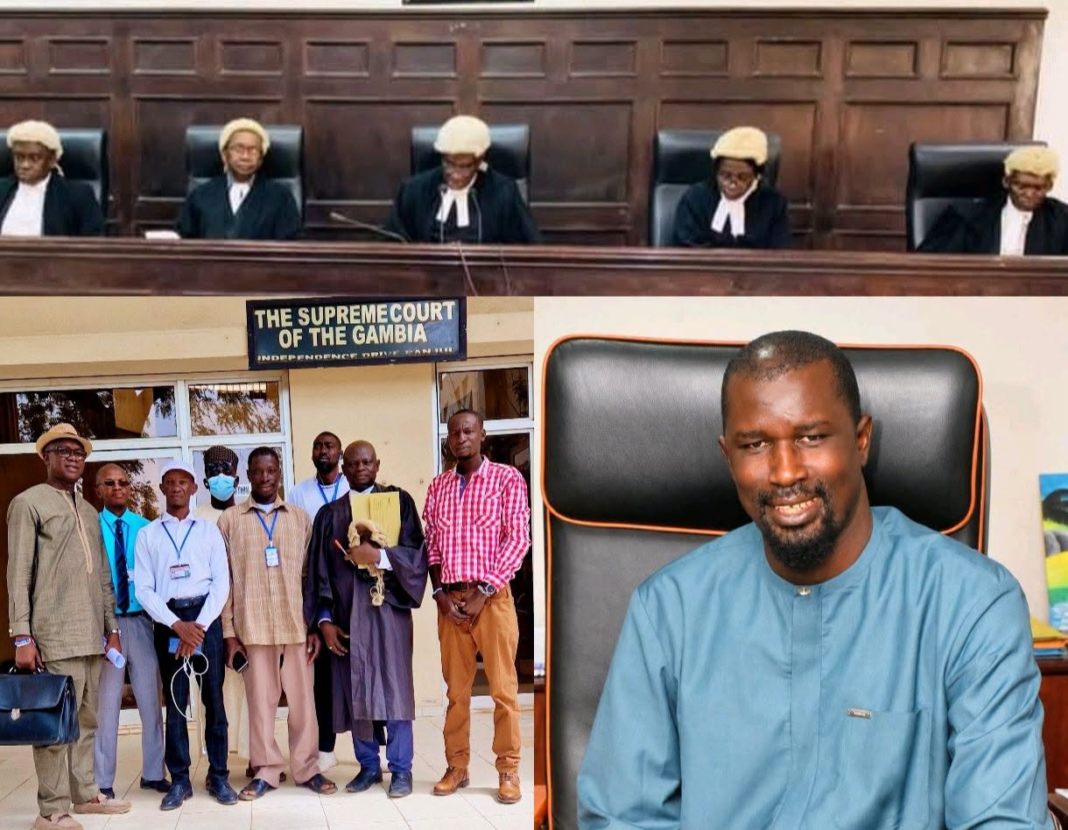
The Supreme Court is set to deliver judgments on two important constitutional cases on Monday and Tuesday. Both cases will make a major decision on how the country’s government operates and how independent institutions are protected.
Case 1: Was the Auditor General Forcefully Removed or Did He Resign?
The first case involves former Auditor General Modou Ceesay. The question is whether he was unlawfully forced out of his office or whether he voluntarily left when he accepted a ministerial position.
Counsel Lamin J. Darboe, representing Ceesay, argued that the Auditor General’s office is protected by the Constitution. He said the office cannot be controlled by the President or other government officials. Counsel J. Darboe claimed Modou Ceesay was removed as punishment for conducting audits that exposed sensitive government financial issues, including the National Food Security Company, land allocations, and GRA (government tax revenue).
The Government’s lawyer, Counsel Ida Drammeh, disagreed. She said Modou Ceesay voluntarily stopped being Auditor General when he accepted the ministerial job on September 10, 2025. Once a new Auditor General, Cherno Amadou Sowe, was appointed, she argued that Ceesay no longer had the right to occupy that office.
Amicus Curiae lawyer (Friend to the court), Counsel A. Fatty, pointed out that the law requires anyone leaving the Auditor General’s office to give 30 days’ written notice. The Government’s timeline doesn’t allow for this, he said.
Case 2: Does the President Have Power to Overturn Commission Decisions?
The second case challenges a 2023 law that gives the President power to grant amnesty to people who were banned from public office by Commissions of Inquiry.
Journalist/Activist Kexx Sanneh and the Coalition of Progressive Gambians, represented by Counsel Lamin J. Darboe, challenge the decision of the National Assembly given the power for the president to grant amnesty to people who were banned from public office by Commissions of Inquiry.
They argue the law violates the Constitution, adding that the Constitution gives Commissions of Inquiry independent power to investigate and make findings. The law should not allow the President to overturn those findings through amnesty.
Both cases are about protecting independent institutions from government interference. The Modou Ceesay case will determine if the Auditor General’s office is truly protected from interference from the executive.
While the Commission of Inquiry case will determine if the President can use amnesty to overturn investigation findings.
The court’s decisions will shape how the country balances the power of the President with the independence of institutions that are meant to check government power.